



How healthy is the European shtetl?
Our ongoing series “The Health of the American Shtetl” has looked at the state that smaller American Jewish communities find themselves in and the changes they have undergone. But there are also interesting stories about the changes that have happened in European Jewish communities. A recent trip by Binny Binet to the Swiss border town of Basel and its Jewish community revealed a fascinating sense of renewal in a city where it had seemed as though Jews might disappear entirely.
Basel
The European continent was once dotted with small, vibrant Jewish communities. But in recent years, as younger families relocate to larger European centers or move to Eretz Yisrael, many of these kehillos have dwindled into shadows of their former selves or disappeared entirely.
Basel, however, is the exception. Here, the Jewish community is actually growing, bucking the continent-wide trend. Intrigued by this anomaly, I set out to understand how this Swiss kehillah managed to not only survive but thrive while so many others faded away.
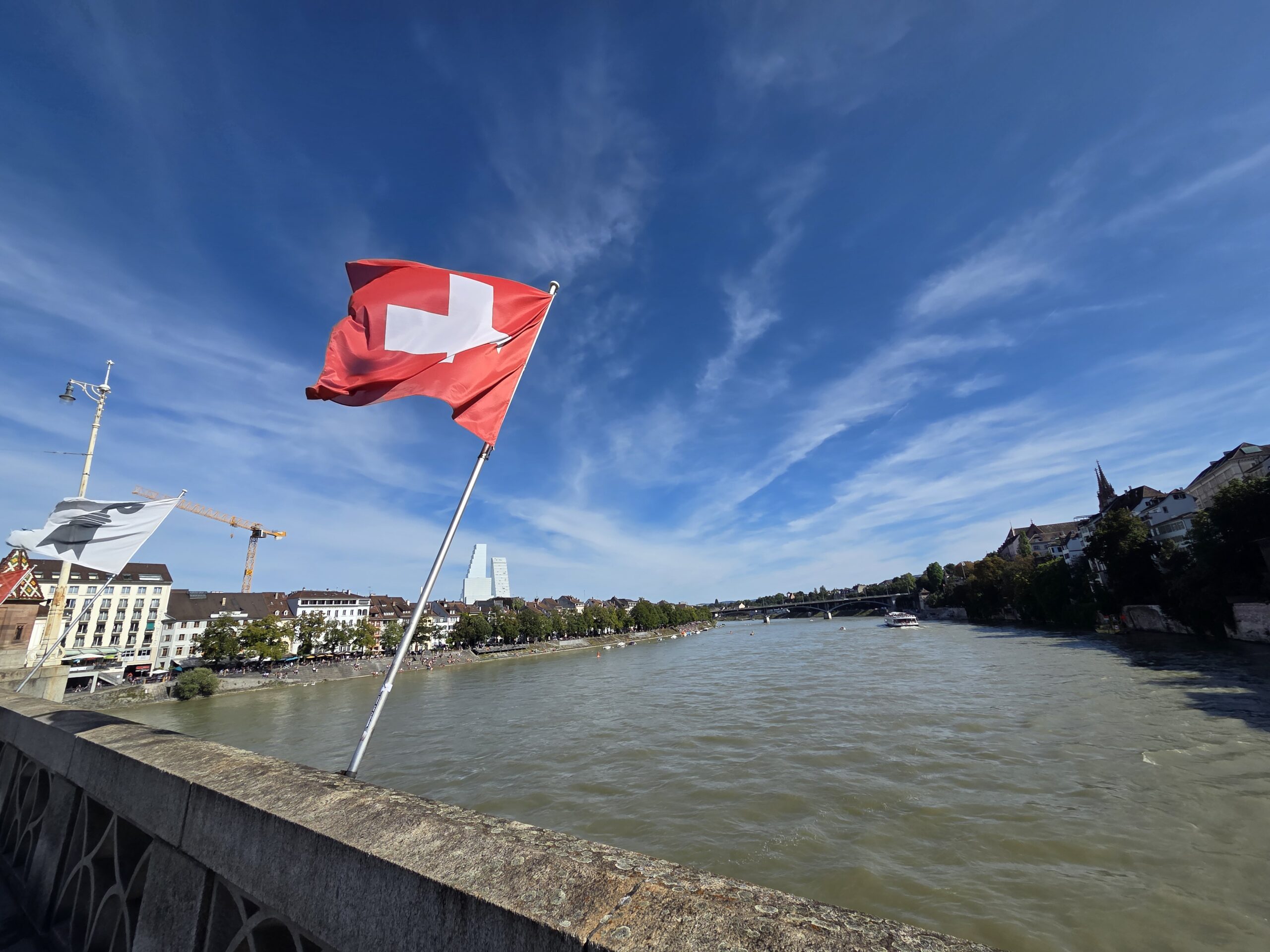
The warm September sun glints off the tranquil waters of the Rhine as I cross the historic Mittlere Brücke—the “middle bridge”—into the heart of the city. Swiss flags flutter crisply in the breeze. Leisure boats drift by lazily, creating a postcard-perfect scene of European calm. Yet the serenity belies a far darker past. Not far from this spot, during the hysteria of the Black Death, Basel’s entire Jewish community was massacred al kiddush Hashem.
My journey began earlier that morning at the EuroAirport, a single terminal that serves three cities in three different countries: Mulhouse, in France’s Alsace region; Freiburg in Germany; and Basel in Switzerland. Though geographically located in France, the airport features two distinct exit corridors, each leading into a different country—an arrangement that feels almost symbolic of the layered identities and borders that define this part of Europe.
Moving Back to Basel
The clock was ticking. I had scheduled my first meeting at 10:00 a.m. with Jeremie Brunschwig, the rosh hakahal of the Adas Yeshurun kehillah, better known as IRG (Israelitische Religionsgesellschaft). I am aware how important it is to be punctual in Switzerland, so I’m doing my best to arrive on time.
It’s Sunday morning, and the streets are peaceful as I make my way along the leafy Ahronstrasse. The only indication that the four-story nondescript building houses a shul is the group of yungeleit casually chatting outside, holding steaming cups of coffee.
Stepping into the building, it feels like I’ve entered a different world. In contrast to the quiet streets outside, the place is pulsating with life. The kollel room is teeming with men who are immersed in learning. On the second floor, a shiur for balebatim is being given by Rabbi Elimelech Lemmel, the mohel of the community.
My first conversation is with Rabbi Duvid Pakter, the kollel’s nasi. I have only a few minutes to ask my questions until his chavrusa arrives. “My shver, Rav Yehuda Grunwald, founded this kollel 28 years ago,” he tells me. “I moved here two years ago to help him with the financial burden, and I also lead the seder limmudim in the afternoon.”
There are 12 avreichim in the kollel in addition to the balebatim who come to learn, some in the morning and others in the afternoon. “Most of the yungeleit live in Basel, but some commute from the nearby town of Saint-Louis in France. In fact, the morning rosh kollel, Rav Refael Breisacher, is the rav there,” he explains.
“How many Jewish families live in Basel, and what are the demographics?” I inquire.
“The IRG community, which is more chareidi, consists of around 70 families. The IGB (Israelitische Gemeinde Basel) community is much larger, and then there’s the Chabad community. There’s a bit of an age gap here. Most of the older people grew up in Basel and have lived here their whole lives, whereas the younger families only moved here more recently.”
He then explains why people are moving to Basel. “A few years ago, Rabbi Auriel Silbiger, who is now rav of the Agudas Achim shul, decided that something had to be done to bring people back because our numbers were rapidly dwindling. To that end, he worked with members of the community to allocate funds to incentivize Jewish families to move here. The influx of people helped the kollel and the school to continue operating and gave a boost to the community.”
He says that from a kollel family perspective, there are many benefits to living here. “The kollel stipend is enough to pay for all of a young family’s expenses without the need for additional income. Although the price of rentals is expensive, they’re only half to two-thirds of what it costs to live in Zurich. Most people here rent apartments, as there aren’t many houses available even if you can afford them.”
The longtime rosh kollel, Rav Yehuda Grunwald, tells me that the spirit of the local community is very Torahdik. “Everything here revolves around Torah and learning. It’s a very unique community in that regard.”
While Basel is only an hour’s drive from the larger Jewish communities of both Zurich and Strasbourg, France, commuting for work or shopping is rare despite the excellent Swiss transport system. “We have everything we need right here,” Jeremie Brunschwig tells me. “People usually only travel elsewhere to visit family or for simchahs.”
To read more, subscribe to Ami