



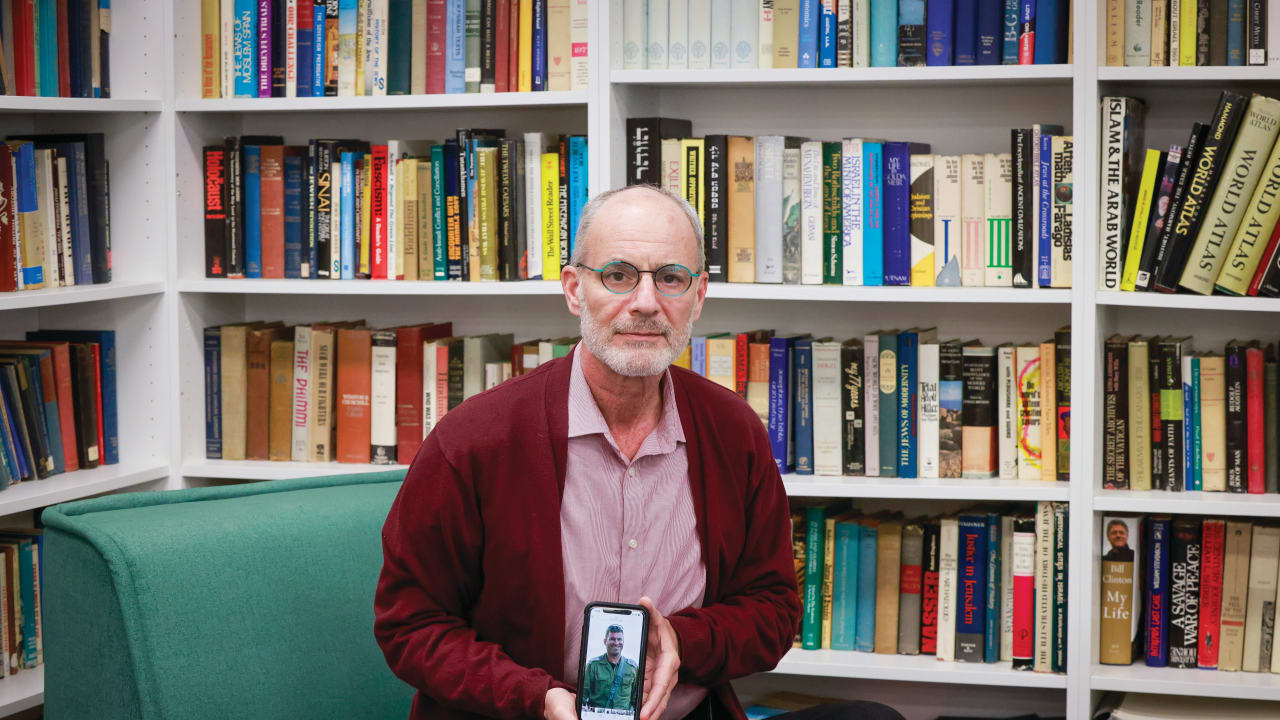
Born in Scranton, Pennsylvania, Yechiel Leiter was appointed Israel’s ambassador to the United States on January 27, 2025. An ordained rabbi, educator and longtime activist for Yehudah and Shomron, he brings an unusual perspective to the role. American-born yet firmly rooted in Israeli life, Ambassador Leiter draws on his decades of experience in public service to bridge cultures and contexts.
You are making Israel’s case to the world, not just to the president of the United States or his administration. That must be frustrating, because many of those criticizing Israel and the Jewish people don’t respond to reason or logic.
Did the Israeli soldiers who were fighting in the alleyways of Gaza not feel frustrated? Sure they did, but frustration is a luxury, and we need to do whatever must be done in order to stay alive. One of those things on the diplomatic front is to keep steady and not allow frustration to set in. Ideas ultimately matter, although sometimes it can take a while.
I think it was the Maharal of Prague who said, “Lasheker ein raglayim—Lies don’t have legs,” which is why falsehoods travel very quickly. Truth has heavy legs, so it takes time to get across. If you don’t give up and maintain your course, ideas have a very good chance of winning if they are true.
That’s a very optimistic assessment of the power of ideas. People often criticize Israel’s hasbarah, but they don’t always realize that it only works with those who are willing to listen.
That’s true. Many of the meetings I have on Capitol Hill are with senators and congressmen who are motivated primarily by partisan politics, so what I say matters very little. If you line up on one side of the aisle or the other, the facts are largely irrelevant because of party loyalty. Nevertheless, you have to present them as best as you can.
The idea of the return of the Jewish people to the Land of Israel is a metanarrative. But in this G-dless world of postmodernism with which we are now plagued, there is nothing that is all-encompassing. Here you have a prophetic vision that has been sustained throughout history, which is why the postmodernists have such a big problem with Israel. The nevuah of Yeshayahu Hanavi is being realized, but as far as they are concerned it wasn’t supposed to happen. What’s supposed to happen is something along the lines of the Inquisition and the Holocaust, whether it’s from a theological or philosophical point of view.
When I first came to Washington, I was told that I’d be living in the ambassador’s residence. I said, “It’s a big house and I’m not anywhere near a shul, so I’d like to have a minyan in the house.” I told my deputy, who has been in America for many years, “I need a sefer Torah. Do you have any ideas?” “Yes,” he replied. “Let me check.” When he got back to me, he explained that he had made arrangements to obtain a very special scroll.
Many people know that Hitler, yimach shemo, had plans to create a museum in Prague that was going to showcase the Jewish nation that would soon be extinct. To that end, he collected many items of Judaica, including 2,000 sifrei Torah. As they did so dutifully throughout the war, the Germans catalogued everything precisely, including where each scroll was from.
After the war, Jews in the UK redeemed the sifrei Torah and brought them to London. They then researched the family names that were associated with each one. One of these scrolls made its way to a family in Potomac, Maryland. It’s a small sefer Torah that is 400 years old. But the family had since moved to Israel and didn’t know what to do with it, so my deputy told them, “Look, this Torah was supposed to be in a museum to commemorate the Jews. Wouldn’t it be fitting to put it in a shul in the residence of Israel’s ambassador to Washington?” They were very taken by the idea. We had a little gathering, and they brought the sefer Torah to the house. A local Jewish carpenter made the aron kodesh, and here we are.
It’s almost like v’nahapoch hu.
Not almost. It’s mamash v’nahapoch hu.
Having to explain something that defies history within the context of historical thinking must be a significant challenge.
There’s no question that it’s a challenge, especially at a time when blood libels are being leveled against the State of Israel. You know the expression, “The more things change, the more they stay the same.” There is little difference between claiming that the Jews poisoned the wells of Europe or use blood in their matzos and the accusation that we are guilty of genocide, starvation or ethnic cleansing. And yet, as they say in Hebrew, “You can’t prove that you don’t have a sister.” Anyone who knows anything about Judaism knows that we can’t possibly consume blood. It’s completely irrational. The whole thing is insane. Genocide? No other army in history has had to confront almost 400 miles of underground tunnels. That’s the width of the entire state of Pennsylvania, about 535 kilometers. Who in history has ever had to deal with anything like that?
Even if you take Hamas’ numbers at face value—which is ridiculous in and of itself, because if you’re going to say that Hamas has a Health Ministry, you might as well say that MS-13 has a social services department—our casualty rate of combatants to noncombatants is still lower than the American figures in Mosul. And in Afghanistan the American forces didn’t have to confront as big a network of terror tunnels along with hostages being held. There is nothing more debilitating than having to defend the truth. But that is what we have to do.
A few months ago, I was in a meeting with five Democratic senators who voted in favor of an arms embargo against Israel. Israel is an ally that is fighting a seven-front war, yet they voted in favor of an embargo. I told them that the food they were claiming wasn’t getting to the Gazans was being hijacked by Hamas. “No,” they said. “That’s not true.” I said, “Yes, it is. Our intel knows that 90% of it is being hijacked.” “No,” they insisted. “You’re making that up. You don’t know.”
A few days later, one of my assistants came to me and said, “You’re not going to believe this, but the UN has its own online tracking service. Here’s what it says: ‘91% of the food is diverted.’ That’s according to the UN’s own statistics.”
I went back to the senators and said, “Look, the UN itself says that the humanitarian aid is being diverted.” They said, “‘Diverted?’ That doesn’t mean that it’s going to Hamas.” How do you respond to something so utterly stupid?
That’s my question to you, Mr. Ambassador: How do you respond?
You say, “You can believe whatever you want, but you should know that we are the people who introduced concepts like ‘Thou shalt not murder’ to the world. The very idea that you would accuse us of starving and killing people indiscriminately is an absurdity, and I’m going to fight you every step of the way. We are not going to accept that, we are not going to bow down, and we are not going to take it on the chin.”
I told my staff that the most important thing we can do right now is make a booklet that is going to debunk all of the lies and circulate it as widely as we can. When one of my assistants who is working on it asked me if I think it will really change minds, I said, “It’s not going to change everyone’s mind, but there are going to be students out there who are facing horrific anti-Semitic attacks on campus, and they’re going to have something to hold onto. They’re going to be able to say, ‘No, that’s wrong.’”
Mimah nafshach, if we don’t do anything, then people certainly won’t change their minds. If we tell the truth, at least there will be some who understand that the accusations are a horrific form of anti-Semitism.”
The Jewish historian Max Dimont once said that the difference between being anti-Jewish and anti-Semitic is that historical anti-Jewishness had a solution: You could convert or do something to save yourself. But the only solution to anti-Semitism is Auschwitz.
And a rational person like Ambassador Leiter has to confront all of this irrationality.
Yes. You get to the roots of it and knock it down. I talk extensively about the evolution of ideas and how postmodernism was developed. It’s an extreme form of relativism, which is a world of no truths, no right or wrong, and where nothing objective exists. It’s a process that began when modernity rejected the idea of revelation and based everything entirely on reason. What does that leave you with? You’re left with nothing. It’s a world without an anchor or meaning.
You became an ambassador at a time when we have a very good friend in the White House, but there is still a considerable amount of hostility toward Jews among the population, including right here in New York, which recently elected a mayor who isn’t particularly friendly.
The current administration is probably the friendliest ever. The president, vice president, secretary of state, secretary of war and the ambassador to the United Nations are all very dear friends, and we have accomplished tremendous things together. There has never been such a level of cooperation between our military and intel communities. The program that the Israeli government adopted on October 8 is ensconced within the American plan for Gaza, which is the complete demilitarization of Gaza and the disarming of Hamas. That is what President Trump insisted that the international community sign onto, which is a huge achievement. At the same time, we have both digital and academic anti-Semitism that is spreading rapidly, which must also be addressed.
From the moment I landed in Washington it’s been a yoma arichta, one long day without a moment’s break. We had the war in Iran. We had the blood libel against us in Gaza. We had the toppling of Assad in Syria, and we had to confront the slaughter of the Druze in southern Syria, where we intervened. We have to deal with Lebanon on a daily basis along with the fact that Hezbollah is trying to reconstitute. Then we have the Houthis in the south, who have shot ballistic missiles into Israel and are threatening international waterways. And every day there are attempted attacks on Jews throughout Yehudah and Shomron. The Shabak thwarts somewhere in the neighborhood of between four and five of them every single day. Last year they prevented between 1,200 and 1,300 attempted shootings, firebombs and kidnappings.
We have a lot of fronts to deal with, and there are no calm moments. I do almost no media in Israel because that’s not my purview. But here, part of the battle for ideas occasionally requires some media work.
Some of the things you mentioned would seem to fall under the responsibility of the Foreign Ministry. How do you view your primary mission?
The embassy in Washington is actually under the purview of the prime minister. I’m an appointee of the prime minister, and the staff who are picked for the embassy here are the cream of the crop. They are the best foreign service people we have, precisely because of the fact that Washington is Washington. I was sent here to oversee this operation, and my primary responsibility is to be the go-between for the prime minister and the White House.
My second responsibility is to be the go-between for the Israeli government and the American Congress, both the House and the Senate, which is a huge undertaking. I usually spend between a day and a half and two days a week in meetings on the Hill. I always split the day between Democrats and Republicans; it’s a bipartisan effort both for tactical reasons—the Democrats could rule tomorrow—and ideological ones, because I think that Israel should remain a bipartisan issue.
Of course, there’s also the job of being a liaison to America, which mostly means the Jewish community but not exclusively. In large part it’s also the evangelical and Christian communities, who are 70 million to 80 million strong, and most of whom are solid supporters of Israel and are being bombarded by the mostly hostile media.
I also try to put students high on my agenda as much as possible. I usually have two or three student groups every week either at the embassy or various universities. That’s a very important part of my work.
In addition, we have eight consulates around the United States, so I have to oversee what’s going on throughout the country.
Do you see the needle shifting at all toward Israel within the Democratic Party?
There are a lot of moving pieces. I’m not one of those who believes that it’s all over for Israel in the Democratic Party. There have always been ups and downs, and some of this past year’s discourse on Israel played into the extreme partisan atmosphere in Washington. There’s nothing we can do about that. Yes, a pro-Hamas mayor was elected in New York. I didn’t say that; Ammi Hirsch of the Stephen Free Wise Synagogue in New York said it. I’m just quoting him. At the same time, two pro-Israel governors were elected in New Jersey and Virginia, and they are both Democrats.
I really don’t get involved in politics, not in Israel and not in America, because I deal with policy and ideas. However, I’ve been told that there is a strong movement within the Democratic Party to go back to its traditional support for Israel, so I’m hopeful.
It sometimes happens that truth overcomes falsehood over time, and I hope that will be the case here. Israel is ultimately an American interest. We don’t control Washington, as some of the anti-Semites claim. Is anyone saying that Qatar controls the United States? That’s nonsense. The reason why America supports Israel is that we go back many years and share many common interests. That’s what makes the world go round.
If the United States wants to lessen its footprint in the Middle East, it needs a strong Israel, and it needs Israel in an orbit with other allies like Saudi Arabia and the Emirates so we can create an atmosphere of regional stability together. That is where we want to go. In order to do that, the extremists and radicals have to be degraded. That is the essence of what we did in Iran and are currently doing to their proxies. They want to keep Islam in an extremist form, whereas Israel and the moderate Muslim states are on the same page regarding the defeat of radical Islam and a more accommodationist attitude toward Western civilization.
What is Israel’s perspective on the Saudi crown prince’s visit to Washington? Some people have expressed disappointment.
Visits are good. Talking is good. We’d like to see the Saudis move into a very close orbit with the United States and with us. Are we in agreement on everything? No, but that’s okay. We negotiated for a while with the Emirates, Bahrain, Sudan and Morocco until everyone signed on. Saudi Arabia is taking a little more time, but we are very confident that even if certain arms sales are made, the American president and his administration are absolutely committed to the qualitative military edge that United States law requires. Think about that: It has been legislated that Israel must maintain its qualitative military edge. So we are confident that if Saudi Arabia is strengthened, it will be to offset the potential for Iran and other extremist radicals who want to eliminate us to rear their heads. They want to eliminate the Saudis almost as much as they want to eliminate us. We have a common interest and must focus on that, because the future of the Middle East is very much dependent on a collaborative effort between moderate Islamic states and Israel.
Have there been any surprises since your appointment to the position of ambassador?
One of the things that surprised me the most is related to the media. I’ve always been around media events, but what I’ve seen since coming here boggles the mind. For example, I’ve come out of a meeting in the Oval Office and received an immediate news report on my phone that was totally unrelated to what actually took place. I couldn’t wrap my head around that. It made me understand that people who are considered serious journalists create narratives, after which they comment on them. They create these false narratives because it’s a business. They used to sell newspapers, but now they’re selling a digital platform. It’s so disappointing. It’s bartering in sheker.
Do you think that it’s solely an American issue?
No. The Israelis are unquestionably experts at this as well. It’s a problem. But in Washington you’re dealing with the most serious issues. Leading up to Operation Rising Lion and Midnight Hammer [the Iran war], the disinformation was off the charts for three or four months. They made stories up about daylight between the prime minister and the president and about Ambassador Witkoff stabbing us in the back. They said the craziest things and none of them were true. The level of cooperation at the time was unprecedented.
What would you suggest that the average person do? How can we discern what’s really happening in the world?
First of all, living in this frenzy of newsfeeds isn’t healthy. People existed for many years without feeling the need to know whether someone sneezed in Sri Lanka. There is so much unnecessary reporting, and you don’t have to fill your head with it. You can read a good book or listen to Beethoven or go to a shiur or a lecture. There’s a lot more you can do with your life than all this…stuff.
You have to observe things over time and from a variety of sources. You also have to be very skeptical about instant reports on something that just happened, particularly commentary. When you have reporters passing judgment on something, you have to sit back and say, “Wait a minute. Is that real? Is that a fact, or is it intended to get a certain message out?”
I often say that every day of maasei bereishis is about discernment: the separation between light and darkness, the separation between the waters, the separation between plant life from animal life. After that, when it comes to the separation between animals and human beings, the first thing we are told as a tzelem Elokim is to discern between one particular tree and all the other trees. The biggest fall is when we stop discerning. The cheit hakadmon was that we didn’t discern. In order to get through the modern morass of data, you have to separate the wheat from the chaff and recognize what is ikar and what is tafel.
What is your assessment of Israel’s standing in the Middle East after October 7?
Al regel achas, we’ve never been stronger. The entire Middle East has changed. Hezbollah has been degraded dramatically, to the point where the government of Lebanon is committed to disarming it. We’re going to have to help them, but there was never a situation in the past where Hezbollah was afraid to retaliate, as they are now. We recently took out their chief of staff. I don’t know if you saw the precision, but it was like giving them a haircut in the middle of Dahiyeh in Beirut. We’ve done a number of operations, but Hezbollah is very hesitant to respond because where they were two years ago isn’t where they are today.
Look at what we did to Iran in Operation Rising Lion. Everyone assumed we would have many hundreds dead as a result of ballistic missile attacks. B’chasdei shamayim and with great intelligence and ability, we avoided that. And who would have imagined in a million years that we would bring about the fall of Assad, who killed so many millions of people and destroyed the country? Of course, there are challenges there as well. It’s not a bed of roses.
We are now sitting on 53% of Gaza, and Hamas has their backs up against the wall. And the entire world wants F-35s because of what we did with them. We still haven’t reached the menuchah v’nachalah. There is plenty more to do and we have to remain vigilant because they haven’t been completely defeated. But the resilience of am Yisrael is tremendous.
I asked my son what it was that kept him from collapsing under the weight when he went into special ops carrying 60 or 70 kilos on his back. I wanted to know how his knees didn’t buckle. He said, “Abba, I add weight.” When I asked him what he meant, he replied, “I have the hopes and tefillos of my bubbies and zeidies on my shoulders and the weight comes off. What I’m carrying on my back isn’t for me today, it’s for all the future generations.”
These days, I don’t carry my bubbies and zeidies on my shoulders; I carry my son.
Is that the son who was killed?
Yes. My bechor, Moshe Yedidya, was killed on the 13th day of the war. He led the troops into Gaza. He was the point commander of the first brigade to enter Gaza, Brigade 551. They entered in the form of a pyramid, and he was its point.
You became ambassador after he was killed.
Yes. He ran a special program inducting young chareidim into the Kodkod Unit, which is a unit within Unit 8200, the intelligence unit. It’s the largest unit in the IDF. It has two floors set aside for young chareidi men. They usually go right into the workplace afterward with a firm trade after having been trained in hi-tech. Four years ago the program was floundering; Moshe was in medical school while doing reserve duty. The minister of defense found out about him and felt that he would be able to turn the program around. At the time there were only 80 talmidim, but now there are over 1,000. It’s growing very quietly and it’s fantastically successful. I dedicated a sefer Torah to their beis knesses in his memory.
What was it like for you as an American-born kid to return here as ambassador?
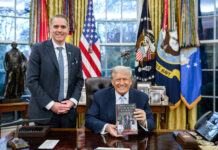
My first time in the Oval Office, I was sitting next to the Israeli prime minister, who was sitting next to the American president. Next to him were the secretary of state, the national security adviser and the vice president. I said to myself, “Ribbono Shel Olam! My father, z”l, came to this country as a refugee from Hitler after the Anschluss in Vienna. He used to say that he came here with a breadcrust in one pocket and a quarter in the other. And look, his son is now sitting in the White House representing the Jewish people to the president of the United States.”
Someone who doesn’t believe in miracles doesn’t believe in life. The essence of our very existence is a miracle. Some people have said that the core of our resilience is the rejection of victimhood. Instead, we overcome. Hakadosh Baruch Hu tells Moshe Rabbeinu at the sneh, “You have a speech impediment? Overcome it.” That’s why it says, “Eileh hadevarim asher diber Moshe.” In the end, Moshe becomes an orator. He starts with a stutter and can’t do his shlichus, and Hashem says, “Well, you’re going to do it anyway.” Hakadosh Baruch Hu actually speaks through his throat. You have an obstacle or a difficulty? Don’t choose victimhood. Our whole history is our choosing to overcome. ●
To read more, subscribe to Ami