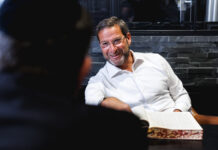




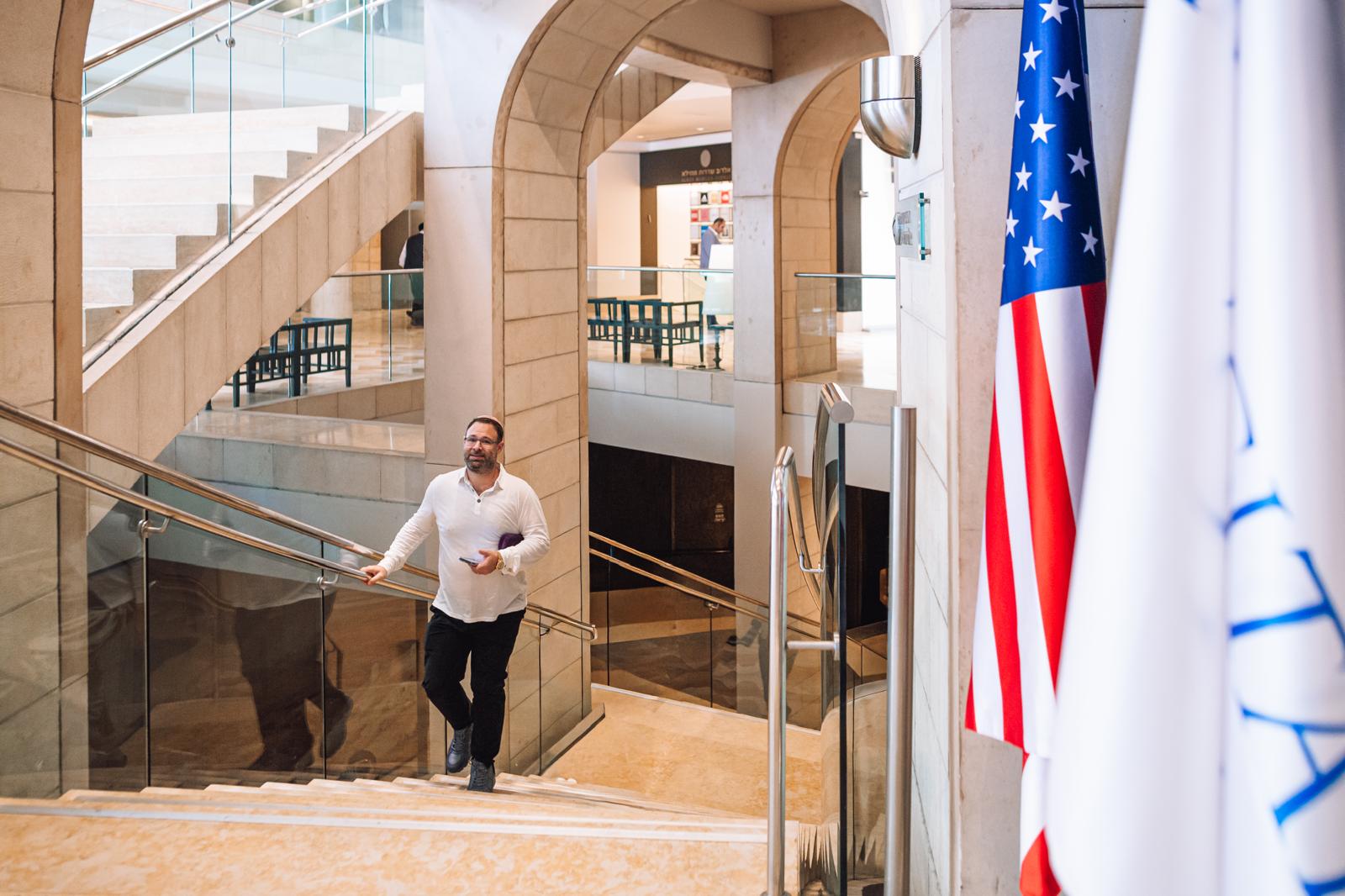
Speaking to Daniel Lowy, founder of EMU Health, one thing is clear: he loves what he does. Daniel’s center is effectively a mini hospital, featuring numerous doctors’ offices and state-of-the-art operating rooms that offer a vast array of services, from complex procedures like cardiology and orthopedic surgery to pain management, physical therapy, radiology and vascular surgery, just to name a few.
Daniel entered healthcare with no prior experience in the field, yet today he is not only thriving but rapidly expanding. He took a similarly bold route in his journey to a Torah lifestyle.
We spoke about the current and future states of healthcare, his personal journey, and his number one piece of advice when it comes to protecting yourself.
Enjoy!
—Nesanel
I am 45 years old. I was born in Sydney, grew up there, and lived in Australia until the age of 22. Although not observant, my family was very traditional; my grandfather and father built two shuls and a day school even though they weren’t shomer Shabbos. I attended a school that was Orthodox, but the students weren’t. Today, I am frum.
“My father was the managing director of Westfield, a big global shopping mall company in Australia and the US. I used to spend a lot of time going to his office. Even though my family wasn’t religious, we had a Shabbos dinner every Friday night.
“My grandfather, Sir Frank Lowy, is a Holocaust survivor. He’s 95 and lives in Israel. He’s a wonderful grandfather. I’m the oldest grandchild, and I spent a lot of time with my grandfather when I was growing up. He arrived in Australia with nothing and built up a huge company. My uncles also went into the business, so I absorbed a lot of information about shopping malls by osmosis just sitting at the table. And from the age of 14, I worked in the malls during the summer. My father would come out of his office to show me how to clean the tables in the food courts.
“My late grandmother, Lady Shirley, a”h, was my favorite person in the world. She’s the one who really influenced me in terms of Yiddishkeit. She wasn’t observant, but she was very spiritual. She loved going to shul, so I love going to shul too. It’s because of her that I love chazanus.
“I wasn’t particularly entrepreneurial as a teenager, but I invested in the Austalian stock market. My father set me up with a portfolio for my bar mitzvah. I was planning on going into finance.
“I earned a bachelor’s degree in economics from the University of New South Wales, where I was very active in the Australasian Union of Jewish Students. Then I got a master’s in commerce. While in graduate school, I lived in England for a time.
“I really thought I would settle in London; it was a fascinating city and had so many kosher places, at least as compared to Australia. But then I got an investment banking job offer from Merrill Lynch and decided to go to New York. I moved there just before my 23rd birthday. I stayed in that job for a couple years and loved it.
“Next I worked for a hedge fund called York Capital as a generalist analyst. But I wasn’t sufficiently skilled or confident, which made me frustrated. My father arranged some executive coaching sessions for me; the upshot from that was that I realized I wanted to work with my father.
“When I relayed that to him, he sent me to Hong Kong to look at buying companies in Asia. While he thought I could do the work, he had an ulterior motive: to test my religious commitment. I was the only frum person in my immediate family then, and even though my father and I are very close today and he respects me for being frum, it was very hard on him for many years.
“I was still growing in my frumkeit at the time. Just one year earlier, after attending a Pesach program in the Arizona Biltmore, I decided that I wasn’t going to eat fish in non-kosher restaurants anymore. In Hong Kong, there weren’t many kosher places to eat or Jewish girls to date. I stuck it out, though, and after nine months, my father sent me to New York to help set up an investment office.
“He hired a team there, but I didn’t feel comfortable with them. Around that time a colleague offered me a job in a hedge fund he had just started, but my father and grandfather didn’t want me working for anyone else. So, I went to Israel to learn in yeshivah.
“I’d like to go back and tell you how I became frum. As I said, I grew up around a Shabbos table and went to a Jewish day school. My extended family was very Zionistic. My mother’s sister was Chabad, so I was sort of familiar with religious people. Her husband taught me my bar mitzvah parshah. I leined the whole parshah, because it was a family thing that you had to do it, and I enjoyed doing it.
“A few weeks later, I decided that I wanted to start keeping Shabbos. That started weekly fights with my father. I wanted to go to my cousins because they were religious, but he wanted me to stay home. That wasn’t easy for me, as it took an hour to walk to shul from my house. I did that for a couple of years.
“Unfortunately, like many others who become baalei teshuvah when they were very young, I went about it too quickly. Also, it was hard being the only frum one in my family. I ended up dropping it when I was 17. I still went to shul on Friday nights because I enjoyed the davening, but that was it. I wouldn’t eat chametz on Pesach, but I wasn’t keeping Shabbos or Yom Tov properly.
“Just before my 21st birthday, our shul hired a new rabbi, Rabbi Levi Wolff, who is Chabad, and he took me under his wing. In Australia, your 21st birthday is a big deal, and it’s celebrated with a big party at which you give a speech. Rabbi Wolff urged me to “put some Torah into” my talk, so I spoke about the sun and the moon standing still in Givon.
“Then, on Sukkos, my mother took me to shul so we could eat in the sukkah. I was sitting at the rabbi’s table and everyone was making l’chaims. When I asked for some, the rabbi said, ‘Daniel, give me six weeks in a row on Shabbos morning and we’ll make a l’chaim.’ ‘Rabbi,’ I replied, ‘You’ve got yourself a deal.’
“This was complicated, however, because I used to go to the gym with my father on Saturday mornings. But since my father liked Rabbi Wolff very much and had even played a role in hiring him, he didn’t want to disappoint him, so I was able to accept the challenge. (After our shul, Central Synagogue, burned down in 1994, my father led the effort to rebuild it. It is truly one of the most beautiful shuls you will ever walk into. He was also on the shul’s rabbinical hiring committee.)
“Around that time, I took part in a leadership development program with the Jewish student organization that would take us to Poland, Ukraine and Israel. It was on that trip that we learned what had happened to my great-grandfather during the Holocaust. The story came out through pure hashgachah pratis: While on vacation, my uncle was at a Pesach program in Palm Springs and met a man who shared the same last name, Lowy. The man asked my uncle where he was from, and when my uncle answered, ‘Sydney,’ the man said, ‘No, where’s your family from? When my uncle told him his father had been in Budapest during the war, the man said, ‘I knew your grandfather.’
“This man was Meyer Lowy, the owner of Chiffon’s Bakery in Brooklyn. [Meyer’s son, Allen, shared his family’s side of the story in Ami Issue 743, “To Save a Life.”] He almost never traveled, but that year he had gone to a Pesach program for the first time. My grandfather visited him in Palm Springs on Chol Hamoed, and Meyer shared the full story. I eventually met him as well, because his house is right around the corner from my in-laws in Flatbush.
“Meyer told us that he and my great-grandfather, Hillel Tzvi (Hugo) were caught by the Nazis at a train station and taken to a holding camp, Kistarcsa. My great-grandfather had his tefillin with him and kept minyanim going every day of the six weeks they were in Kistarcsa. Then they were transferred to Auschwitz-Birkenau.
“When they got off the train, they were carrying their pekelach. My great-grandfather refused to give his up, because his tefillin were in there. The SS guards threw it on the ground. He picked it up, but the guard grabbed it and threw it down again. He didn’t stop trying to get his tefillin until the Nazis beat him to death.
“I stood in Auschwitz with an Israeli flag on my back and thought, ‘My great-grandfather died for his tefillin; I’m going to live for mine.’ I put my tefillin on in Auschwitz. That was the moment I became fully religious again, and I never looked back.
“Back to the business story.
“I got married at the age of 28. Eventually my wife, Elana, and I moved to Israel and lived there for a couple of years.
“When I was in Israel previously, my father suggested I work with ION Asset Management, a hedge fund our family had seeded there. I have a lot of hakaras hatov to them. They taught me so much and I really enjoyed the work.
“Now that I was back in Israel, ION offered me a full-time role. My family had a significant stake in the fund, so it felt like a natural place to be.
“I analyzed stocks and visited companies, which was very educational. I learned a lot about healthcare because Israel has so many healthcare companies: Teva, Perigo and Mellanox (which ended up being bought by Nvidia) were all on my radar. Nonetheless, after the financial crisis I realized finance was not the path I wanted to stay on long term. My wife and I discussed it, and I resigned from ION. After that, we went back to the US.
“We decided that I should go to business school, so I took the GMATs—three times. On the third try I got the score I needed to apply to Harvard, Columbia and Wharton. My wife is a Penn graduate and was very happy when I was accepted to Wharton. I started at age 31.
“Around this time I started looking into the surgery center business. I had run a distressed-debt screen that searched for companies that were looking to sell, and the name Symbion kept coming up. Symbion was an Ambulatory Surgical Center company, and I found the ASC concept—a center for surgeries where the patient is treated and discharged relatively quickly—very interesting. I called a friend, Yehuda Kleinman, who is an orthopedic surgeon in Queens, and said, ‘Let’s build one.’
“We brought in a consultant, hired lawyers and began planning an ASC in Queens. Old St. John’s Hospital had just closed, and this felt like the right moment to try. That’s really where my entrepreneurial streak began.
“We drove around Queens scouting possible locations. Yehuda had worked at St. John’s, so he knew the area well. We began the application process, but New York Hospital of Queens opposed what we were doing. They even took away the consultant we had hired for the certificate of need and conflicted him out.
“My close friend, Leonard Harlan, ran the private equity firm Castle Harlan. I told him how difficult the hospital was making things. He arranged a breakfast meeting for me with the hospital’s chairman, George Heibrich. We hit it off, and they ended up becoming our partners. George and I are still close today.
“Originally we planned to build a new center, but then we heard about a five-room surgery center in Astoria that was in bankruptcy and was being sold under Section 363 in court. I had just been accepted to Wharton, had a little money from my wedding, and a couple of partners willing to help, so we decided to try buying it.
“We submitted a bid, but I didn’t like the way the bidding documents were written. I rewrote them myself and submitted a new version along with my bid. We didn’t win at first. Then the court reviewed the bids and decided ours was the best. They reopened the auction, and we won it for $1 million.
“I had never set foot in an operating room, and I knew nothing about the space, but I learned quickly. A couple of days after we closed, we opened a drawer and found $2 million of receivables.
“During this time, my wife had twins, a boy and a girl. I was commuting from New York to Philadelphia for school and going into the office every Friday to stay involved in the details. After I finished school, I went in every day to run the center.
“To grow, we needed to recruit doctors in addition to the ones already practicing there. We slowly added orthopedics, pain management and podiatry. The rest was pure hustle to find doctors who would bring cases.
“Around then my family decided they wanted me to try something else. They pushed me toward a sandwich business in California with a famous chef. It was not kosher and fell apart quickly. At the same time my lawyer was urging me to look at another surgery center in Queens. The owner was elderly and ready to retire. I went to see it and checked the license on the wall. It had the broadest Article 28 license in New York State. Article 28 is the license for a diagnostic and treatment center, the same license hospitals receive, just they list the services. This one had both a multi-specialty ASC and a clinic license, including dentistry. I had been trying for years to build a clinic to feed cases into my existing surgery.
“Having already bought a center out of bankruptcy, I understood how to look at margins, which doctors made sense, how to manage anesthesia and what kind of cases belonged in a surgery center. A year later I took out a loan and bought it without partners. I paid too much, the business was a mess, and I was not prepared to handle it. The center had a full complement of doctors and was running to capacity, but the way it was set up wasn’t profitable. The first three years were extremely difficult. It felt like jumping onto a treadmill running at full speed. Thankfully, Covid forced that treadmill to stop.
“We were mandated to close, and that shutdown saved the business. We were closed, but receivables kept coming. I received PPP money, employee-retention support and Medicare facility payments. I furloughed almost all employees except a few essential ones. I stopped paying vendors temporarily and focused on collecting what we were owed. Later I negotiated payment plans with the major vendors and paid them off over three years with no interest.
“I evaluated every procedure and every physician. When we were allowed to reopen, I did it one room at a time. Those that weren’t profitable I didn’t bring back.
“Baruch Hashem, I am happy with where we are today. I sold the first center I bought; I wasn’t involved there anymore and it was not generating enough cash, so when a good offer came in, I took it. I recently bought another center in Pearl River, Rockland County, to serve the Monsey and Monroe communities, since many of our patients come from there. It currently has one operating room, and I plan to add a clinic as well. I am already approved by the Department of Health and looking at expanding into other areas too.
“My main operation is in Queens. EMU Health is essentially two businesses under one license, a multi-specialty clinic and a multi-specialty surgery center in one building. It functions almost like a small hospital. Among other services, we handle orthopedics, general surgery, podiatry, urology and women’s health, and we recently added pediatric dental surgery. It’s not the most profitable service, but there is a tremendous need, especially among large families where dental care can be hard to keep up with. Many of our patients are frum, and Medicaid patients make up 80 to 90 percent of our business. I’m really in this to help people.”
Most people are not familiar with this model. Other than urgent care, in the frum world a doctor usually owns the clinic or works for another doctor. How does it work in your setup?
In my case, the doctors work for me or choose to bring their surgeries to us. Many prefer us over a hospital because it’s quicker and safer for the patient. I also have physicians who work in the clinic and operate in our ORs.
What services does your center offer?
It’s a long list; in addition to the ones I just mentioned, we offer family medicine, cardiology, physical therapy, rheumatology, pain management and sports medicine.
And all these specialists are part of your operation?
Correct. I don’t view them as employees. I view them as partners.
How does the billing work when a doctor performs surgery in your facility?
There are three components to every case: professional, facility and anesthesia. The doctor handles one, and we handle the other two. If it’s not a cash case, the doctor bills the insurance company for the professional fee. We bill the facility fee and anesthesia.
It sounds like a win-win. The doctor gets paid for the surgery and you get paid for the facility.
Correct. It is a real win-win. In a hospital a doctor might get four cases done in a day. In our center, they can do eight to ten.
You must need enormous insurance to run something like this.
It’s not as bad as people think, because the doctors carry their own malpractice insurance. We have facility malpractice insurance, which is still in the hundreds of thousands a year, but it is manageable.
Today you have a solid operation, but you started very small. Walk me through how the business grew.
After Covid we were allowed to reopen in the summer, but I held off on that until January. In hindsight, I probably should have gone into Covid testing; I would have made a lot of money. But my focus was on building the ORs. As I said, we started one room at a time to keep costs down. I also was not paying rent at that point because of Covid. I lease the building, but I worked out an arrangement with the landlord.
Growth was slow until about two years ago, when it just took off. The clinic side has grown more than 50 percent year over year. We also added physical therapy with James Nusbaum, a Hatzalah member from the Upper West Side, who kept urging me to let him take it over. I finally agreed, and it flowed.
You sound happy about your business.
I have a real purpose in life. Some people grow up in extremely wealthy families and never find that. I have a purpose. I want to give tzedakah.
It sounds like you want to earn more so you can give more.
I am very involved in communal work. I sit on the executive committee of my kids’ school, Manhattan Day School, for the last ten years. I have been the treasurer of my shul, West Side Institutional, for over a decade. I’m on the boards of the OU, Teach NY, American Friends of Tel Aviv University and one of the Kuni schools. I also started investing in healthcare technology companies in Israel. I like contributing where I can.
Did your family help you when you started this business?
For the second center, yes. They gave me the money to buy it. For the first one, I had no family help at all.
You probably could have gotten funding from anyone for the second venture. How do you feel about building something on your own, especially with people assuming your family’s wealth made it easy?
I wanted to do something myself. I’m not burdened by my family’s success; I appreciate it. Some people run from it, but I embrace it. I just wanted to build something in my own right, something real. I figured I could always go back to investing.
I like that answer. Some people feel that if they don’t make it on their own, they’re a failure.
Money can disappear tomorrow. Education and a skill set never go away. Today I have the skills to run a hospital, even a large system; I just happen to be running my little operation. I probably spend half an hour a day on this business.
Really?
Yes. I had a very bad accident last year. I developed cauda equina syndrome. My spinal cord was essentially compressed by a disc and I needed emergency surgery. One hospital treated me poorly in the ER. After the surgery I was out for three months and couldn’t do anything. I would walk around the block a couple of times a day. Then, during rehab, my neck started hurting and I needed a second fusion. But I have good people working for me, and they carried everything. Now there is not much for me to do day to day.
I’m still not fully recovered, but I’m much better. I swim three times a week; I love swimming. I still have numbness in some areas, but I’m okay. I’m here, and I feel that I have a purpose.
How did you deal with your father’s dislike of your becoming religious?
It was a risk. But I believe in Hashem, so I took that risk.
How is your relationship with your father today?
Fabulous.
Your father must have a lot of nachas from your kids.
Yes. I have 14-year-old twins, Channa and Eyal, who are in ninth grade at Frisch. My ten-year-old, Raanan, is at Manhattan Day School. My seven-year-old, Liora, has special needs. She was born at 26 or 27 weeks. She’s a miracle. The doctors told us she would never walk or talk. Today she runs around and has about 30 words, and she can get dressed if you help her.
It’s very difficult. She’s also at Manhattan Day School, in a program that is like homeschool within the school. They’re wonderful with her and help us a lot.
We don’t look at it as a tragedy, but it is difficult. But Hashem gave her to us.
These children have special neshamos. There is a holiness there we can’t understand.
The community at Manhattan Day School has been incredibly open and accepting. We have a very special community.
What is a business lesson you got from your grandfather?
That it’s all from Hashem. You have to work hard, but it’s 10% skill and 90% mazel.
It’s interesting that even though he wasn’t frum, he still spoke about
Hashem in these terms.
Yes. His parents were very religious. His mother survived. His father, as I mentioned, didn’t.
Where do you daven on Shabbos?
West Side Institutional, with Rabbi Daniel Sherman and Chazan Zevi Miller. He’s in his 30s, and he built a beautiful community. Rabbi Einhorn was here before. After he left, the next rabbi didn’t work out, and the community thinned out for a bit, but a few of us stayed. After Covid a whole new group came in, and now the shul is popping. The French Moroccan minyan joined us too. We have 400-500 people in the building every Shabbos. It’s officially Modern Orthodox, but we also have black hatters and everything in between.
Everyone seems to be opening urgent care centers today. What do you think of that model?
I don’t think it’s sustainable. Healthcare in New York is not sustainable in general. Hospitals have too much CapEx, reimbursements are too low, and people don’t realize how hard it is to run a healthcare business. I’m not even sure how much CityMD makes. How can you survive by doing only one thing?
Because they open six locations.
I’m in this business. I don’t know if that model is right or wrong. It is needed, but it’s not acute enough. Take cataracts. Many surgery centers focus on them. When I started, I did cataracts surgery, too, because that’s what was there. But I wanted to do real surgery, more acute cases. That’s where you drive real value.
The reason many urgent cares are struggling financially is simply that there are too many of them.
Another factor is that the majority of visits are handled by mid-level practitioners, and there is no continuity of care. I will not work with second-rate physicians. I want my patients to be healthy and stay healthy, and that’s what keeps them coming back. It’s a relationship. Urgent care doesn’t worry about return visits. Their motto is, “See them, treat them, street them.”
That said, urgent care does serve an important purpose in lowering the cost of unnecessary ER visits.
How do you get patients?
The doctors bring them. It builds on itself. We advertise, but word of mouth does most of it.
How do you find your doctors?
We partner with top surgeons who have stellar reputations. They work both in our surgery center and in our specialty care clinic. We have a strong credentialing program and a robust quality assurance process that evaluates our physicians quarterly. Most of our providers in the specialty care center are MDs or DOs, with only a small number of mid-levels. In the surgery center I use only anesthesiologists; we don’t use CRNAs (certified registered nurse anesthetists). All of our physicians and dentists are board certified.
Where do you see the future of healthcare in New York?
It’s a disaster. Hospitals have too much power. They spend and waste money. They advertise, they buy luxury boxes at ballgames, they don’t pay sales tax or property tax, and some of their executives make millions of dollars a year. They call themselves charities, but they operate like businesses. And the government allows it. Until the government comes up with unorthodox solutions, we are heading for a real crisis.
What is the solution?
There is a pot of money being spent every year on car accidents. It will never happen because of the trial attorneys, but the better approach would be to give that money directly to the hospitals and let them manage the care of injured patients.
As opposed to what happens now?
Right now the money goes to chiropractors, pain management doctors and a lot of unnecessary procedures. If someone gets into a car accident and is taken by ambulance to the hospital, that patient should remain the hospital’s responsibility. Especially in poorer areas.
And today they are not the hospital’s patient?
They go to the hospital, the hospital gets $200 five years later, and they don’t even know how to bill it. Instead, give the hospital the full $40,000 or $50,000 up front and let them manage that patient for the year.
What is the biggest mistake you ever made in business?
I paid too much for my second business—twice what I should have. Warren Buffett always says the best thing is to buy a business at the right price. Most people who fail do so because they overpay. You want a good business at a fair price.
Do you see AI helping or hurting your business?
I use it for data analytics. Eventually I want to use it for billing. I’ve invested in a couple of companies trying to improve efficiency through AI, but it’s not ready to treat patients yet. Radiology might be the first area where it works because AI can look at an image and really assess it.
Are people treating themselves more because of Google? Does AI make people go to the doctor more or less?
Probably less, which is not good. You can’t diagnose yourself. Even doctors can’t diagnose themselves.
I think it balances out. AI scares some people and sends them to the doctor faster, and for minor things it might calm someone down. Does that make sense?
Yes.
If you could go back ten years and tell yourself something, what would it be?
Be patient. It takes 20 years to create an overnight success.
People sometimes feel they’re not going to make it, and that thought makes them panic. If a person knew he had another 30 years ahead of him, he might feel calmer about working through things.
I agree. People are often dooming themselves to failure, and quickly. There is always another way. It sounds like a cliché, but it’s true. When something goes wrong, slow down, step back and figure it out.
How do you deal with stress?
The right medicine.
That’s a long-term approach. How do you handle stress day-to-day?
Not very well. I eat a little too much for a person with two spinal surgeries. But when you keep Shabbos, you have a time when you don’t have to do anything. You go to shul, the chazan starts singing Lecha Dodi, and it resets you. I’m exhausted when I get there. I don’t like going out for Shabbos meals. I prefer being home with my kids.
It’s impressive that you’re open about taking something to ease the mental load. When did you start?
When we found out about my daughter. It was the best thing I ever did. I would love to get off it, though, because it keeps you a little heavy.
Any message you want to leave people with?
I got involved with the Aleph Institute. In healthcare especially, people need to understand the rules and regulations; you need to know what you’re doing or you could end up in jail. You must follow the law and you must get an attorney. And if you’re unsure about something, whether it’s billing a specific code or a DME item, the best thing is to tell the insurance company exactly what you’re doing. A lot of people get in trouble because they do things that might technically be kosher but could be construed as fraud. If you’re up-front with the payers and the government, it will never be fraud.
Can you give an example?
I once had an issue where rates changed, making the old billing method impossible. I came up with a different way to bill a certain procedure that had never been done before. I wasn’t sure it was correct, so I wrote letters to every insurance company explaining exactly what I was doing. They each responded differently, but that part doesn’t matter. What matters is that I was honest and transparent. The biggest mistake you can make in healthcare is to be dishonest. You will get caught.
You reached out to the insurance company and they agreed with your procedure?
Some did. Some didn’t respond, but that doesn’t matter, because I told them what I was doing and I was able to cover myself.
That’s solid advice. Hoping to get away with shtick isn’t worth it.
If you think you found a way to make money legally, let them know. One of two things will happen. A, they will be okay with it, win-win. B, they won’t be, in which case you save yourself a huge headache down the line, which is priceless.
Final question. Why did you name your company EMU health?
The Emu is an Australian bird that only walks forward.
That’s excellent mussar! ●
To read more, subscribe to Ami