




Quite a warplane, that F-35. It’s described by military aviation expert Gareth Jennings as “the pinnacle of Western combat aviation,” and has, among other high-tech systems, advanced radar and sensors—and state-of-the-art stealth coatings.
“What makes the F-35 particularly formidable,” according to Bradley Bowman, senior director at the Foundation for Defense of Democracies, “is the increased difficulty our adversaries have in detecting it… if you can’t see it, you can’t kill it.”
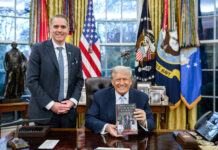
“We will be doing that, we’ll be selling [the Saudis] F-35s, yeah,” President Trump responded to a reporter’s question before meeting at the White House several weeks ago with Saudi Crown Prince Mohammed bin Salman, the de facto leader of his country. The president subsequently reiterated his intention to sell the jets to the kingdom, which he described as “a great ally.”
Mr. Trump and his son-in-law Jared Kushner have fostered close relationships with the crown prince, seeing him as a critical partner in security and, especially, business deals.
The Saudis, for their part, have been waging a “charm offensive” in the US, a multi-faceted public relations campaign to improve their nation’s image and attract foreign investment.
There have been high-profile sports and cultural events, extensive advertising, and the general promotion of the idea that the kingdom is warm and cuddly.
It should be (although it doesn’t seem to be) a steep uphill battle. Saudi Arabia is rightly infamous for torturing dissidents, denying basic rights to women and others and for employing things like amputations and executions in its penal system. Public religious expression for non-Muslims is strictly forbidden; convening a minyan there would risk arrest or deportation
And while the September 11, 2001, attacks may have receded far in the rear-view mirror, the suspicion persists that Saudi government agents—15 of the 19 hijackers were citizens of the kingdom—provided a support network for the terrorists. Lawsuits making that assertion have been cleared to proceed.
And few sane observers doubt that the Crown Prince was behind the murder of dissident journalist Jamal Khashoggi, who, trying to obtain documents related to his planned marriage, entered the Saudi consulate in Istanbul in 2018 but never left it, at least not alive and in one piece. Audio evidence (the Turks had the place well-bugged) indicated that he was strangled, dismembered and disposed of by Saudi agents.
The US has sold F-35s to a number of friendly nations, including the United Kingdom, Italy, Canada, Australia and Israel.
The latter used the F-35s during its 12-day war with Iran in June. The jets’ ability to quickly destroy some of Iran’s air defenses enabled older Israeli jets to, according to military aviation expert Gareth Jennings, “operate over Iran with virtual impunity.”
In 2020, the first Trump administration agreed to sell F-35 jets to the United Arab Emirates as part of a deal to get the UAE to normalize diplomatic relations with Israel.
Some US officials objected to the sales because of the UAE.’s close partnership with China—something that should be of concern with regard to Saudi Arabia no less—and because of the fear that Israel’s military advantage would be weakened by the sale. F-35s could travel with virtual invisibility from Saudi sand to Israel—with which the kingdom has no relations—in a matter of minutes.
The Biden administration suspended that Trump first-term deal in early 2021. It then gave the UAE a list of conditions, including the installation of “kill switches” in the jets so that the US could render them inoperable if necessary. The demands proved too much for the Emiratis to swallow and the deal, thankfully, dissolved.
Unless similar (ideally even stronger) safeguards are put in place with the Saudis, the prospect of the most advanced warplanes in our arsenal being sold to the kingdom is deeply nervous-making.
Congress has the power to prevent the proposed sale, but successfully wielding that power will require the House and Senate to pass a joint resolution of disapproval, and with a high enough threshold of support to overturn a presidential veto.
It’s a goal well worth pursuing.
To read more, subscribe to Ami