




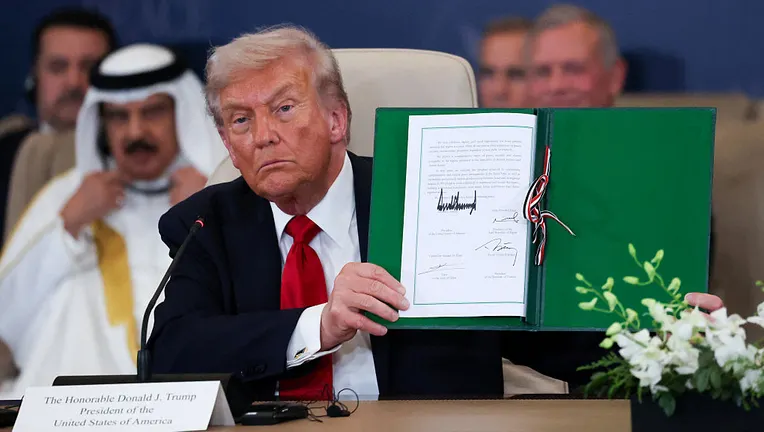
“Fifty-nine countries are part of this. We’ve never seen anything like this. Now it’s all happening.”
—President Trump, speaking to CNN last week about the prospects of his peace plan for Gaza succeeding
Jews around the world have finally been able to take a breath after two long years, now that all of the living hostages have returned from Gaza under the terms of the peace plan between Israel and Hamas negotiated by the US and Muslim countries.
However, at last count there are 15 bodies of hostages still being held there, and it appears that Hamas has been stalling on its obligation to return all of their remains, releasing a paltry number every few days.
And the ceasefire itself seems shaky, to put it mildly. An attack on Israeli forces and air strikes on Hamas targets in response brought back a day of violence between both sides, while Hamas has continued to execute Palestinians in the street. Once again, Jared Kushner and Steve Witkoff headed off to the Middle East on behalf of the White House to try to ensure that the ceasefire lasts more than a few days.
But what about the long-term prospects for the peace plan, which also requires, among other things, that Hamas disarm, an international military force will maintain peace in Gaza, and a technocratic Palestinian government—one not affiliated with Hamas or the Palestinian Authority—take control during its reconstruction? There have been reports that both the Saudis and Emiratis are concerned that Qatar and Turkey, the countries closest to Hamas that also serve as negotiators, are going to quash the peace plan. Is any of it going to come to pass? Or will Qatar or Turkey gain a foothold in Gaza?
To better understand the situation, we spoke with Dr. Rob Satloff, the executive director of the Washington Institute for Near East Policy; Professor Kobi Michael, a senior researcher at INSS (the Institute for National Security Studies) and the Misgav Institute, who previously served as the deputy director general and head of the Palestinian desk at the Israeli Ministry for Strategic Affairs; and Dr. Eran Lerman, the vice president of JISS (the Jerusalem Institute for Strategy and Security), who previously served as the deputy national security adviser to the Israeli prime minister.
A plan for peace?
“What we face now,” said Dr. Satloff, “is a very different challenge from what we faced two weeks ago. It is a challenge of how one implements, executes and enforces the terms of an agreement, which is very different from how you achieve an agreement. Am I hopeful? Well, I’m realistic.”
Both Professor Michael and Dr. Lerman suggested that referring to the plan as a “peace deal” is a misnomer.
“It is a stretch of the word peace,” Dr. Lerman said. “Whatever it is, it has nothing to do with peace as we understand it. We are learning that vocabulary is used differently by different people. It is a consolidation of a ceasefire, backed not only by the forces of stability in the region—Egypt, Jordan, the Saudis and Emiratis, and, of course, Israel—but also by the Turks and the Qataris.”
Professor Michael also noted that the deal is not really fleshed out enough to be called a plan. “It is a framework, principles that pave the way toward a general vision of President Trump to create a new regional architecture.”
He pointed out that President Trump’s recent comments have made it appear that the release of the hostages and cessation of hostilities were the most important parts of the deal to him, one that could perhaps be used to extend a Pax Americana to other parts of the world such as Ukraine and the Chinese theater.
To read more, subscribe to Ami