




The release of the remaining living hostages held in Gaza filled the Jewish world with happiness and a sense of relief after such long suffering. As Hamas slowly returns the bodies of hostages, some families are finally able to mourn.
But the deal that President Trump put forth and negotiated between the sides, one that still is in the first stages of implementation, can’t erase the torture, suffering and deprivation that the hostages went through in their captivity and the murderous rage of the terrorists that afflicted them and killed some of them even as they were captive. It also won’t cause us to forget the strength and faith that it took the hostages to survive in the tunnels, cages and other places of imprisonment during those two long years.
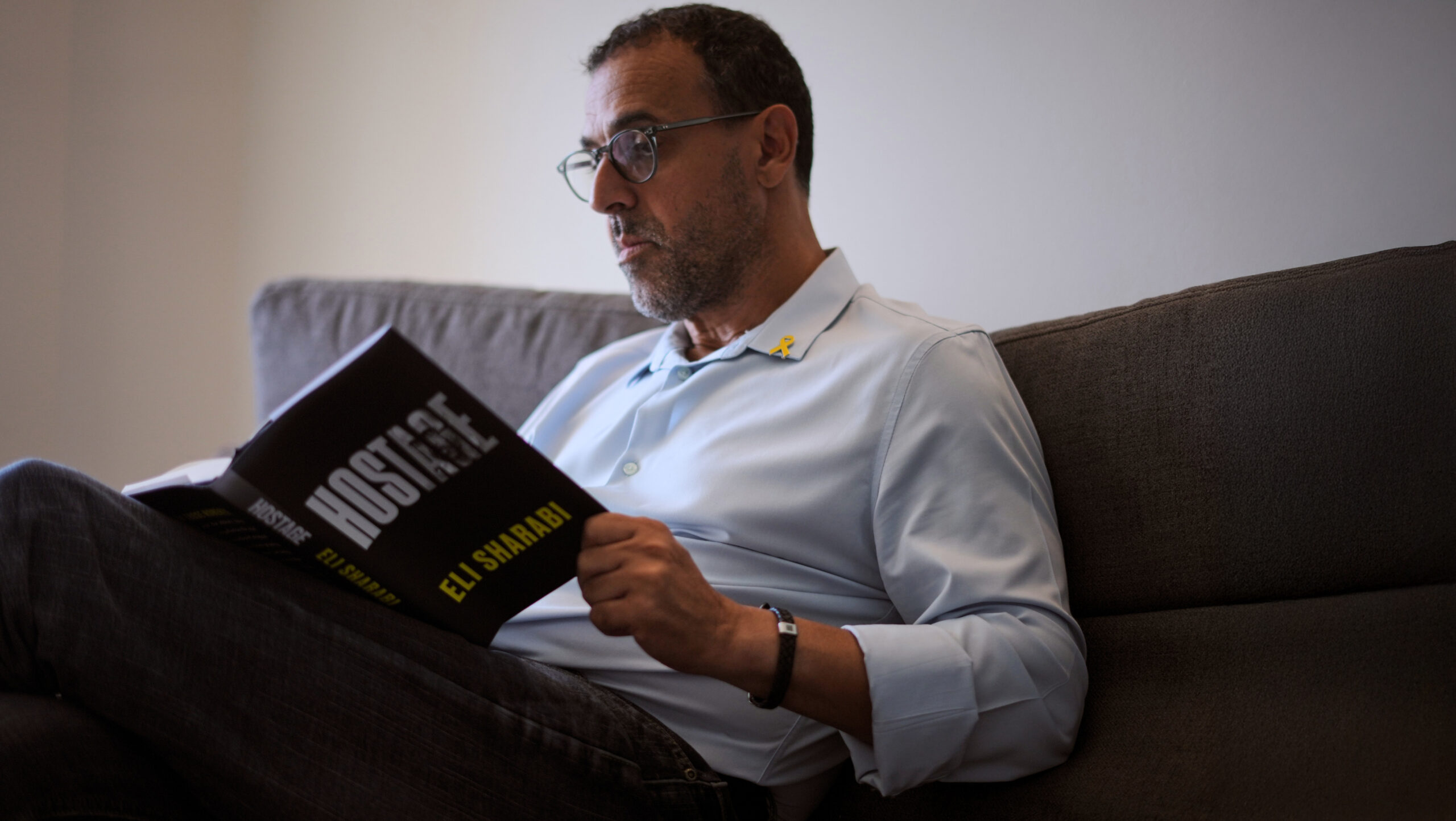
A number of the hostages have been speaking out about what they experienced and what the outside world, including the Jewish world, needs to know about their time in captivity. Eli Sharabi, who was released in February of this year after 491 days in Gaza—and whose brother’s body was returned to Israel on Hoshana Rabbah—has written a book and has made public appearances in an effort to convey both his experiences on October 7 and afterward and the experiences of those who were kidnapped alongside him. He spoke with us about his time in captivity and what it is like now to have returned home—and the lessons that we all need to learn from the hostages.
For over a year, Eli Sharabi lived in the depths of hell, shackled in the dank and airless underground tunnels beneath Gaza, cut off from the world and the family that he believed was waiting for him. Taken hostage by Hamas on October 7, 2023, he endured starvation, fear and cruelty that seemed without end. Yet it was precisely in that darkness where he discovered something unexpected: hope.
In this candid conversation, he reflects upon his ordeal and what it means to get a second chance in life.
I’ve heard you say many times that you came back from hell, but I wonder: Have you really come back?
That’s a very good question. I’ve done thousands of interviews, but this is the first time anyone asked me that.
That’s because I imagine it would be quite impossible to fully return after such an experience.
Undoubtedly. I am an av shakul (bereaved father) and an alman (widower). The worst thing I could have imagined actually happened to me. I’m also a bereaved brother. At the same time, I know that I can either allow the pain to envelop and bury me, or I can find a way to move forward. I’m a very practical person, and I know that there is nothing I can do to bring my wife or my children or my brother back. Fortunately, my other family members and amazing friends who fought for my release for almost 500 days are very supportive.
I went through a very difficult time, but I was given a second chance, and I am grateful for it. I love life, and I intend to wake up every morning and be a positive person who chooses to rebuild. The pain will never go away, but it will be alongside my life rather than instead of it. Right now I’m very busy doing things that were never in my comfort zone, such as interviews, photo shoots and things like that.
Meeting presidents…
Yes. Just imagine, me, Eli Sharabi, meeting presidents. It’s a different life, but I will do everything I can to maximize this second chance. I hope that my wife and daughters will be very proud of me.
Your memoir of what you endured, Hostage, has just been published. Do you think that enough time has elapsed to fully process everything?
That’s another good question. First of all, it’s extremely difficult to handle this kind of multiple trauma. I was in captivity for 491 days, but even what happened to me on October 7 itself is hard to digest, as are the consequences of everything that happened afterward. At the same time, it didn’t come as a total shock after I was released and was told that my wife, Lianne, and our daughters Noya and Yahel were no longer alive, and then learned that my brother Yossi had been kidnapped and was also no longer among the living. Despite our plan not to resist the terrorists and to try to use my wife’s and daughters’ British passports as protection, I understood that it might not have worked. Writing the book and giving speeches both in Israel and around the world are all part of the therapeutic process.
Are you being helped by therapists, or are you dealing with everything on your own?
From the moment I arrived at the Sheba Medical Center there were two therapists and a psychiatrist with me practically the whole time, and since then I’ve continued to see a therapist. Therapy helps me, and I’m happy to have it.
How are you able to relate to people who haven’t gone through something like this and are living regular lives? Is there some kind of metaphorical wall that separates you?
No. There are no walls. I speak openly about everything, which is why people feel free to ask me questions after being with me for only a few minutes. No one would dare to claim that he understands me if he didn’t have those experiences. I am fortunate to be surrounded by a lot of warmth, love and empathy.
Your mother lost a son, a daughter-in-law and two granddaughters, and she also suffered while you were in captivity. How is she coping with all this?
My mother is a very strong woman who truly believes in Hakadosh Baruch Hu, which gives her a lot of koach. She always tries to focus on the positive. On the day I was freed, she told me, “Now that you’ve returned, I can finally mourn for Yossi, Lianne, Noya and Yahel because I have some oxygen in my lungs. We’ll get through this together.” She’s an amazing woman and I salute her. There are many other women like her who are suffering every single day, the mothers of soldiers who were killed on the battlefield. This is one of the most difficult and challenging times for the State of Israel and the Jewish people, and we have to be unified and get through it together.
Was there anything in your past that gave you the strength to be able to overcome such trauma?
You could say that the way I was raised and the things I did in life were helpful. I’m the kind of person who isn’t afraid to make life-altering decisions, which began when I was 16 and moved from Tel Aviv to Kibbutz Be’eri on my own, without my family. I felt that living on a kibbutz would be good for me, and if I ever had a family I would want to raise my children there.
The environment on the kibbutz and the jobs I was assigned served to forge me into the person I am, and to prepare me to deal with situations that are fraught with uncertainty. It also made me understand that not everything in life would go smoothly and I would just have to deal with them anyway. Those were the tools I brought with me to Gaza, all part of the file labeled “Eli Sharabi.” I’m not a spoiled or pampered person. There is no doubt that I found myself in many life-and-death situations, but I was prepared to do whatever it took to survive. I knew that even though you can’t choose what happens to you, you can choose the way you respond, and I think I did that rather well.
To read more, subscribe to Ami