




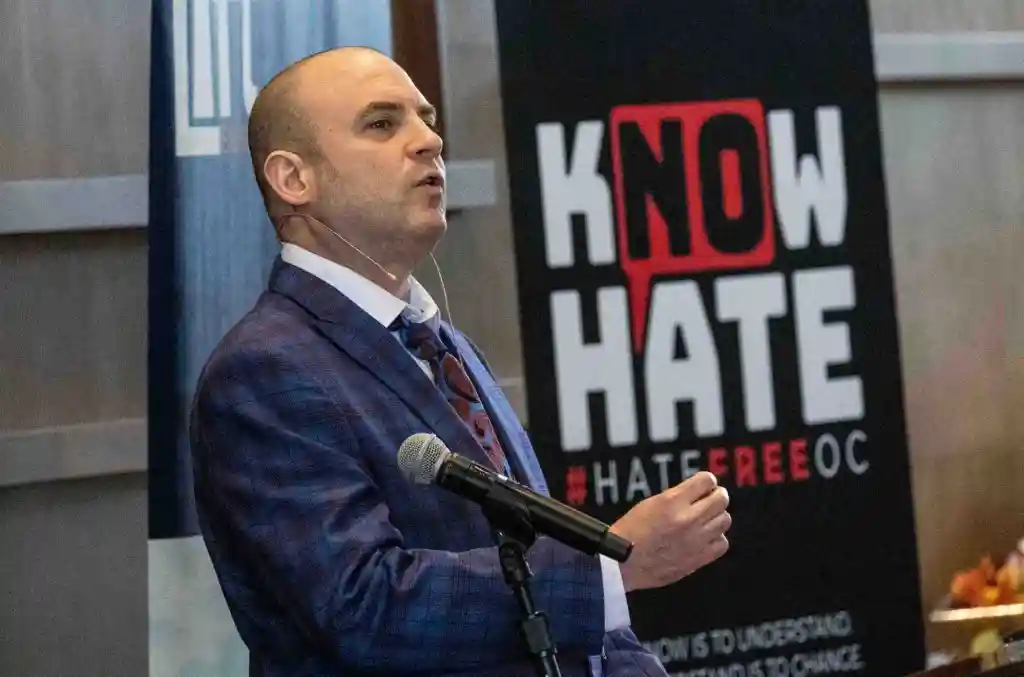
For 25 years, Jeff Schoep was the commander of the largest neo-Nazi group in the United States. Today, he is involved in the Simon Wiesenthal Center and other organizations building bridges. This is his story.
Your trajectory from being a white supremacist to fighting hatred is fascinating. How do you view your turnaround? As a conversion? As repentance?
It is repentance, in many ways. But it’s also more than that; it’s a positive mission for humanity. I was on the wrong path for a long time, and I put a lot of negativity into the world. I feel that it is my responsibility to try to repair some of that damage by bringing people together in healing, unity and peacebuilding.
Do you find that people are accepting of your “teshuvah”?
It would be easy to say that I want people’s forgiveness—I think every human being desires that—but it’s not up to me to decide whether people can accept it. Some people may never be able to, and I have to be okay with that.
What I do know is that there’s value in my present work. I’ve seen how it has helped people change their lives, even people you’d never imagine could change. If someone had told me ten years before I left the movement that I would one day disengage and deradicalize, I would have laughed in his face. I would have said, “You don’t know what you’re talking about.” Yet here I am, and I’ve seen others who were in even longer than I was make that same transformation and walk away.
Most people who leave don’t speak out publicly. There are only a few of us who do because it’s difficult, especially for men. I don’t want to stereotype, but I think it’s often harder for men to stand up and say, “I was wrong.” It takes a lot of strength and conviction. It’s hard enough for anyone to admit that in everyday life, let alone something that defined your entire existence.
Maimonides says that the first aspect of teshuvah is the belief that it’s possible, meaning that a person can turn things around and mend his ways so the bad deeds are no longer counted. You started your life one way and are now in a completely different place. Do you feel that you’ve “washed away” your past?
I feel like I’ve come a very long way. Life is a learning experience, and I believe we’re all constantly learning. I still discover new things about myself and the world almost every day. When people disengage from extremism, some struggle with being pulled back into that old mindset. I’ve been fortunate not to experience that. I don’t feel that draw anymore. For me, the work I’m doing now is a form of atonement, a way to give back and try to repair the harm I once caused. If you were to measure it year by year, I’d say that I still have a long way to go. But this is the path I’ve chosen, and I’m dedicating the rest of my life to it.
You need to change my mind about something. I’m a child of Holocaust survivors who lost their entire families, but I don’t think my parents viewed the neo-Nazi or white supremacist movement as a genuine threat, and neither do I, for that matter. I think we feel far more threatened by anti-Semitism on college campuses and the like. Do you believe that neo-Nazis pose a genuine threat, or are they just a bunch of loonies who like to march around?
I’d say that the answer is both. The organization I was involved in would be considered what’s called an “aboveground” group, meaning that at least in theory we were supposed to operate within the law. The leadership tried to keep things “legal,” and if a member committed a violent or egregious crime, he would often be removed from the group. That’s how it was structured.
But that doesn’t mean the movement as a whole is harmless. Some people who were members at one time or another did go on to commit horrific acts of violence. And aside from the groups like mine, there are also “underground” or “accelerationist” organizations. Those are the ones that openly promote violence; they want to see society collapse, the government fall, and a race or civil war ignite. That is their goal, and they are dangerous.
A lot of the radicalization these days isn’t even happening inside formal organizations. It’s happening online—in encrypted chats, social media groups and private servers—where people are feeding off each other’s anger and paranoia. You don’t know who’s influencing them or how far they will go. That’s what makes the lone-wolf threat so unpredictable and, frankly, frightening. So yes, some of these people might look like “loonies,” but it only takes one person who believes the rhetoric literally to do something catastrophic.
At the same time, I completely understand what you’re saying. The rise in anti-Semitism we’re seeing now, especially on campuses and in progressive spaces, is deeply concerning. What’s striking—and what I think many people miss—is that the far-right and far-left forms of anti-Semitism actually mirror each other in a lot of ways; they just express it differently. Since the October 7 Hamas attacks, we’ve seen a surge of far-left anti-Semitism that’s been shocking even to me. So while the far-right remains a threat, we can’t ignore what’s coming from the other extreme either.
Let’s talk a bit about your background. Where were you born?
In Minnesota.
Did you grow up in a mainstream American white family, or is there anything about your upbringing that we should know about?
My father is American, but my mother and grandparents came over from Germany after World War II. My grandfather fought in the German Army during the war, and my grandmother’s family was from Prussia, so her brothers—my great-uncles—also served in the German military. I grew up aware of that family history, and I really looked up to my grandfather.
I always share that part of my story with a caveat, because people sometimes assume that my family must have influenced or indoctrinated me into extremist beliefs. That’s not true at all. In fact, my family was strongly against what I was doing. They tried everything they could to discourage me. Even my grandfather, who had actually fought in the war, sat me down after I’d been involved for a few years and said, “Jeff, the path you’re on is going to lead to one of two places: prison or death. I really wish you would get out of this movement.”
At the time I was so deep in it that I told him, “You might have given up and surrendered, but I’ll never stop fighting. I don’t care if they kill me or throw me in prison; I’m not going to stop.” That was probably the nastiest thing I ever said to him and one of the moments I regret the most. He was just trying to help me, and I couldn’t see that back then.
To read more, subscribe to Ami