




Across the globe, the biggest companies are pouring billions of dollars into the next generation of artificial intelligence. These new AI tools and agents go far beyond answering questions. They can understand objectives, reason through complex challenges, make decisions, and even take action on their own transforming how business gets done.
Comparing business AI to everyday ChatGPT use is like comparing someone who checks a weather app to a meteorologist who studies the atmosphere and predicts storms. The technology behind them may be related, but the purpose and capabilities are entirely different. Consumer AI answers questions; business AI is embedded into a company’s operations, harnessing its data to solve problems, make decisions, and get work done.
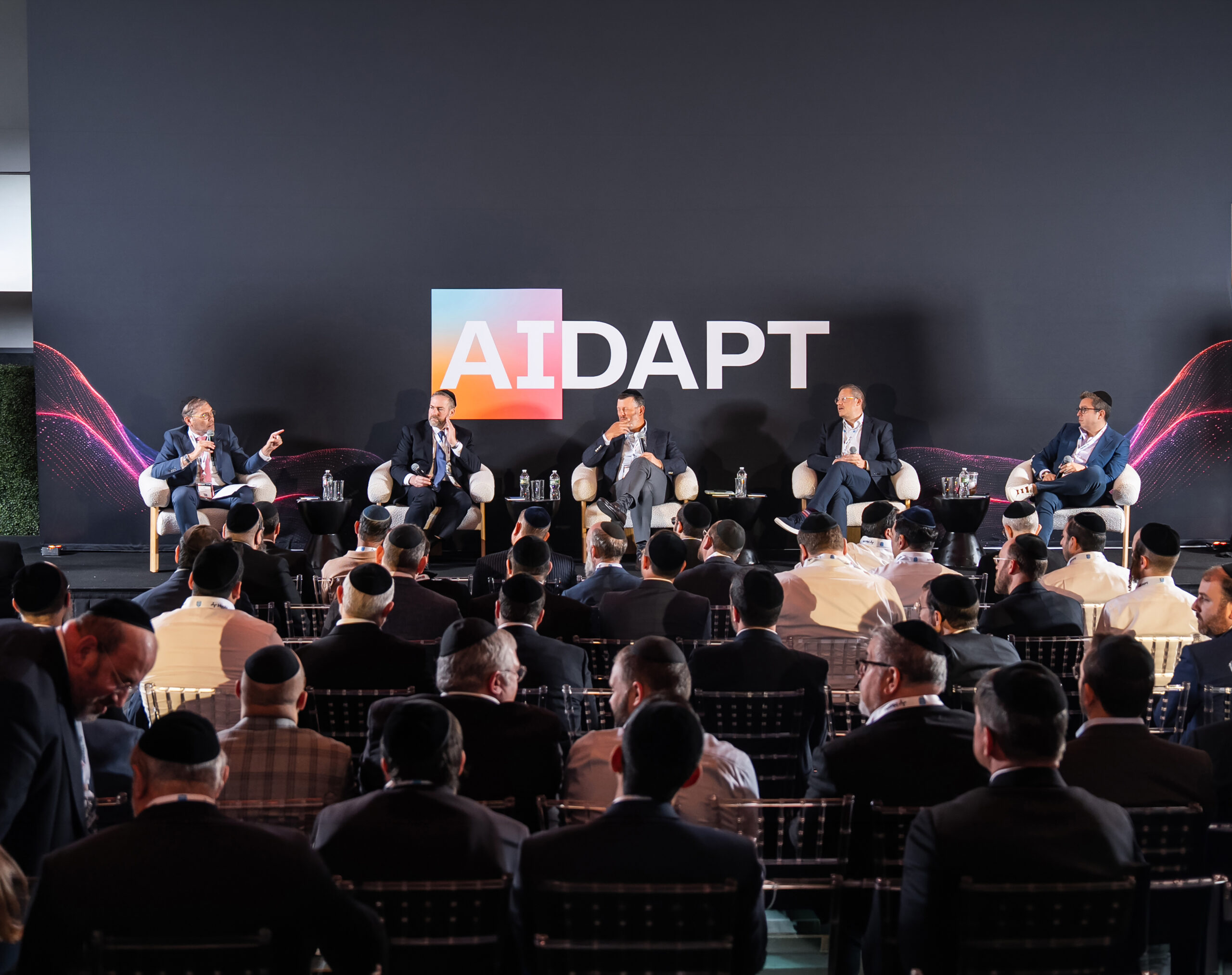
The AiDAPT Conference was the result of a partnership between Avi Schron and Tech Flatbush, the Powwow Events team, Ira Zlotowitz, and the SCHWAI team.
At the conference, Avi joined Simcha Hyman, CEO of TriEdge Investments; Mordy Golding, former Adobe and LinkedIn product leader; and Sruly Rosenfeld, partner at PwC, for the keynote panel moderated by Ira Zlotowitz.
Their conversation explores the current needs and concerns of businesses as they navigate the rapidly evolving world of AI. It provides a valuable introduction to what the future may hold, the importance of adopting new technologies for your business and the need to adapt to an increasingly competitive marketplace.
Ira Zlotowitz: They used to say that AI is the future. Now, many say it’s the present. Personally, I think it’s the past.
I took a quick poll of the audience, asking how many people here have used ChatGPT at least once, how many pay for at least one AI model, how many regularly use two or more AI models, and finally, how many of you have built an AI agent or automation? Almost everyone had their hands up for the first question, and almost everybody had their hands down for the last.
About eight weeks ago, the senior equity broker at Eastern Union told me he no longer needs an underwriter because Claude could do it for him. In less than six minutes, he was able to underwrite an equity deal with all the Excel, with all the formulas, with all the waterfalls, the IRR, more accurately than the most senior analyst. And this was before Fable 5.
The change has stopped coming from the bottom, from the junior levels; now, it’s coming from the top. Avi Schron, Sruly Rosenfeld, and I set up a Zoom training; 3,300 people joined, and they stayed an average of 40 minutes. We realized people need to be, and want to be, educated in this area. That’s why we arranged this panel.
There are representatives of four different businesses up here, and each one views AI through a different lens. They’ll present four different perspectives. Put them together, and you get the full picture.
Avi Schron, executive vice president of Cammeby’s, owns and oversees a large portfolio of industrial, office and multifamily properties. Avi will discuss how he implements AI throughout his operations, how he prioritizes its use, and how he convinced his organization to adopt it.
Sruly Rosenfeld, partner at PricewaterhouseCoopers Asset and Wealth Management, is plugged into the highest level of corporate America. He explains how the biggest corporations in the world are using and dealing with AI.
Mordy Golding, as product leader at Adobe and LinkedIn, had a front-row seat to the AI revolution before most of us knew it was happening. Today, as the founder of Transformative Studio, Mordy pushes businesses to look past simple automation and ask: If you were starting your company from scratch with AI on day one, what disruptive model would you build before a competitor does it to you?
Simcha Hyman, CEO of TriEdge Investments and Chief Helper at Hypha, operates a family office investing heavily at the intersection of AI, healthcare, finance, cyber and defense tech. Simcha will share where the smartest capital is flowing in the AI landscape, helping you understand how the outside world values a business so you can strategically recalibrate and focus your own operation moving forward.
The conversation will center on two defining questions: When did each of these leaders choose to go all-in on AI, and what was the inflection point that convinced them this technology is here to stay?
Avi Schron: It’s very appropriate that we’re holding an AI conference in Bell Labs. Fiber optic cable was developed in this building. Without fiber optic cables, we would not have any internet, and we would not have any AI. So we’ve come full circle.
As consumers, we must understand that all AI companies have one goal: to make money. The way they have been doing that since the advent of social media is to draw us into their world and make us feel that their technology is essential to our lives. About 10 or 12 years ago, social media design changed significantly: instead of clicking to the next page, now you scrolled. That scrolling kept you engaged on the site for an endless amount of time, which is necessary for them to sell advertising dollars and make money.
This change came after companies hired psychologists to figure out how to keep you involved. They did the same thing with AI. If you notice, the AI will always praise you, will always validate what you’re saying, will always tell you you’re right, will always ask you another question. They want you involved. They want you engaged. They want your time. They want your life. They want your soul. So, while AI can help your businesses perform better, stay on guard. Be careful. Be cautious. It’s a power tool, a very dangerous tool, and people have lost their lives by letting down their guard.
Keep this in mind when that sweet voice of ChatGPT says, “Would you like me to provide another answer for you? Would you like me to research that topic for you?” and then all of a sudden it’s your therapist and friend, and it’s giving you bad advice, but it sounds good.
I’ve always been interested in current technology, so when AI came out, I had to try it. I tried ChatGPT and all the other platforms as they became available. When our company realized that AI could save us time, we knew we had to adopt it. We held an informational seminar for our employees, explaining what an AI model is, what an LLM is, how it works, how it can benefit the company, why it is or isn’t accurate, why its answers can be good or bad. Then our staff tried it; they looked at their workloads, they looked at repetitive tasks that could be assigned to an agent, to a skill within the LLM that we were using, and they adopted it for tasks like processing invoices and utility bills or sending out emails to tenants and other form processes. That gave us the impetus to go forward.
Ira Zlotowitz: Sruly, were you an early adopter or did you come around later? What was your turning point?
Sruly (Jerry) Rosenfeld: People ask me, “Why are you, an accountant, speaking at an AI conference?” Ira and I speak to each other every Friday—we’ve been doing so for over 30 years—and a few months ago, he was telling me about this incredible new AI application that he came across called Claude. I told him I’ve been using Claude for months. He couldn’t believe it. I’m a senior partner at PwC. Typically, I’d give those technology-oriented tasks to my staff to do. He wanted to know why I was personally involved in its use.
My “wow” moment came when The Financial Times ran a story in which the PwC US CEO stated that any partner who doesn’t get on board with AI will no longer be a partner in this firm. Now, this firm has been around for over 175 years. Never in our history has a CEO gone public to the press and implicitly or explicitly threatened partners to opt into the firm’s strategy. So, even though I’m within ten years of retiring, I said, “I better start exploring this,” and I called on my team to teach me. I was blown away by how powerful this technology is.
It’s very important that everyone gets on board, because those who don’t are going to become obsolete.
Mordy Golding: Am I an early adopter? Yes. If you look up “early adopter” in the dictionary, you’ll see my picture there.
A bit of history: I met Ira—I think he was eight years old—at my first paying job, at a company called ArtScroll. I had the zechus of working on the first Gemara, which was very exciting, and every day, your father used to ask me as I walked out, “Is there anything more that we can do? Give me ideas.” He was always thinking about how to move forward, and I was the young kid.
The company was using very antiquated computer systems for typesetting, and I suggested they get a Mac. Rabbi Zlotowitz would just laugh and call it a toy. After a year, I had to relocate to Silicon Valley and began working for Adobe. When you’re living in the valley, you’re two years ahead of everyone else.
I joined LinkedIn in 2015. In 2016, LinkedIn was acquired by Microsoft, which was, baruch Hashem, an incredible experience. ChatGPT first came out in 2022. Microsoft was the largest investor in ChatGPT. They invested $40 billion, which was a big deal. [Microsoft CEO] Satya Nadella instructed each of our teams to show him the plans they were building for the future. We showed him our content planning and strategy planning, and he said, “Throw them out! From now on, this is the future: AI.”
AI was invented in the 1950s. At LinkedIn, we’ve been using LLMs from the beginning. We’ve been using machine learning to match recruiters to profiles and things like that. That’s all artificial intelligence, so we laughed it off. What Satya understood was that this technology, which had been the domain of only a few hundred thousand developers in the world, was being brought to the masses. That meant that we had to think completely differently about every product we built and every service we offered.
That was the moment for me.
To read more, subscribe to Ami