



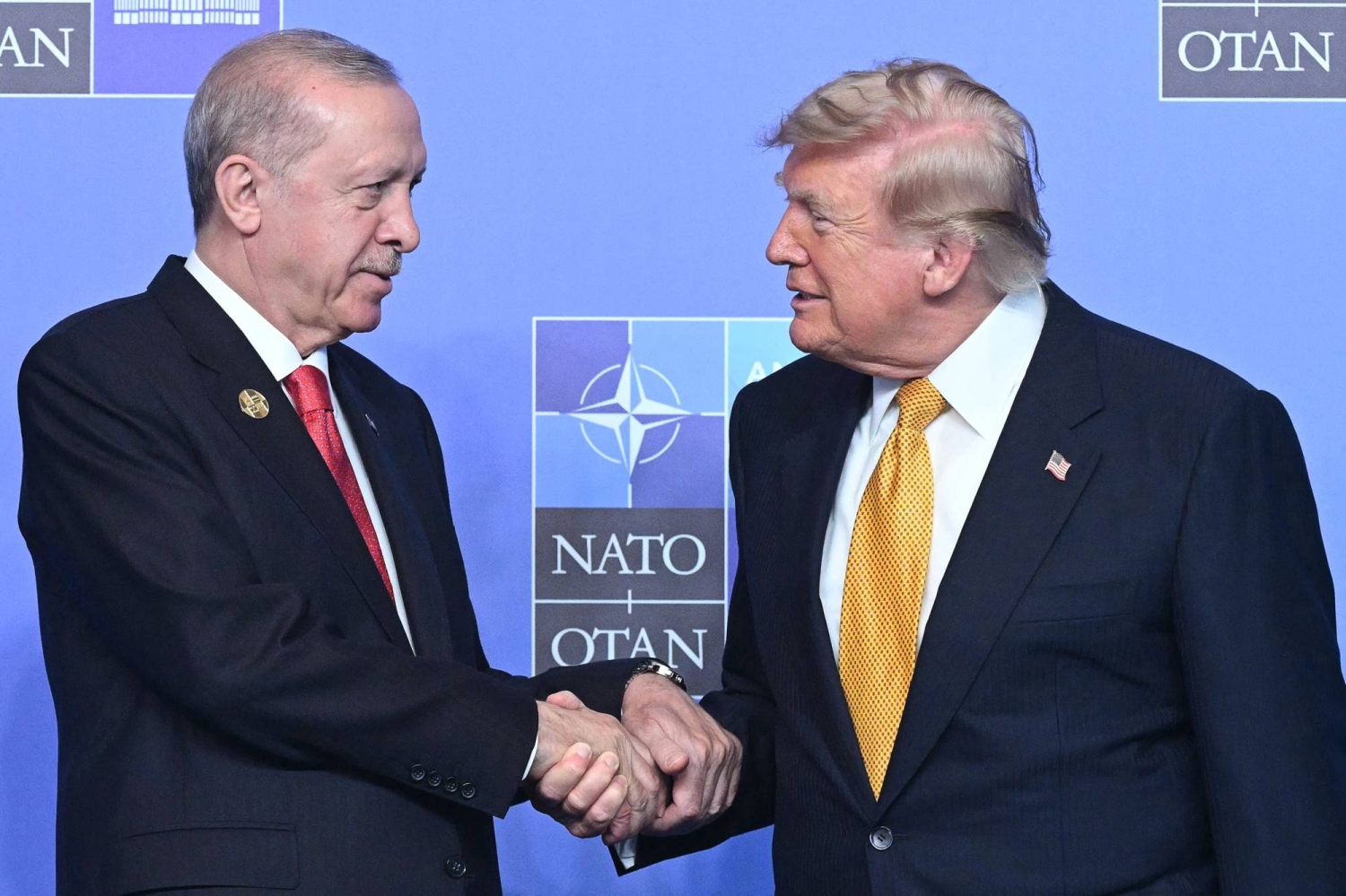
Upon arriving in Ankara for the recent NATO Leaders’ Summit, President Trump remarked that had the summit not been “held in Turkey, where my friend happens to be a very strong leader, a very strong person, it’s possible that I wouldn’t have attended.”
The “friend,” of course, is Turkish President Recep Tayyip Erdoğan:
…the man who has compared Israeli Prime Minister Benjamin Netanyahu to Hitler, ym”sh, and bragged that “Turkey is a country that speaks openly with Hamas leaders and firmly backs them.”
…who, in March 2025, prayed publicly that “Zionist Israel” be “destroy[ed] and devastate[d],” and for “mercy upon the martyrs” of Hamas and the Palestinian Islamic Jihad and for a “speedy recovery” for their wounded members. He has also called Zionism “a genocidal ideology.”
In May 2021, the Times of Israel reported that Mr. Erdoğan called Israelis “murderers” who were “only satisfied by sucking their [victims’] blood.”
In a recent interview, his foreign minister, Hakan Fidan, said that Israel is one of “humanity’s common problems…a burden that humanity can no longer bear.” (Mr. Hitler was unavailable for comment.)
Mr. Erdoğan has cracked down on demonstrations, arresting and jailing protestors of his authoritarianism. On the eve of the NATO summit, he ordered the arrest of a popular Turkish comedian, Deniz Goktas, for insulting the Quran and him. (The comic had quipped that the book was “a bold statement in the 600s” and that the Turkish president had progressed from being a “shy dictator” to a “more-at-peace-with-himself dictator.”) Mr. Goktas faces a four-year prison term.
President Trump’s warm words about Mr. Erdoğan were accompanied by our president’s announcement that he is dropping the sanctions on Turkey that have been in place since 2020, after Ankara bought air-defense systems from Russia, and that he would like to abandon a Biden-era policy and sell advanced F-35 fighter jets to Turkey.
That proposed sale was the subject of a letter signed last week by a group of Democratic congressmen. It read, in part: “Erdoğan has made no attempt to hide his cozy relationship with our adversaries, including Iran and Russia. Despite sanctions on those countries, Turkey maintains significant economic and energy ties to both.” Several Republican lawmakers have also expressed concern about supplying the jets to Turkey.
What lies at the root of President Trump’s embrace of the Turkish leader?
Some contend that Mr. Trump values Mr. Erdoğan for strategic reasons, because the Turk is a leader of a powerful military, can actually “make a deal,” and will honor and deliver on agreements. And that’s enough to counter Mr. Erdoğan’s objectionable words and behavior.
Others see Mr. Trump’s impatience with most European NATO allies as what has led him into a de facto alliance with Mr. Erdoğan. In this view, Turkey, which, among NATO members, has a formidable military, second only to that of the US, and which controls access to the Black Sea, is a foil to other member nations. And, indeed, Turkey has used its veto power to extract domestic or military concessions from other NATO countries.
But there may be a more simple reason for the bromance: a psychological one. Mr. Trump himself inadvertently hinted at it when, sitting among reporters across from Mr. Erdoğan in Ankara, he said: “You never know why a relationship is special. Sometimes you get along with the toughest people, like him, and sometimes you don’t get along with the weakest, most pathetic people.”
Our president, it has been repeatedly demonstrated, has an elemental soft spot—if the term can be used in this context—for dictators and would-be dictators, like Vladimir Putin of Russia, Jair Bolsonaro of Brazil and Kim Jong Un of North Korea.
Some might say he views them with admiration.
Mr. Erdoğan cajoled his parliament to approve a highly centralized presidency, granting himself overwhelming control over economic and foreign policy, as well as most of the organs of state, including the judiciary.
The presidential palace complex in Ankara, built under Mr. Erdoğan, is known as the “White Palace”; it’s more than 30 times the size of the White House.
While Mr. Erdoğan’s presidential term expires in 2028, his parliament is expected to call an early election to allow him to run for an additional term in office.
You might say he’s making Ankara Great Again.
To read more, subscribe to Ami