




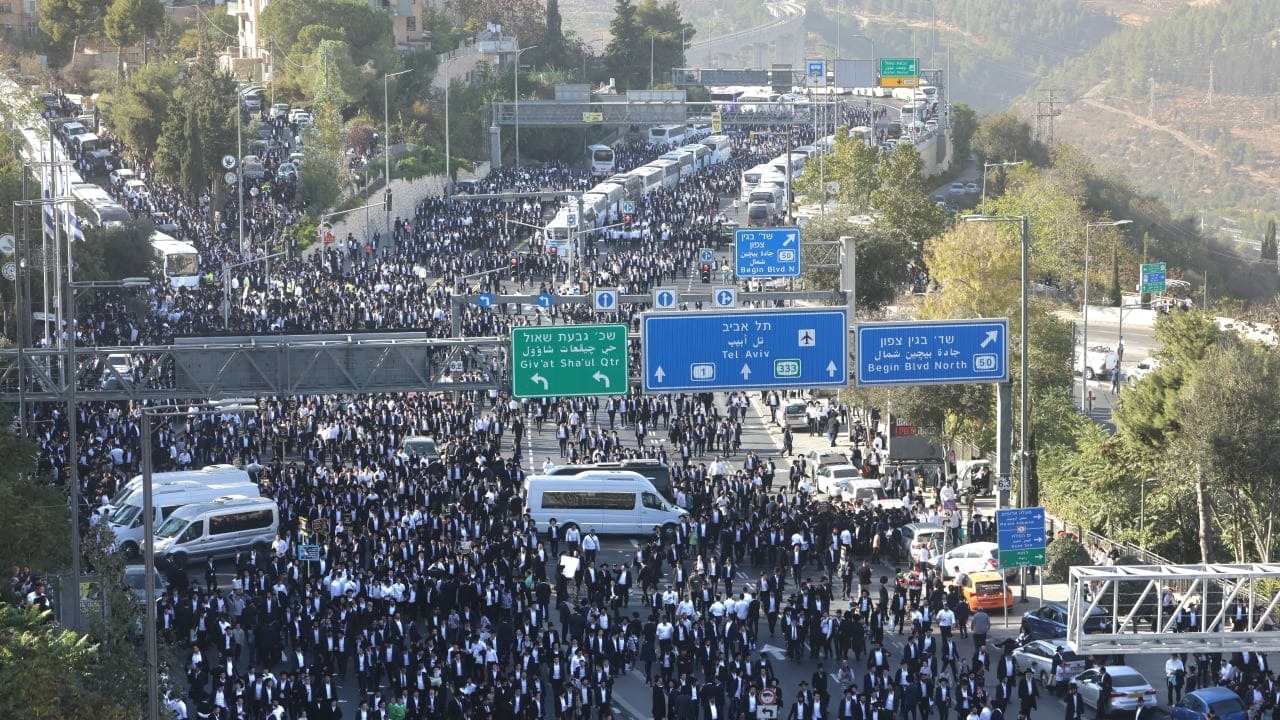
Last Thursday, a crowd of hundreds of thousands of Jews turned out in Yerushalayim for an atzeres tefillah—and a de facto protest against the Israeli government’s actions to draft bachurim into the IDF and imprison those who have refused.
The gathering shut down the entrance of the city for almost the entire day, stopping transport in, out and around the city in a show of anguish over the arrest of three bachurim who refused to comply with draft orders. It was a public condemnation of the government’s plans to go further, and a concerted request of the Eibershter to intervene.
Massive numbers from all sections of chareidi Judaism showed up: Sefardi, Ashkenazi, yeshivish and chasidish.
To understand the message of the atzeres tefillah, we spoke with Rav Yosef Chevroni, rosh yeshivah of Yeshivas Chevron, and Rav Sholom Ber Sorotzkin, rosh yeshivas Ateres Shlomo, as well as with Ariel Shammai, a talmid of Rav Sorotzkin’s who was arrested and remains in prison.
Elevating Our Connection to Torah // A conversation with Rav Yosef Chevroni,
Rosh yeshivah of Yeshivas Chevron
When we last spoke, we discussed the challenges facing the yeshivos and their talmidim in the face of Israel’s push to forcibly conscript them. Since then, the situation appears to have worsened significantly.
Completely. What they were threatening has begun to materialize. They spoke as if they only wanted boys who weren’t learning, as if they understood that those who were learning would not be drafted. They made it seem that those for whom Torasam is umanusam could remain in yeshivah. Instead, they are now arresting them and throwing them into jail. Clearly, they are operating under the assumption that it’s only a matter of time before a deal will be reached for those who are studying. However, those are precisely the ones they wanted to draft in the first place.
It is obvious that this conflict isn’t about needing more soldiers or finding real solutions. If it were, they would speak openly and the situation would look very different. They know they cannot force us to do anything. They should have sat down with us to discuss what is possible and what isn’t. But that’s not the issue.
Everyone who understands the political situation in Eretz Yisrael knows that this is not the real cause of the problem. This is simply a tool they are using to destabilize the government. There are multiple agendas behind this, but it’s not about increasing the army’s manpower. If that were the case, even we could have contributed some constructive ideas.
At today’s atzeres tefillah, we were k’ish echad b’lev echad. I don’t know exactly how many people attended, but between half a million and a million people stood together and davened as one. We were there with umanus avoseinu b’yadeinu, davening to Hakadosh Baruch Hu. We are standing with the strength of 3,000 years of unbroken Yiddishkeit, a continuity that will always endure. That is beyond question. The only question is how much harm and suffering they can inflict on us.
A right-wing channel sent a few of its employees to our yeshivah. Some of their staff are more dati-leumi, but the owner is somewhat more chareidi in orientation and wanted them to be exposed to the ideas we represent. They spent a few hours there and then met with me. After observing our yeshivah, they said, “We really don’t have any questions.” I encouraged them to ask anything they wanted. “Now is the time to speak,” I said. One of them finally asked, “What will happen in 25 years when the chareidi population grows and becomes a larger percentage of the country?” I replied, “Let’s first get through this crisis and then we’ll worry about that.”
This exchange illustrates that no one is addressing the core of the problem, whether real solutions exist and what is feasible. In its place there is tremendous propaganda against the chareidim, driven by forces seeking to dismantle every part of Yiddishkeit in Eretz Yisrael. Their real fear is that the medinah will become more chareidi.
The truth is that they really don’t want us in the army. Their goal is to weaken Yiddishkeit, not to make the IDF more aligned with Jewish values. It goes against their entire ideology. We are merely pawns. Their true objective is political: to bring down the government and force new elections so they can take control. They don’t care if a few sincere yeshivah bachurim are jailed along the way. Their concern is power, not people.
We are both talmidim of Rav Dovid Soloveitchik, zt”l. I’ve shared with you before that a number of years ago, he summoned me to Eretz Yisrael to do something about the danger of giyus. He was the first to recognize the threat. He became deeply concerned as soon as Lapid began speaking about it. At the time, I tried to reassure him. He told me that he did not have menuchas hanefesh, and I wanted to say that they would never be able to close down such a makom kadosh. But then I stopped myself because I knew what he had experienced in Europe. Who was I to tell him to relax or that a sacred place like his yeshivah would not be threatened?
Baruch Hashem, we have a history that we can look back to for lessons. We have the havtachah of “Ki lo sishachach mipi zaro.” Torah will never be forgotten, and b’ezras Hashem we will always survive. Hakadosh Baruch Hu has His ways.
I’ll share something interesting with you. Our yeshivah, the Slabodka Yeshivah, was saved from the Holocaust through a gezeiras hagiyus almost exactly 100 years ago. My great-grandfather Rav Moshe Mordechai Epstein was part of a delegation that included the Dvar Avraham, Rav Avraham Dov Kahana Shapiro, and Rav Kook. They traveled around America to raise money for a central relief fund for Litvishe yeshivos. They wanted to raise a million dollars. They only managed to raise $350,000 after eight months, but l’maaseh it saved the yeshivos.
During that year, Rav Moshe Mordechai received a telegram from the Alter of Slabodka saying that a law had been passed that even though the yeshivah bachurim had been exempted from the army, the government wanted to set a condition that would interfere with the yeshivah curricula: they wanted them to learn the Lithuanian language as well as other secular subjects. Rav Moshe Mordechai writes in his hakdamah to Levush Mordechai that he responded that he had always believed that we would have to go to Eretz Yisrael, and he thought that now was the time to go. He raised money in America to move the yeshivah from Lita to Eretz Yisrael, and the yeshivah moved at the end of 5684 (1924). Shortly after they arrived in Eretz Yisrael, the gezeiras hagiyus in Lita was annulled. Rav Moshe Mordechai would say, “You can clearly see that this was entirely min hashamayim because it was meant for us to go to Eretz Yisrael.” As a result, everyone who went with the yeshivah was saved from the Holocaust.
I think we have to look at the existence of klal Yisrael through all the persecutions we have suffered and see what we can take from them. I see some kind of chizzuk here for the bachurim, because I think they understand the situation and that they have to make some sacrifices to be able to continue learning. For now, that means that they can’t leave the country or get driver’s licenses, and who knows how many other redifos there will be. But this connects us to the Torah. We understand the value of what we’re doing. We’re giving something up for the Torah. It was very easy to learn Torah beforehand.
This is the lashon of the letter we wrote to the bachurim instructing them to go to the atzeres tefillah: “To the precious bnei hayeshivah: Am Hashem chizku v’nischazku. We are fortunate to have merited to be the ligyonos, the armies of the King of all kings, Hakadosh Baruch Hu. We are the ones who bear the crown of Torah, the splendor of His delight. Since we are being pursued for this, ashreinu that we merited to be caught for the words of Torah. In our struggle over the very existence of Torah in the Holy Land, we will heed the call of the gedolei Yisrael to join the atzeres hatefillah that will be taking place this Thursday. May Hashem hear our cries to raise and make great the glory of the Torah, and may we all merit to rise in Torah and go in its ways as we always have.”
We were telling the bachurim, “You have something that is more important than driver’s licenses or going to chutz laaretz. We are living on a higher plane.” Today we stood together with hundreds of thousands of Yidden and said, “Shema Yisrael, Hashem Elokeinu Hashem echad.” They are busy with the army and the Supreme Court and their unfortunate values. We are standing with our tremendous heritage and the powerful koach of Shema Yisrael and the Yud Gimmel Middos Harachamim. How can they even try to touch us?
When outsiders come to the yeshivah and see the power of the bachurim sitting and learning with such seriousness and sincerity, they see it on their faces and can’t say anything. A visitor once asked me, “Why are chareidim like Neturei Karta so opposed to the medinah?” I replied, “I don’t know why, but there’s something that’s bothering me, and I want to ask you a question. I hear that the outspoken people of the medinah speak to the umos ha’olam and ask them, ‘Why do you hate us? We represent your values. We are the only democracy in the Middle East.’ I’m ashamed when I hear that. Is this why we came home after so many years? To represent the degraded, lowest Sedom and Amorah values of the Western world?”
I would like to ask the Rosh Yeshivah about the bachurim who have to face challenges such as missing family simchos that take place outside the country. I am sure that the Rosh Yeshivah is addressing these issues on a personal level as well, correct?
Sometimes it’s very hard, but it’s also a time when the bachurim are learning about priorities and what must come first. Hakadosh Baruch Hu is placing us in a situation where we have to weigh what we have against what we stand to lose. I’m not saying that I would want this l’chatchilah, but Hashem is giving us an opportunity to elevate ourselves and understand how tremendous is our zechus.
There’s a bachur who lives in Ramat Gan, which isn’t such a chareidi area, and they knocked on his door looking for him. Baruch Hashem, he was able to elude them. He came to me because he was afraid. I told him, “Baruch Hashem that you were zocheh. Ashrecha shenitfasta al divrei Torah.”
There’s nothing else we can do. It’s mindboggling that they call themselves the Jewish State.
To read more, subscribe to Ami