




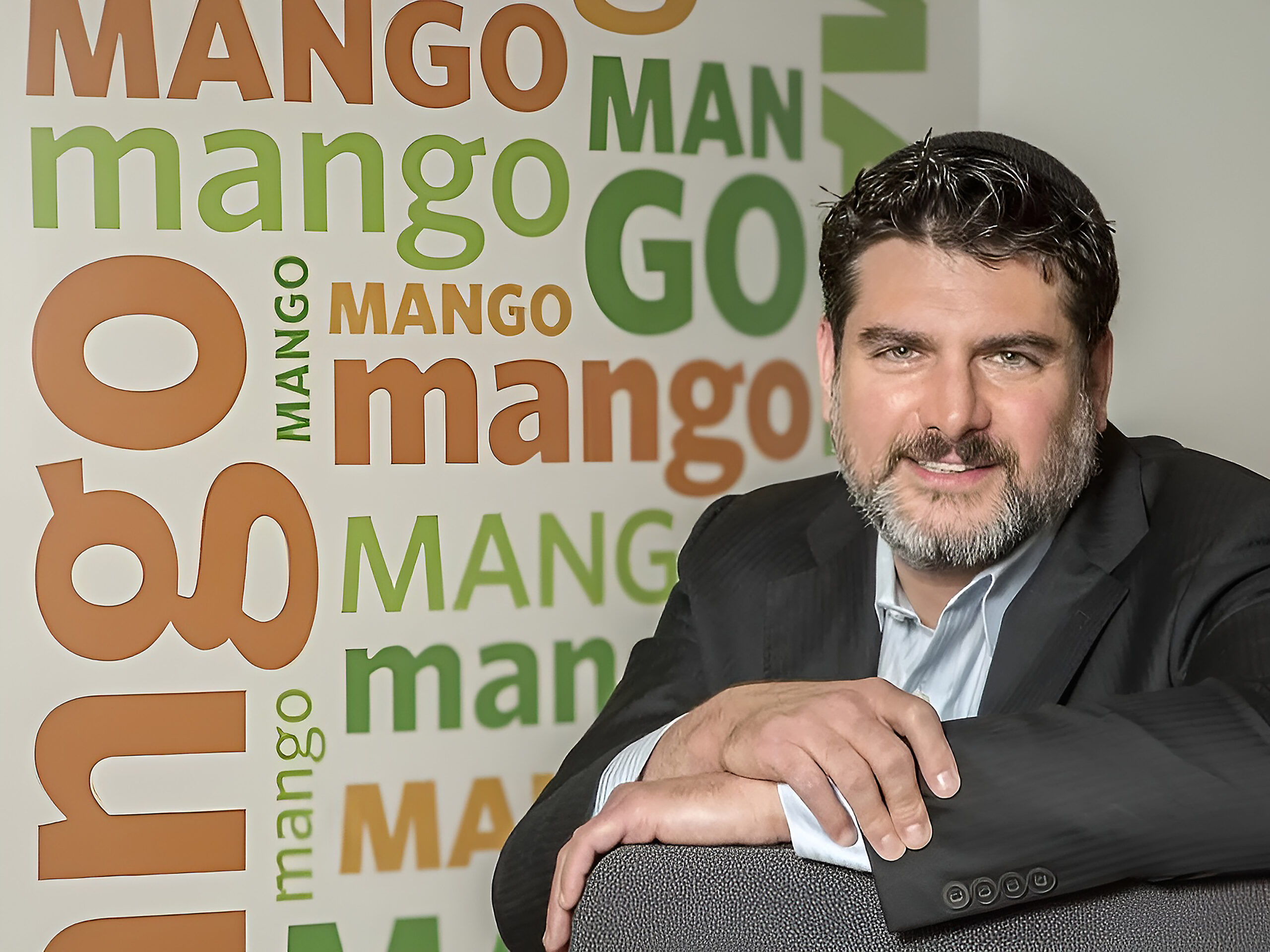
我会说一点儿汉语。 (pronounced, Wǒ huì shuō yīdiǎn er hànyǔ). It means, “I can speak a little Chinese.” It’s something Jason (Eitan) Teshuba might say, as he does, in fact, speak a little Chinese. That makes sense, because Jason founded Mango Languages, one of the world’s top-rated language-learning companies.
Jason and his brother Michael never intended to start a language-learning business. The idea came to Jason when he learned Italian, trying to impress a potential customer. The move didn’t work, but it rekindled his love for languages. Using their software development skills, the brothers slowly but steadily developed one of the most popular language learning apps in the US. In fact, Mango is the #1 rated app in that category on multiple platforms.
In my conversation with Jason, we covered a wide range of topics, from what type of languages he offers (Aramaic?) to how he landed the New York Public Library as a client.
Learning a new language is something that many readers dream of doing. This dive into that world might just be the catalyst to help you accomplish that.
Enjoy!
—Nesanel
I’m originally from Detroit. My father is from Libya, which ties into the language part of my life. I spent most of my life in Detroit, moving East in the last five years. I am the oldest of six. My mother did bookkeeping and my father worked in heating and cooling.
“I went to Hillel, which is a Conservative Jewish day school, through seventh grade, and then I went to public school through high school. I’d say we were better off than some and worse off than most in my town.
“As a teenager I kept trying out new business ideas with my younger brother Michael. One was a unique greeting card that I thought would take off. People liked it, but producing it at scale would have taken more capital than we had, so we shelved it. A more successful venture was a power washing service that we started in college. We focused on decks and houses, ran summer crews, and at one point tried to run it year-round. We even took time off early in college to give it a push, then chose to go back and finish our degrees. I also looked for small arbitrage opportunities. During welcome week at Michigan State I found a salvage yard selling couches for eight dollars. I asked for the lot, got the price down to four dollars each, loaded a truck, and sold them to students for $50 to $100 a piece. It was a bargain for them and a 10x-20x margin for us. That’s how I thought: find an inefficiency, test it fast, learn and move to the next thing.
“Though I enjoyed the process, what genuinely energizes me is innovating and building new products. That’s where I naturally lean in, where I lose track of time, and where I create the most value. I started college focused on the hospitality industry. I figured that I needed to have hands-on experience to learn that industry. I worked almost every job in hotels and restaurants, but the reality was not the fantasy I had in my head; it wasn’t all luxury and vacations.
“I tried a short stint in finance. Then I went back to what I always liked: programming.
“In eighth grade, I begged my mother for a programming book and taught myself to code. Computers sit at the center of the modern world. I didn’t know exactly what I would do with the degree, but I knew it would matter, so I switched and finished with a degree in computer engineering.
“My first job after college was as an embedded systems engineer at EDS, Electronic Data Systems. The division worked on embedded computers for the big automakers. Modern vehicles have computers that manage the engine and transmission. I worked on a project called SimuCar, a vehicle simulator that let us test those embedded computers without building millions of dollars’ worth of test vehicles. Engineers could run long tests, come back after a week or a weekend, study the results and tune the software. My role was to write the software that ran those embedded system tests.
“I stayed a little under two years. I left because my younger brother had a connection with a pharmacist in Michigan who wanted to build an online pharmacy. Today that is common, but at the time there was almost nothing like it. I worked on the site after hours, saw we could secure a larger contract, pitched it, and he accepted it. I worked on it after hours until I felt secure enough to quit my day job.
“While building the pharmacy website, we landed some other clients. By the time that project wrapped up, we had real experience building secure and user-friendly websites, and we expanded into a full service web development company. The problem was that as a startup, we also had to find new clients. My brother tossed me a phone book and told me to get to work. Through cold calling, we landed enough business to keep going for a couple of years. One example of a win from that period was Wayne State University Law School in Detroit. They hired us to rebuild their entire website. I believe the lead came by word of mouth.
“After the pharmacist job, we did many small sites for local businesses—a high end jewelry store, a hardware supplier. It was mostly my brother and me building the backend. We later partnered with a designer because our sites did not look great and we knew it.
“Interestingly, the web development company led us to our language business in a roundabout way. We were invited to bid on a site for a large Canadian manufacturer. During the meeting they told us they had ten quotes, and if we wanted to compete we had to give them our cheapest price. I thought price might not be the only angle. I researched the company and learned the owners were Italian. I decided to learn some Italian and then try speaking to them in their language. I rented Italian learning CDs and studied for about ten days.
“Nothing came of that bid. The Italian ownership was not involved with the Canadian office we dealt with, so Italian didn’t help, but it rekindled my love of languages. It’s part of my family story. Libya was under Italian rule for a long time. My aunt lived with us when we were little and spoke mostly Italian because that’s what they taught in school in Libya. The people spoke Arabic, but they taught Italian in the schools.
“Languages always drew me in. At Hillel we studied Hebrew, but the real spark was in third or fourth grade when a classmate brought a Japanese newspaper. I went home and asked my mother for a Japanese-English phrase book and a book that taught the [written] characters, and after school I would copy them and try to teach myself. Around the same time, one of my closest friends was Russian. His parents didn’t speak English, so he would translate between us at his kitchen table. That seemed miraculous to me. Being bilingual struck me as something extraordinary.
“I asked him to teach me. On the bus we pointed at things out the window and he told me the Russian words for them. I only know a minimal amount of basic Russian today, but I still remember the word he taught me for truck, грузовик (gruzovik).
“After I had been learning Italian for about ten days, I was out with friends and learned that one of them, a pilot, had been using a popular program to learn Italian for six months. I got excited and, in Italian, suggested we get a beer and schmooze together. He looked at me blankly. He did not understand what I said—and he’d taken Italian for six months!
“When I asked him what he could say in Italian, he gave me a line about a donkey eating a carrot. He had been using a different program that taught quirky sentences but not real conversation. That contrast stuck with me. Even a handful of the right lessons can give you practical language you can use to communicate with people.
To read more, subscribe to Ami