



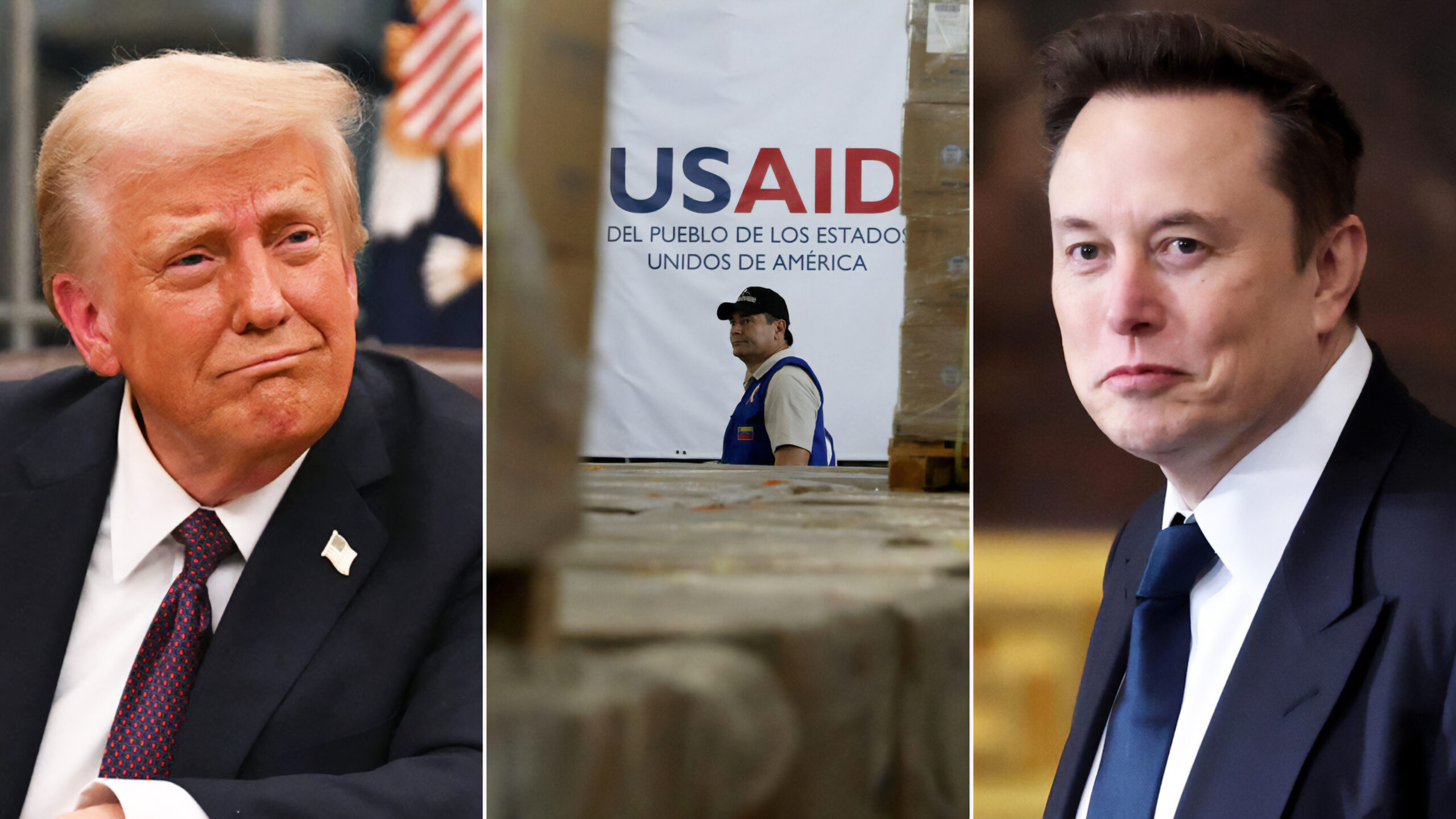
“We spent the weekend feeding USAID into the wood chipper. USAID is a criminal organization.”
—How Tesla CEO and head of DOGE Elon Musk described his actions to shut down the United States Agency for International Development.
When you pull the letters of the name of an organization off a building, it gives off an air of finality. Last week, workers removed the name of the United States Agency for International Development, or USAID, from the building in Washington, DC, that housed the agency, and they taped over the places from which its name couldn’t easily be removed.
That move was just the symbolic part of the shutting down of the agency that is going on under the direction of Elon Musk. The CEO of Tesla was appointed by President Trump to head the Department of Government Efficiency, or DOGE, and in that role, he has said he will lay off all but 611 essential USAID employees. The agency employed more than 10,000 people around the world, about two-thirds of them outside the US. Some are reportedly trying to figure out how to get back home, after being shut out of the USAID computer system and essentially fired.
These shutdowns appear to be having real-world consequences. People in Sudan who rely on community soup kitchens as the war there rages have been unable to get food. Reportedly, some 500,000 metric tons of food that was intended for people around the world is currently in limbo because of the shuttering of USAID.
Medical assistance in other places in Africa has been stopped. Charities in Ukraine helping people affected by the war have had to close or stop services.
There are questions about whether the moves by Musk are legal. There are also questions about whether this will save the kind of money the Trump administration is aiming for; USAID’s latest complete numbers showed that it had a budget of about $44 billion in 2023, out of a total US government budget of $6.75 trillion, or about six-tenths of one percent of the budget.
But President Trump and Musk have said that their opposition to USAID was in part because of its political stance and left-leaning activity. Musk called it “a viper’s nest of radical-left Marxists who hate America” and “evil.” Trump said that it was run by “a bunch of radical lunatics.” If so, the choice to shut it down would have less to do with money per se and more with what it was doing with that money.
But some experts claim that what USAID was doing with that money was countering both Chinese and Russian influence around the world—and those countries are gleefully watching the agency fall.
USAID’s reason for being
That idea, of fostering pro-American views around the world, is a major reason USAID was founded in 1961 by order of then-President John F. Kennedy Jr. Until that point, US aid to foreign countries, such as food aid to Europe, had been administered by several different agencies. USAID was conceived as a place where the vast majority of foreign aid would be sent, particularly food and medical aid.
That didn’t mean that foreign aid really ever stopped being handled by several agencies. The Food for Peace program, for example, which Kennedy wanted to reform, would be handled by USAID but also by the State Department and the Department of Agriculture.
In 1998, Congress passed a law making USAID an independent agency.
In the modern day, as well, USAID delivered the majority of foreign aid, but the State Department still had a large share. In 2023, when USAID had a $44 billion budget for foreign aid, the State Department had a budget of over $20 billion for foreign aid. The State Department’s budget included things like military aid, while USAID was more likely to provide humanitarian aid. Other agencies, such as Health and Human Services, are also sources of humanitarian aid of different sorts.
One point that is worthwhile to note is that there is often one agency that is the managing agency for the aid, meaning the agency that is “giving” the aid, while another agency actually distributes that aid. For example, the State Department may have a program to give aid for a specific cause, but it actually sends that aid to the recipients through USAID.
To read more, subscribe to Ami