




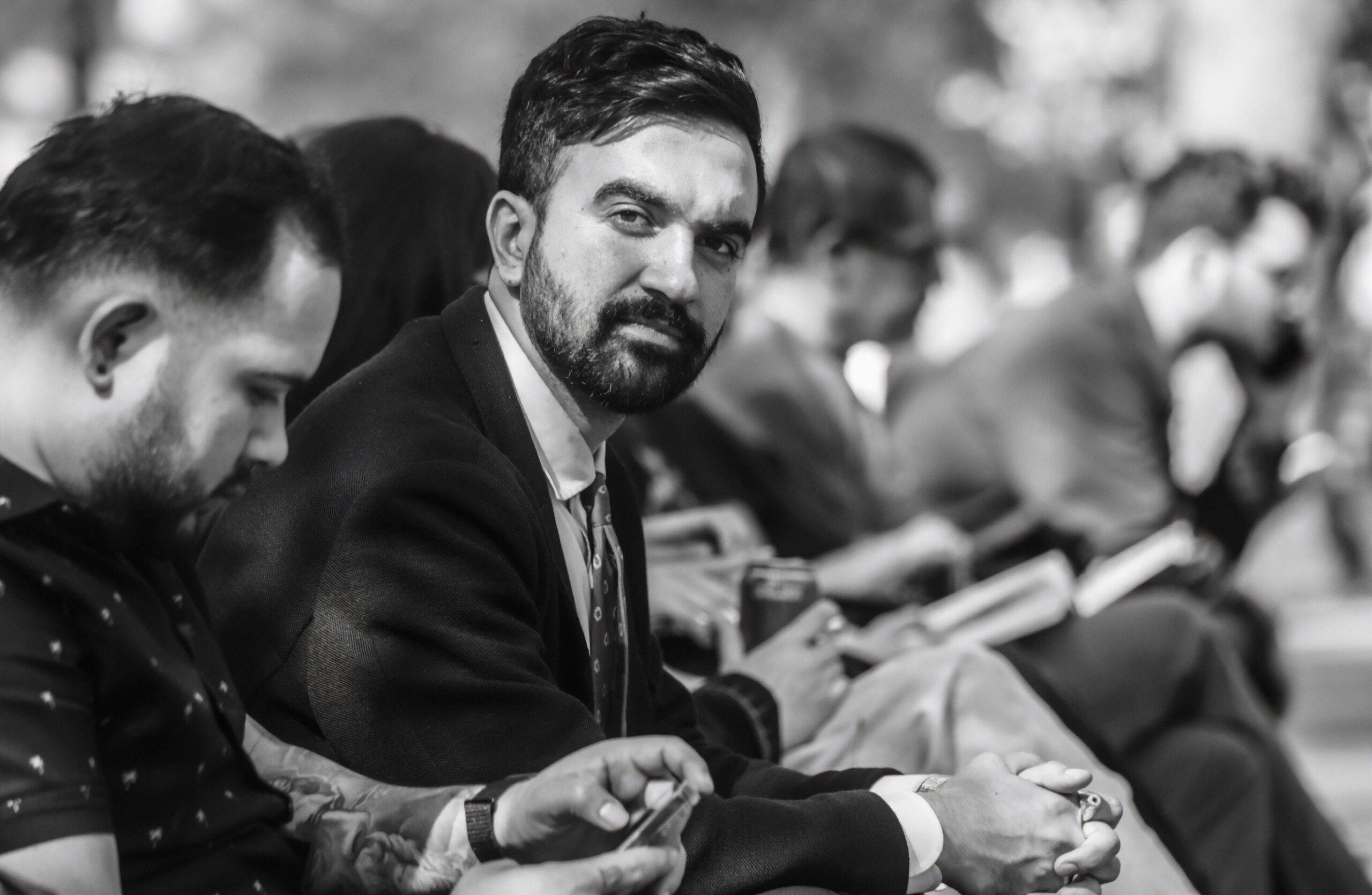
“Zohran Mamdani says he wants to keep Jewish New Yorkers safe, but he refuses to acknowledge that ‘globalize the intifada’ is not a call for justice. It’s a call for violence. It’s incitement.”
—Ted Deutch, CEO of the American Jewish Committee, echoing the concerns that many other American Jews have had about rhetoric New York City mayoral candidate Zohran Mamdani has refused to condemn
The old saying that “all politics is local” presents the idea that even national politics is really based on local conditions and issues. But over the last few months we’ve seen a reversal of that notion in New York City, where the candidacy of Democratic nominee Zohran Mamdani for mayor has raised questions about both the future of the national Democratic Party and the safety of Jews across the United States.
The latter concern prompted over 1,000 Jewish leaders of various denominations as well as a wide swath of political affiliations—including many well to the left—to sign an open letter published last week that denounced Mamdani’s anti-Zionism and also characterized it as something that threatens all Jews, not just those who support the state of Israel. In other words, what those signatories—and many others who have weighed in on the race—believe is that Mamdani’s rise is not just a local issue but an issue for the entire country.
At the same time, there has been a concerted effort among some Jews—mostly those hostile to Israel but including some who say they are not—to cast Mamdani as not anti-Semitic nor a danger to Jews. They claim that he will be a good foil to the Republican Trump and should therefore be supported, pouring scorn upon on the idea that he is problematic for Jews.
A History of Hatred
One of the rhetorical weapons Jew-haters have used consistently for decades but even more frequently since the October 7 attacks is to say that opposition to Israel or Zionism (by which they mean Israel existing as a safe haven for Jews) isn’t the same as anti-Semitism. Mamdani’s candidacy, in which he has been explicitly opposed to Israel in its current form and calls himself anti-Zionist, has been a proving ground for this kind of argument.
His anti-Israel stance clearly originated with his parents, Professor Mahmood Mamdani and filmmaker Mira Nair. Indian Muslims whose family lived in Uganda (where Zohran was born), they have protested and taken public stands against Israel for years, including calling for arms embargoes and boycotts. Many prominent Palestinian academics were also close friends of the family, including Edward Said and Rashid Khalidi.
Mamdani has said that he owes everything to his parents: “These are people to whom I owe everything—not simply the person that I am, but the thoughts I have.” His parents clearly have negative beliefs about the US as well; his father recently claimed on stage that Hitler learned how to commit genocide from Abraham Lincoln’s treatment of Native Americans.
The young Mamdani took anti-Israel activism seriously. In Bowdoin College, where he was an undergraduate, he started the school’s local chapter of Students for Justice in Palestine, a group that has staged sometimes violent anti-Semitic demonstrations and other actions all over the United States. During his time leading the group, he refused to continue talks with the school’s chapter of J Street, considering any dealings with Jews who support Israel as “normalization.” As if clarifying that his academic life revolved in part around anti-Israel activism, photos of his college laptop show an “End Israeli Apartheid” sticker adorning its cover.
Mamdani would eventually reveal that he was fine with the Hamas version of Palestinian activism when he included lyrics in a rap about the Holy Land Five, defendants in a case about the Holy Land Foundation, which had funneled money to the terrorist organization.
After college Mamdani moved on to politics, joining the Democratic Socialists of America, a far-left group that is often as communist as it is socialist and whose members frequently threaten to “tear down the empire from inside.” The group’s platform is explicitly anti-Israel as well. For Jews, one of the clearest views of what the DSA is really like was when its New York chapter celebrated the Hamas attacks on October 7. That prompted even some prominent DSA members, such as Representative Alexandria Ocasio-Cortez, to distance themselves from the group or even leave it.
To read more, subscribe to Ami