



In 70 CE, Titus entered the Second Beis Hamikdash. His sword pierced the Paroches and, in a heart-wrenching miracle, caused blood to spurt from the cloth. His legions captured tens of thousands of kedoshim along with the holy keilim and took them into galus. The golden Menorah was held high in a triumphant procession through the streets of Rome.
Emperor Vespasian and his son, Titus, erected the Temple of Peace to house the spoils of their many wars. The Menorah, a silent symbol of our defeat, was displayed there for about 100 years. When the Temple of Peace burned down, the trail of the Menorah went cold… But the possibility that it might be hidden somewhere in Rome remains in the minds and hearts of our nation.
As another Tishah B’Av draws near, like an ember of hope from the ashes, the age-old question arises: Where? Where is our golden Menorah?
* * *
Rabbi Yoel Gold is a world-renowned storyteller and filmmaker. He says, “My wife encouraged me to start making videos and for years she urged me to focus on Jewish history. Last year, right after Tishah B’Av, I got a call from someone I’d never met…and that was the beginning of what would be the biggest story I’ve ever filmed, and the most important.
“The caller, who lives in Deal, NJ, told me about Rabbi Rafael B., who lives in Eretz Yisrael. He had an audience with Pope John Paul II in the early 1980s and had seen the keilim of the Beis Hamikdash in the Vatican.
Rabbi Gold admits, “At first, I was skeptical. Why had no one heard about this for so many years? But as I heard more details, my interest grew. It’s my practice to go to the original source when I bring a story to life, so I contacted the rabbi and arranged to visit him in Eretz Yisrael. We met, and he shared his experience with me. His testimony, in his own words, is in my film, Hidden Light, which will be ready for viewing on Tishah B’Av, iy”H.
“Rabbi B. was given a ksav rabbanus by Rav Ovadia Yosef in 1979 and sent to Bologna, Italy, to serve as rabbi of the community. He met Pope John Paul II and was granted permission to go beneath the Vatican and see the keilim. He describes being led through a bronze door and down dark curved stairways to five levels beneath the ground, where he was shown a room with a wall of glass nearly three feet thick, lit by spotlights. There, what he saw made him feel like his neshamah was leaving his body. Suspended from the wall and the ceiling were the forks, fire pans and shovels that were used on the Mizbei’ach Hachitzon, some of the begadim of the kohen gadol, including the efod and choshen with 12 colorful stones, the Mizbei’ach Hazahav, and the Menorah—with diagonal branches, which is different from the Menorah depicted on the arch of Titus.
“For 40 years, Rabbi B. guarded his secret because he’d been cautioned by the Vatican not to publicize what he’d seen. After October 7, he was haunted by the situation of the hostages held captive in the tunnel, unreachable. He chose to raise the hopes of am Yisrael by letting them know about the parallel: the captivity of the keilim beneath the ground that were finally discovered and ready to be redeemed.”
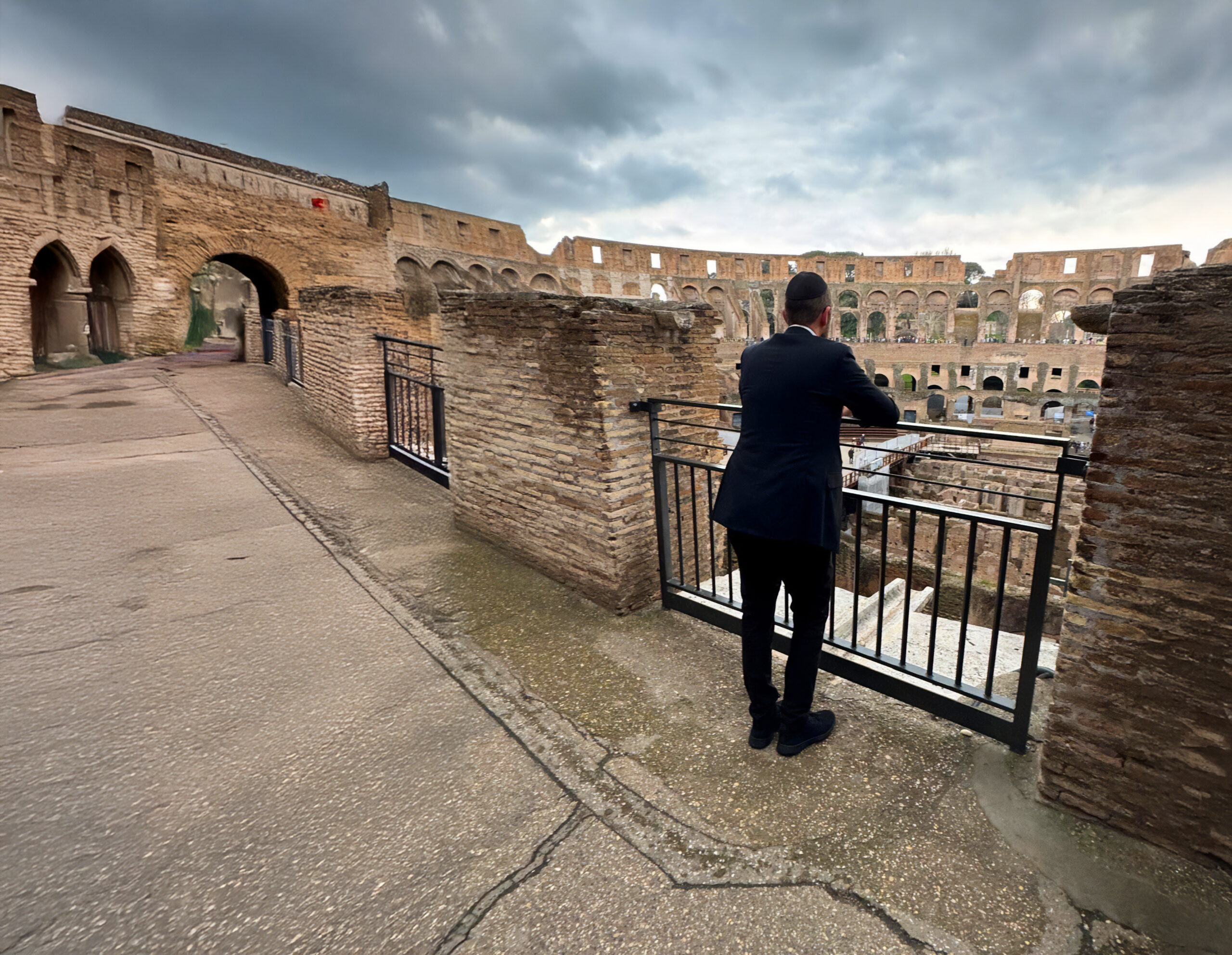
Rabbi Gold was determined to find out more. “Did I expect to get to Rome and see the Menorah? No. I was realistic. My intention was to uncover as much as possible by visiting sites and interviewing politicians, historians and diplomats—people ‘in the know’ who could shed some light on the mystery.”
He began his research by studying two other testimonies of people who claimed they’d seen the keilim in the Vatican with their own eyes: Rav Yitzchak Chai Bokovzah in 1930 and Oscar Goldman in 1962. “I can’t say for sure where the keilim are,” Rabbi Gold clarifies. “I can only present what I heard and leave the viewers to draw their own conclusions.”
The sefer Beis Halachmi was written by Rav Yitzchak Chai Bokovzah, zt”l, chief rabbi of Tripoli, and published after his passing. In the sefer, his grandson references the following story: The king of Italy, Vittorio Emanuele III, visited Rav Bokovzah’s shul and was highly impressed by the rabbi. In 1930, the king invited Rav Bokovzah to the wedding of the crown prince in Rome and, before the rabbi returned home, the king insisted on giving him a gift. Rav Bokovzah asked to see the keilim of the Beis Hamikdash in the Vatican. The king asked Pope Pius XI, who granted permission.
On January 11, 1930, Rav Bokovzah was taken down four stories beneath St. Peter’s Basilica in the Vatican compound. He was led through a labyrinth of tunnels to a dusty chamber. The representative of the church who accompanied him moved a curtain aside and, for a moment, Rav Bokovzah glimpsed the keilim. He said, “I saw enough” and turned away. Those were his last words. What Rav Bokovzah saw in that chamber is not known.
To read more, subscribe to Ami