



Not far from the Gaza border, opposite Kibbutz Kfar Aza, between the cities of Sderot and Netivot, sits Moshav Yachini. A quiet, pastoral village, its entrance is lined with trees, welcoming visitors with the fragrance of citrus blossoms. According to the weathered sign at the gate, the moshav was founded by a frum settlement movement in 1950, and neither the sign nor the modest homes beyond it have changed much since. Looking at this tranquil scene today, it is hard to believe that this community lived through the horrors of October 7 only three years ago.
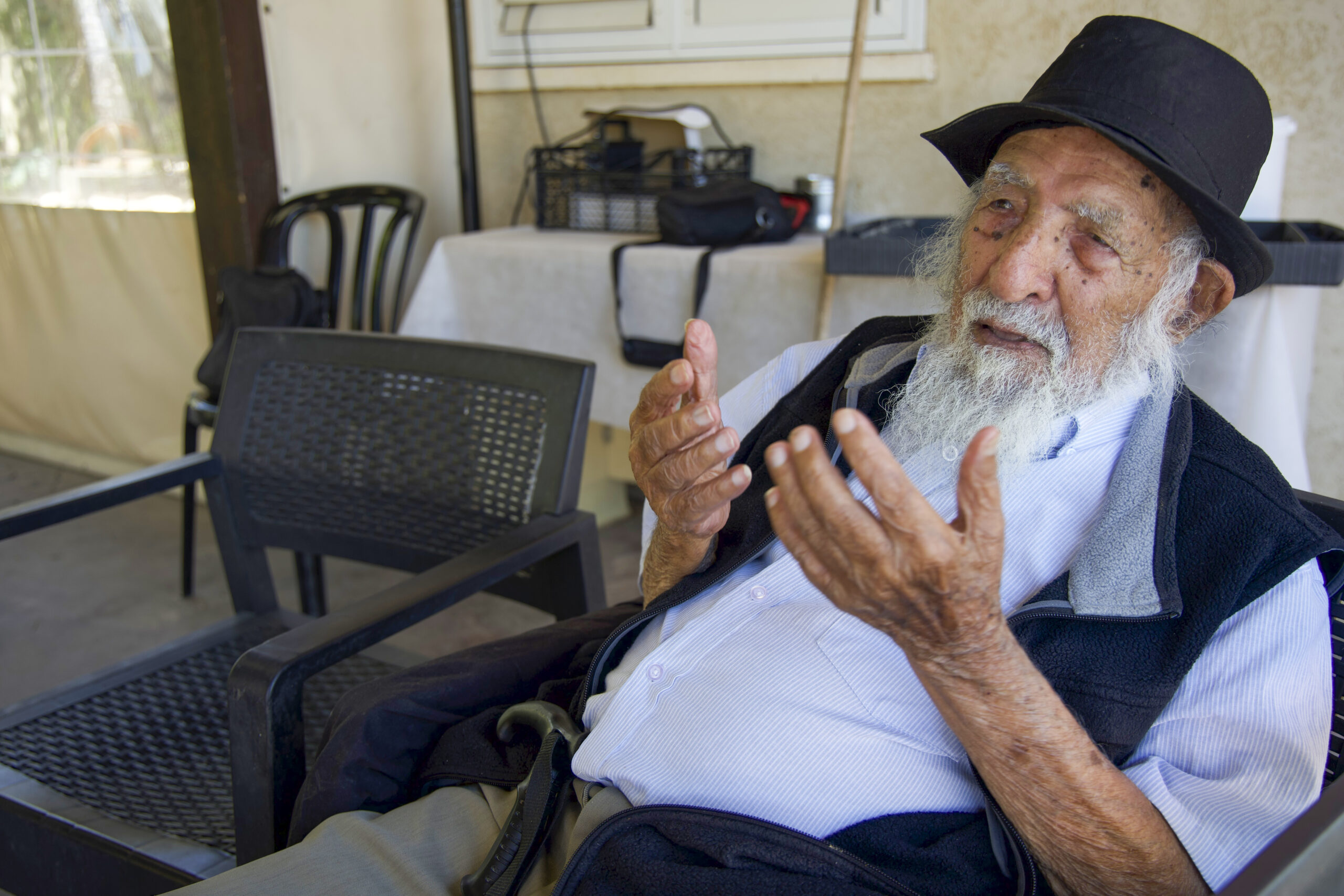
Entering the moshav, the first structure I see is a small home surrounded by trees, with a large cowshed behind it. Sitting in the yard is the homeowner, reciting pesukim from this week’s parshah b’al peh. This is Mori Salman Shlomo Hagbi, apparently the oldest person in Israel and likely one of the oldest people in the world. Born during the First World War, he is well over 100 years old.
“I’m not sure if I’m 107 or 108,” he says. “But Hashem is great. He knows. The calculation is with Him.”
Despite his advanced age, Salman’s vigor has not faded, nor has his intellect. He welcomes us warmly, his speech flowing with words of Torah and praise in the original, ancient Yemenite dialect. Salman has witnessed nearly every chapter in the history of the State of Israel. He lived through the War of Independence, the Sinai Campaign, the Six-Day War, the Yom Kippur War, and the wars that followed, up to the most recent one. He watched Sderot grow, the Negev transform, Israel evolve from a young state into the country it is today—and his own village flourish. Yachini, in fact, is full of members of the extended Hagbi family; nearly all of them are residents who came from Yemen, the majority from the same cluster of villages north of Yemen’s capital, Sana’a.
“The Hagbi family,” Salman explains, “originates from the town of Hajjbah in Yemen, most of whose residents were Jews. I was born in the town of Bilad Anis, south of Sana’a. Many Jewish communities lived in that region.
“My father was a great mori, and it was he who taught me Torah. But he worked as a merchant of jugs and pottery; he sold beautiful things. In fact, every Jew had his own trade: one was a tailor, another a shoemaker, a third a silversmith. Like my father, I too was a pottery merchant. I would set out on Sunday and return home on Friday. Everyone there was a trader, traveling through the cities of Yemen on donkeys and camels.
“My father was a great talmid chacham who studied constantly, but you should know that in Yemen, we made sure that even the rabbanim worked, because that is the ruling of our great teacher, the Rambam. So even though my father was a talmid chacham, he worked. That is how we were taught, and I believe that that is how one should live.
“Growing up in Yemen, I also devoted much time to Torah study, and I became acquainted with the great rabbanim of Yemen. They were truly great. They knew everything, the entire Torah, by heart. My father was the same; he taught me the whole Torah from memory. It is very important to learn by heart, because that way, when you set out on the road, you can review words of Torah as you go. My father knew the entire Rambam by heart. Every book of the Chumash by heart. Everything.
“As a child I only studied Torah, but later, I went to work. I married while still in Yemen. I would often travel to Sana’a and the nearby villages, selling all sorts of goods, mainly pottery. That was our livelihood.”
Yemenite Jewry is divided into two main streams: the Baladi and the Shami. The distinction refers to the two principal nuscha’os hatefillah and halachic traditions of Yemen’s Jews. Baladi—local in Arabic—refers to those who preserve the ancient, original nusach of Yemenite Jewry, based on the rulings of the Rambam. Shami, by contrast, is a later nusach that took shape in Yemen from the 18th century onward, under the influence of Sephardic siddurim that arrived from the region of Bilad a-Sham—Syria and Israel.
Hagbi proudly declares that he is Baladi and not Shami: “We are all Baladi, of course,” he says. “All of us. Only Baladi—our entire family is Baladi. Our siddur is a Baladi siddur, to this day. That is the core tradition of Yemenite Jewry. The Shamis came later and made changes. We changed nothing. And it is important not to change, because we Yemenites have the purest tradition, passed down directly from the Beit Hamikdash itself. So why should we change it?”
To read more, subscribe to Ami