




When it comes to growing a business, exposure is everything. The more people know about your business or product, the chances are the better you will do.
Since Ami featured gourmet popcorn company Popinsanity in the Lunchbreak column back in December 2018, the brand has become a household name in the US, the UK, Canada and Israel.
While the brand has been growing, the company’s co-founders CEO Aaron Zutler, President Yankey (Jacob) Goldenthal and COO Jonathan (Yitzchak) Joseph realized that their brand’s organic growth via word of mouth was hitting the proverbial “wall” many companies experience when the growth of their current accounts keeps them too busy to explore, and hopefully acquire, new markets and new accounts.
That all changed—or began to—a few months ago when Aaron received an email from a California-based production company that was in pre-production on a series called “The Fixer” about businesses looking to get to the next level. Business guru and entrepreneur Marcus Lemonis (chairman and CEO of Camping World and Good Sam Enterprises, executive chairman and principal executive officer for Beyond, Inc., the parent company of Bed, Bath & Beyond and other national brands) and a nationally renowned business troubleshooter who has built his brand by turning around companies and businesses through his signature mix of business smarts, financial savvy and, when need be, tough love—would be the one giving advice as “the Fixer.” If Lemonis was impressed by the company’s performance and/or potential, he would offer to invest in it in exchange for equity.
What follows are some behind-the-scenes insights culled from my conversation with Aaron Zutler that explain some of the more critical decisions he and his team made. Grab a tub of popcorn and read on!
While the benefits of national exposure and learning from a seasoned, proven professional like Lemonis were obvious, Aaron, Jonathan and Yankey also realized that there were obvious challenges to it as well.
“When they reached out to me,” Aaron explained, “I realized it was a huge opportunity. It was an opportunity to possibly partner with someone we respect, someone we felt could help us grow, and also an opportunity to get significant exposure. But you have to go out there and answer very sensitive questions in a very public setting. You’re opening up information you wouldn’t normally share.
“But what about the millions who never heard of us before? What about the hotels and corporations that now want to do business? We can’t be small-minded. So we were weighing the potential negative exposure—the so-called nudniks who act like your accountants, trying to figure out what we make, what we own—versus the opportunity to expose ourselves to new business, new industries, new possibilities. Are you going to give all that up because of a small group of people?
“We had to make a decision.”
The first decision they made was to get daas Torah.
“We discussed it with my rebbe, Rav Nachman Brodie of Beit Vegan, who is our rav. To give you a sense of how involved Rav Brodie is, when we first started the business, I called him in Eretz Yisrael and told him, ‘I have a problem. We’re growing fast. More and more orders are coming in. But I don’t have the money to buy ingredients. I’m borrowing from Chaim to pay Moshe, juggling credit card bills…’ That’s how we started. From the bootstraps. My rebbe said, ‘I’m coming to America. I want to see what’s going on.’ It was amazing. He doesn’t come to the US very often, and when he does come, it’s just for learning and a few visits. This time, he came to our office in Monsey, asked about every machine, the difference between wholesale and retail. He asked so many questions, I was amazed. And he got it. He said, ‘You have a gold mine, if you run it right.’
“I told him what we needed. It wasn’t just money; we needed more bandwidth. I was doing the sales, collections, deliveries, design, everything. Yankey was doing the same. We couldn’t keep up. So Rav Brodie said, ‘Let me think about it.’ The next morning, Yitzchak (Jonathan) Joseph walked into my office. I’d gone to yeshivah with him 35 years ago. He said, ‘The Rebbe sent me. How can I help?’ Jonathan was in apparel manufacturing—buying from China, selling to Guatemala, producing in Vietnam, selling in Buenos Aires. Thirty years of experience in manufacturing, forecasting, product design. He was a gift from Hashem. He sat with me for four hours going through everything.
“Going back to this offer from Lemonis: once Rav Brodie had all the facts, he discussed the pros and cons with us, and then he gave us his brachah to go ahead. More than being a business opportunity, it also represented an opportunity to create a kiddush Hashem. In today’s climate, kiddush Hashem is a top priority. That was very important to us, to come off as hardworking frum Jews, and to show that three very different personalities could build something real without fighting or drama.
“During this process, I probably interacted with three dozen members of the production team. Afterward, a member of his team told me that ‘even though they were Jewish, they were unaffiliated, and dealing with us made them proud of their Jewish heritage.’ Between hearing that and hearing Marcus’ own observations about the experience, we knew we had accomplished our goal.”
Readers may remember that Popinsanity’s journey began in Yankey Goldenthal’s basement kitchen in Monsey, where he was trying to make sense of a failed cafe venture and the fact all he had to show for it was the brand new popcorn machine he’d been planning to use there. Being a world-class foodie and a talented tinkerer, Yankey began putting both those talents to good use in terms of teaching himself the art and science behind crafting authentically gourmet popcorn.
Yankey’s tinkering became the catalyst for the brand.
In the beginning, the growth the brand enjoyed was organic—as in word of mouth that was the result of their unique flavor combinations and the fact everything was handcrafted and produced in small batches, and the team’s high commitment to quality. Popinsanity prided itself on using high-quality, non-GMO corn, premium ingredients and flavors, and on the fact all its products were certified kosher/parve and dairy-free.
While they were united in their goal to produce the best premium popcorn money can buy, Aaron and Yankey each took on the responsibilities that played to their strengths. Aaron focused on operations, sales and marketing, while Yankey focused on sourcing ingredients, flavor creation and production
Before gaining national attention in 2018 after their “Sweet & Salty,” “Chocolate Drizzle,” and “Cookies and Cream” flavors were featured on “Oprah’s Favorite Things/2018,” their growth was primarily due to the leveraging of their network within the frum community, as well as catering events and developing a presence in kosher supermarkets.
FROM “FAVORITE THINGS” TO “THE FIXER”
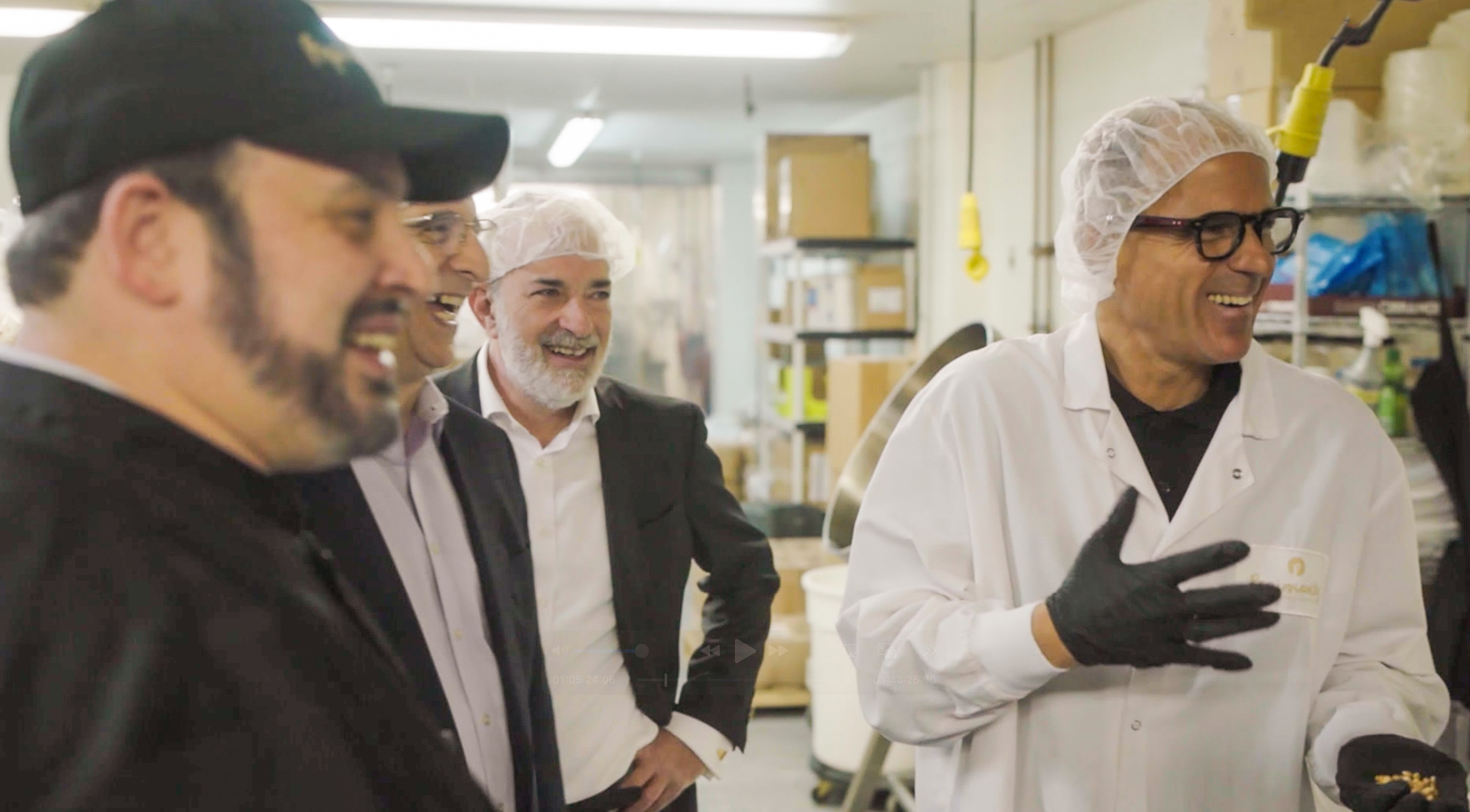
By the time Marcus Lemonis visited the Popinsanity plant, it had, baruch Hashem, grown significantly. They were operating out of a state of the art, 11,000 sq. ft. facility with over 20 employees.
What was his first move?
“Analyzing our numbers,” Aaron says. “We were generating nearly $4 million in annual revenue—enough of a bottom line to impress even Marcus Lemonis.
“Despite our impressive growth, though, we faced challenges, such as an industry-wide flattening of sales, increasing costs, operational inefficiencies and defining what would come next in terms of our strategic direction.
“All of which made us a good fit for Lemonis’ program.
“Lemonis’ approach to business is based on the Three P’s: People, Process and Product. He focuses on all three of these simultaneously and with unerring accuracy.
“In our case, we impressed Marcus with all three. From the moment he saw our displays, booth and packaging, he lauded their visual appeal and how well we presented our brand.
“After tasting our popcorn, his reaction was that it’s delicious. This strong, positive initial reaction confirmed that in terms of the all-important product, our brand was already operating at a truly premium level.”
Lemonis’ goal in visiting the Popinsanity factory in Lincoln Park was to learn about operations and the dynamic between the three founders, as both are crucial elements in a business’ success.
As a result of that visit, he returned to the three co-founders with numerous priorities that he felt they should immediately address:
1. Three partners was fine, but they needed to agree on one leader;
2. Given the scope of his responsibilities, Yankey should have a dedicated creative space/test-kitchen;
3. Key employees needed to be incentivized and not just recognized;
4. Time management must improve: case in point, the downtime that resulted from cleaning procedures cost them over $200,000 a year;
5. That operations and production were not in the same location was a negative;
6. Underperforming flavors and off-brand extensions like freeze-dried candy should be eliminated.
In Lemonis’ eyes, the underlying factor responsible for most of these issues was the fact there was a lack of clear decision-making authority among the three partners.
“The likelihood of success is typically greater when somebody has to make the ultimate call,” Lemonis pointed out. “It isn’t just about the decision, it’s about the strategy.” Lemonis also felt strongly that the leader the partners chose would have to be vocal about his opinion.
Another critical issue he brought up was the fact that Aaron and Jonathan were handling the bulk of the brand’s sales, marketing and operational responsibilities from Popinsanity’s original Rockland County location. This facility, which was closer to Jonathan’s and Aaron’s homes, was also used for the production of their recently discontinued freeze-dried candy line—a product Marcus found “disgusting” and more importantly, “very off-brand.”
THE SYNERGY
“Lemonis impressed upon us the value of leadership and staff being side by side and working together as a team. When this isn’t the case, people tend to ‘just try to sort of figure it out on their own,’ he explained. ‘It’s that camaraderie that you have an obligation to provide to your people.’
“Regardless, Marcus was impressed to discover that despite our shared vision for the brand, whenever we found ourselves at an impasse regarding critical business decisions, our ‘move’ is to give Rav Brodie the final say. For him to see business owners run all their major business questions by a rabbi clearly intrigued and impressed him.
“We all met over a bagel lunch—Marcus Lemonis, Rav Brodie and the three partners. We discussed the company’s leadership structure. ‘I see Jonathan as the engine,’ Lemonis told us, ‘I see Aaron as more of a people person…I see Yankey as the roots of the tree. When you take those three, it works. But somebody still has to be the ultimate leader in a business.’ Rav Brodie agreed: ‘In every business, there has to be one soloist.’ The rav encouraged us to choose our leader, and if we couldn’t, he offered to do the choosing for us.”
Under Lemonis’ guidance, Popinsanity underwent swift changes. Aaron was designated the definitive boss, and the unprofitable second location was shut down.
On his next visit a week or so later, Lemonis recommended moving desks into the conference room as a signal to the rest of the team that “progress is happening.”
Now that he was seeing progress on the people and process fronts, Lemonis was ready to address product.
His first move was to optimize their product line. He observed that seven core flavors accounted for 80% of Popinsanity’s revenue. He suggested they double down on their winners and innovate based on those.
This led to an exciting opportunity: A potential major account with Nut Factory, a large retailer interested in carrying Popinsanity’s products in all 40 of their locations. This represented a potential annual revenue of about $1 million.
In keeping with his business strategy in employee recognition, Lemonis identified Joe (Chai-Goldberg), the company’s operations manager, as the linchpin of day-to-day operations, as he was involved in everything from managing manufacturing to bagging, shipping, inventory and staff.
Lemonis proposed making Joe an equity stakeholder with a vesting schedule to secure his commitment to the company. His advice to entrepreneurs is clear: incentivize key talent with more than just a salary, and empower the entire “people” infrastructure, rather than allowing any single person to become indispensable.
One of Lemonis’ most critical pieces of advice revolved around what he considered financial management. He stressed the absolute necessity of a more robust financial system, specifically a “super duper version” of QuickBooks for inventory management, tracking receivables and understanding daily sales. Using a comprehensive tool like QuickBooks, he said, “takes the guesswork out of decisions” and provides the data that allows businesses to thrive.
While on the subject of technology that would improve operations and processes, Lemonis also suggested implementing Salesforce over their current blast email approach to create more targeted and effective communication with online buyers.
Over a formal meeting, he finally made his investment offer: $500,000 for 10% of the company, which meant he was valuing the business at $5 million, while their personal valuations were substantially higher.
Lemonis felt that the company’s financials presented a different reality. He argued that while the business had potential, its current state warranted his more conservative valuation. “I don’t want to pay for what’s going to be in the future when what exists today is this,” Lemonis said. “Money is money until money becomes control. I have no interest in becoming a significant holder of the business.”
At this point, Aaron reiterated that what they were really looking for was a strategic investor; they were not merely seeking capital, they were looking for someone to be both a source and a resource.
“That’s not how we understood Marcus’ offer; he said, ‘What do you mean? I helped you with more than just my money. I spent so much time with you; I gave you advice—that’s very valuable.’ At the time, we understood his offer as being only financial.
“This was a major turning point in the direction of the negotiations. Our refusal to see an investor as just a source of capital was not anticipated. Both Marcus and the Popinsanity team felt, to say the least, let down.”
While the deal didn’t close, both Lemonis and Popinsanity came out achieving significant victories: For Lemonis, the experience aligned with his broader mission and personal brand, which is all about helping businesses thrive and improving the lives of the people who make them run. Joe, the critical operations manager, reaffirmed his compensation and equity. And since this segment went public, Popinsanity’s sales, site traffic and new inquiries into growth trajectories saw a significant, well, pop.
The deal-that-wasn’t serves as a powerful reminder for any entrepreneur: a great product is just the beginning. True success hinges on decisive leadership, efficiency, valuing your team, fostering innovation, and, perhaps most importantly, having a clear, data-driven understanding of your business’s financial pulse. As Lemonis said, “If you don’t know your numbers, you don’t know your business.”
“That said,” Aaron points out, “the 42 minutes that were shown are a sliver of the many weeks and dozens of hours of filming, as well as the lengthy exchanges, interactions and moments that simply can’t be conveyed in a manner that would connect with today’s attention spans.” There are no cookie-cutter business models. Every entity has its own dynamics at play and personalities running it.
“There is no doubt that we gained financially from our participation,” Aaron says. “When it aired, our online sales increased by over 200%. Additionally, we have been getting requests from retailers and wholesalers across the country, plus we’ve also been receiving calls from potential investors.
“However, we did share many details most companies prefer to keep under wraps. Both in terms of our finances as well as the day-to-day difficulties of running a company. Was it an easy decision? No. Ultimately, we were happy with the outcome, as we got the privilege of meeting and learning from Marcus Lemonis —he’s really a great guy—and because it reminded us everything is courtesy of the One Above, so it’s all good…always.”
We wrapped up the conversation with a few more questions for Aaron:
I’m sure many people are surprised to see that you brought your rav into the business.
The way it happened was wild. Marcus found it fascinating that we kept referencing our rebbe when making decisions. He said, “Aaron, in my world, I speak to my lawyer, my accountant and my advisers. I’ve never heard of involving a rabbi like this.” He was very fascinated by that. He said he’d love to meet Rav Brodie, and that’s how it happened.
Did Rav Brodie come specially from Israel for that?
No, he was already here for a wedding. He was supposed to leave the morning after the episode aired.
Do you consult with your rav on every business decision?
We don’t go to him for every detail. We usually hash things out among ourselves. If I have an idea and my partners aren’t feeling it, we weigh it. Sometimes they say, “Let’s try it. If it works, great. If not, we’ll pull the plug.” But for major things—new locations, big opportunities, significant changes—yes, we go to Rav Brodie.
All three of you are equal partners?
Yes.
Have you taken on investors who diluted your ownership?
No. That didn’t come easy. We had opportunities. Especially after being featured on Oprah’s Favorite Things/2018, people were interested. But when I started, when Popinsanity was written on the back of a napkin and it was just me and Yankey with a dream, no one wanted in. A couple people offered $100,000, but we wouldn’t be allowed to take salaries, and they’d own like 60% or 70% of the company, so we said no. Yankey and I went four years without salaries. And during that time, Hashem, in His sense of humor, gave me a wonderful son-in-law and daughter-in-law—two chasunahs, a bris and a pidyon haben—all while I was sleeping on a mattress in Yankey’s basement in Monsey because I lived in Brooklyn. It was hard. But it created beautiful memories.
Do you think it helps businesses to get involved in a program like this?
If you have no clue what’s in your bank account, no idea about your inventory, and your staff wants to quit, this isn’t for you. But if you’re a hardworking business owner, and you’re organized, motivated and ready to learn, then yes, I’d recommend it. But you have to know what you’re walking into.
Now that you’ve shut down the other location are you happy with that decision? Was it the right move?
Yes. It adds to the commute, but it adds way more to the productivity.
Why did you turn Lemonis down? Was it hard to say no to the money?
As I said earlier, baruch Hashem, people have approached us many times before with different opportunities. This wasn’t the first, and I know it won’t be the last. There’s a lot that goes into decisions like that. And the viewer doesn’t get to see all the details we have to consider when making a deal. Some companies have everything buttoned down; all they need is funding capital. For us, baruch Hashem, there are other important aspects that will take us to the next phase . It wasn’t just about being offered money. And I think we portrayed our sentiment fairly well.
Had he told you, “Look, it’s not just about the money. I want to stay involved. I want to keep helping your business,” you would have said yes. But when you thought he was just offering money, you felt that it didn’t make sense financially, right?
Precisely. There are other very important things we need besides capital. But aside from the overall experience, just getting to work with Marcus and seeing how he operates and thinks was priceless on its own. With all the companies he’s involved with and everything he has going on, when he talks to you, his entire focus is on you.
I’m assuming that you’ve had people reach out offering better terms and higher valuations since then. Even if you didn’t take those deals, it’s natural that people would come knocking.
Yes, we’ve baruch Hashem been seeing more activity on that front. At the end of the day, we’re growing the business. We just moved into a bigger facility with more employees and higher expenses. We need to grow. Between Marcus’ expertise and the exposure, we felt it was the right move.
What percentage of your customers are from the frum world?
Most of our business is mainstream America now. The kosher market is extremely important to me; that’s where I got started. It used to be 90% of my customer base. Now it’s much less. But we’re always expanding, looking for new kosher markets across the country.
What was the best business advice Marcus gave you?
Every company, even when responsibilities are shared, needs someone to ultimately steer the ship…and if you don’t know your numbers, you don’t know your business! ●
Special thanks to Sam Ash for facilitating this article.
To read more, subscribe to Ami