




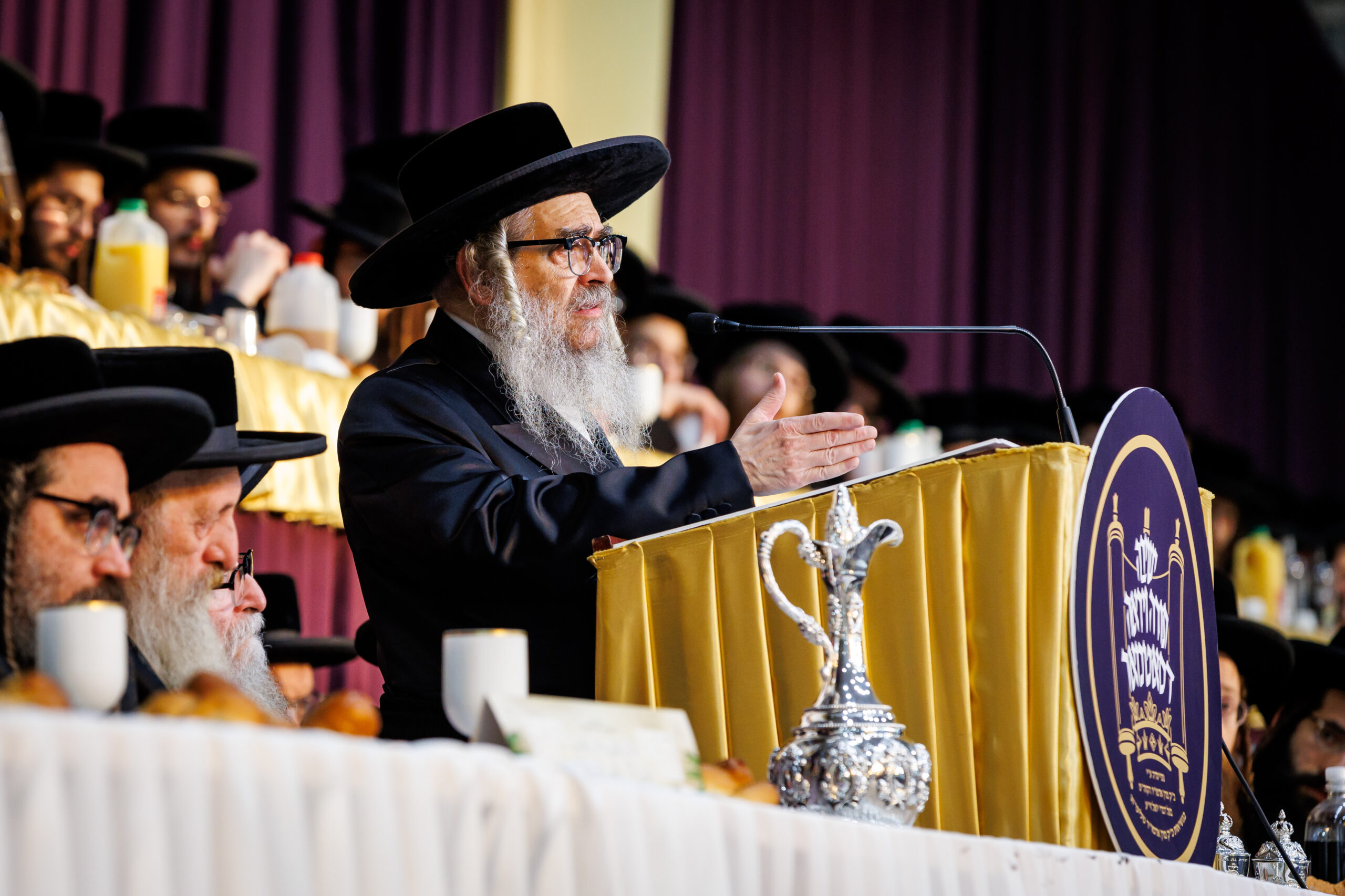
As is the cherished custom of many in the days leading up to Rosh Hashanah, I made the journey to Kiryas Yoel to visit the Satmar Rebbe, shlit”a, and present a kvittel. This annual pilgrimage offers not only the opportunity to receive the Rebbe’s heartfelt brachah for the coming year, but also a chance to seek his daas Torah. I was humbled and deeply privileged to be granted an extended audience despite the ever-growing throngs gathered outside, waiting patiently for a fleeting moment in his presence.
As always, the encounter was deeply moving and filled with insight. The Rebbe received me warmly, with his characteristic presence and attentiveness, and listened carefully as I presented both individual concerns and broader questions impacting the community at large. Our conversation spanned a range of topics—some timeless in nature, others urgent and contemporary—but one theme in particular stood out for its boldness and benevolence: the Rebbe’s recent efforts to address the ongoing housing crisis by spearheading initiatives to make affordable housing a reality for families in Kiryas Yoel and beyond.
This ambitious undertaking is far more than a logistical or economic endeavor; it is a reflection of the Rebbe’s farsighted leadership, his connection to the klal, and his unwavering sense of achrayus for the physical and spiritual well-being of his community. I was eager to hear not only about the technical aspects of this initiative, but also about the hashkafic and halachic underpinnings that guide such a project. For as is well known, the Satmar Rebbe is not only a revered chasidic rebbe but also a distinguished rav and posek whose rulings are respected throughout the world.
I also asked the Rebbe how his approach might serve as a model for other communities—especially those in urban areas—that face similar challenges related to housing affordability, communal planning and the preservation of Torah values in a rapidly changing world.
What follows are selected excerpts from that conversation, insights that were as enlightening as they were inspiring.
It’s a tremendous zechus for me every time I come to the Rebbe. My father told me that when he brought me to the Rebbe, zichrono livrachah, to have my hair cut for the first time, I didn’t want to kiss the Rebbe’s hand. My father kept insisting, but I refused. So the Rebbe told my father, “Leave him alone. The time will come when he’ll know how to kiss a rebbe’s hand.” So when I come to the Rebbe, I feel a ruach hakodesh from the Rebbe, zt”l.
Laughs.
The Rebbe knew my father.
Of course I knew him.
I believe that the Rebbe traveled with my father during the first trip after the Beirach Moshe became rebbe. Their starting point was in my father’s hometown of Kashau.
I didn’t go to Kashau. My father was there, but I wasn’t. There were two groups. My father went through Kashau, but I went a different way. I ended up meeting up with them in Ujhel.
My father’s zeide was a rebbe in Kashau.
Reb Yekev Frankfurter.
Yes. The Shinover Rav had sent him there to become rebbe. After spending one Shabbos in Kashau, he went back to the Shinover Rav and said he couldn’t handle it because it was a treife city. It’s interesting that the Shinover Rav’s son, the Stropkover Rav, ended up living in Kashau and passed away there.
That was much later.
The Stropkover Rebbe is buried near Reb Yekev. After the First World War, there was a big influx of rabbanim, rebbes and rebbishe kinder.
The Radomyszler Rav is buried there. So is the Baitcher Rav. They came later. They escaped to Kashau during the First World War because it wasn’t far from Galicia.
If we can speak about something that’s closer to home: What the Rebbe is doing for the residents of this city needs to be emulated. The problems that exist here aren’t exclusive to Kiryas Yoel.
They exist everywhere.
It’s a makkas medinah and possibly of the entire world. What motivated the Rebbe to do what he has done in Kiryas Yoel?
The prices of the houses were soaring. They were shooting up every three months, and I couldn’t understand why. It wasn’t as if the cost of building materials had risen to that extent. So why did the prices go up? Because that’s what people decided to do, and the customers had to pay those prices because they didn’t have a choice. So I started to learn the sugya. I quietly called in builders and told them I wanted to know how much things really cost, and they didn’t know why I was asking all these questions. One builder told me that a house costs $98 per square foot, another told me $100 and another told me $110.
I learned through this sugya very well—very well—and then I started to make a cheshbon of how much the land costs and how much it costs to build on it. The conclusion was that if someone charges $300 per square foot, he’s making a lot of money. In that case, why are people charging $500? Then it even went up to $600! People weren’t embarrassed to charge $600 per square foot! There was a developer from the city who owned land here, and he was ready to spend a lot of money to buy more. When someone asked him why he was willing to spend so much money, he replied, “I don’t know why people can’t pay $1,000 per square foot like they do in Williamsburg.” That reached my ears. It meant that people are dreaming of houses costing $1,000 per square foot! I had to do something about it. And as I said, I had already figured out that people were making a lot of money at $300 per square foot. Why ask for $400? Or $500? Or $800? What is this? I had to find some sort of keili to be able to do something.
Then the Eibershter was chonen daas to give me the idea of not allowing them to get permits if they don’t comply. I said to myself, “You’re a shliach tzibbur, which means that you have to work for the good of the tzibbur. The good of the tzibbur is that housing must be affordable.” I encouraged Kiryas Yoel to issue permits only to those who comply.
To read more, subscribe to Ami