



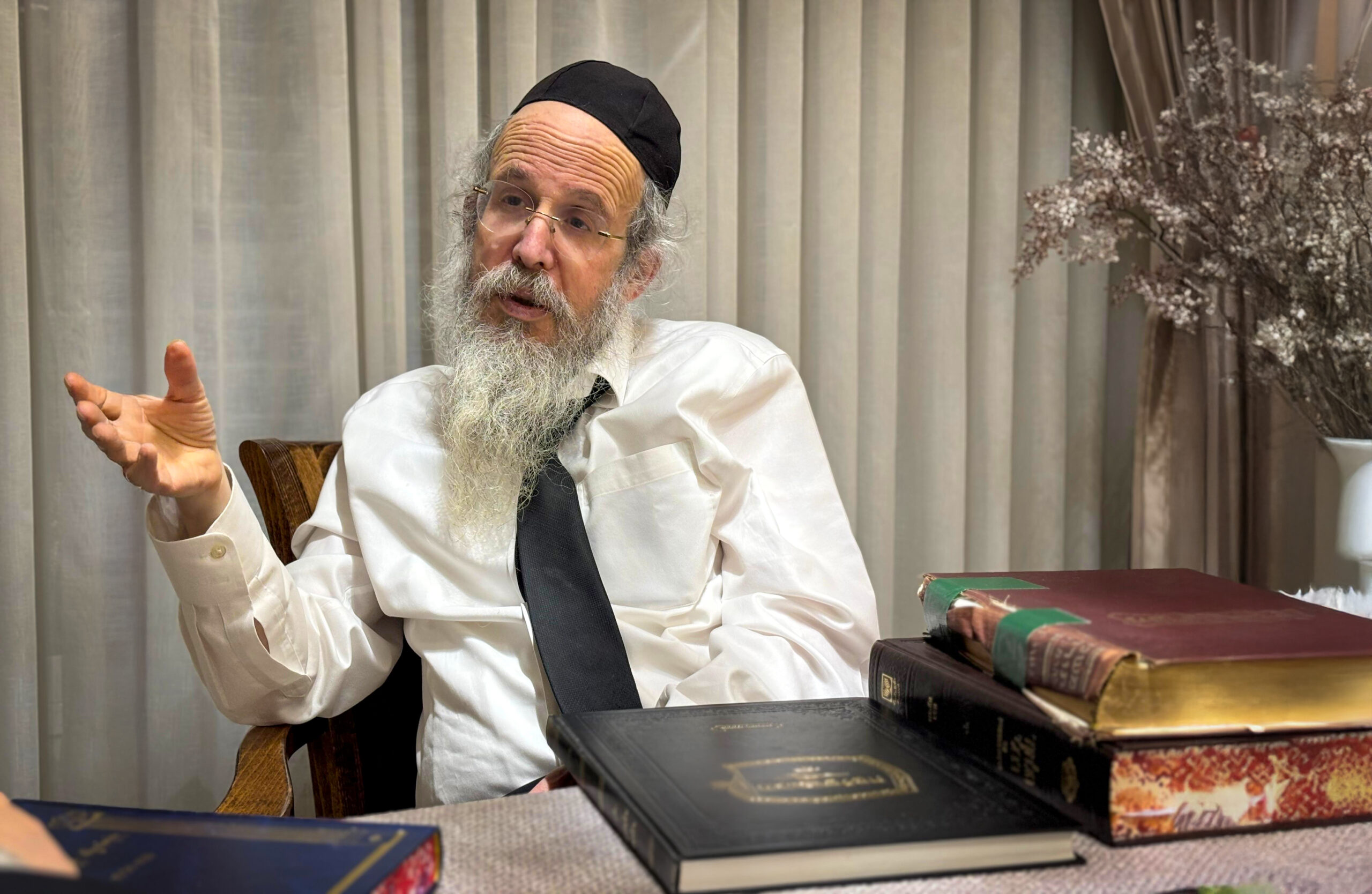
Rav Chaim Peretz Berman, Rosh Yeshivas Ponevezh, remembers his illustrious father, Rav Shlomke Berman, zt”l
It is an unusually chilly and windy night for Bnei Brak as I ascend an outdoor staircase to a third-floor apartment. As I get to the entrance, I hear animated voices inside, the sounds of rischa d’Oraisa penetrating through the thick door. I am standing outside the apartment of Rav Chaim Peretz Berman, Rosh Yeshivas Ponevezh. Rav Chaim Peretz lives directly above the apartment of his father-in-law, Rav Berel Povarsky, the senior Ponevezher rosh yeshivah.
It has been 20 years since the passing of Rav Chaim Peretz’s father, Rav Mordechai Shlomo Berman. More widely known as Reb Shlomke, he was the son-in-law of the Steipler and one of the roshei yeshivah of Ponevezh. A towering talmid chacham, lamdan, and extraordinary iluy, he stood out from the moment he entered Ponevezh at age 14. His brilliance caught the eye of Rav Shach, Rav Shmuel Rozovsky, Rav Dovid Povarsky, and even the Chazon Ish. When he was only 15 years old, the Chazon Ish remarked that while it was rare to call someone so young a gaon, in Rav Shlomke’s case, the title was fitting. The Chazon Ish ultimately arranged his marriage to his niece, the daughter of Rav Yaakov Yisrael Kanievsky, the Steipler Gaon.
Rav Shlomke was just 49 years old when he was diagnosed with a progressive disease. Just six years later, he had to cease giving shiur in the yeshivah. Rav Shlomke battled his debilitating illness for 25 years until his passing in 2004 at the relatively young age of 74.
When I called Rav Chaim Peretz to request an appointment, he told me he was only available on Friday. When I mentioned that I was returning to the United States on Thursday night, he replied that he wasn’t available at all on Thursday but told me to come Wednesday—at the conclusion of his last shiur.
“What time does the shiur finish?” I asked.
“I finish around one a.m., but I need a few minutes afterward. Please come at ten after one.”
I was stunned by the kindness the Rosh Yeshivah extended to a complete stranger.
Naturally, as someone who always gets to an airport four hours before a flight, I also arrived early at this appointment. I found myself outside his door, straining to catch snippets of the shiur. Though I heard the agitation in the bachurim’s voices, I couldn’t make out enough words to grasp the topic.
A few minutes past one, the door opened, and the bachurim began streaming out—none looking surprised that the Rosh Yeshivah had a visitor at such an hour. About 20 students left, the last two carefully stacking plastic chairs in a small alcove near the door.
Just moments after the last of the bachurim left, I knocked gently. The door opened immediately, and Rav Chaim Peretz himself stood before me.
“Kumt arain,” he warmly offered, ushering me inside.
His home is sparsely but tastefully decorated. A plain tablecloth covered the dining table, which was strewn with papers and sefarim—remnants of the vast amount of Torah being learned and taught within these walls today.
After some small talk, I told the Rosh Yeshivah that I had come to hear memories of his father, whose 20th yahrtzeit had just passed. Rav Chaim Peretz smiled warmly, his eyes distant, sifting through recollections. Then, suddenly, he rose from his chair and walked over to the sefarim shrank, retrieving a sefer.
Rav Shlomke’s sefarim are titled Asher Li’Shlomo, and the Rosh Yeshivah brings one to the table. “In the hakdamah to this sefer, they printed part of a letter the Chazon Ish wrote about him when he was still a bachur. My father, who was an anav, had kept it hidden away, never showing it to anyone. But after he passed away, he couldn’t keep it hidden anymore,” he said with a wry smile. “It was found in one of his drawers.”
He read aloud from the Hebrew letter:
“Elevated above tens of thousands and distinguished by his wondrous depth of wisdom in Shas, when he opens his mouth, grace flows from him and draws bonds of affection from everyone around him. He has already become known as an ish mofeis, an extraordinary person. In addition to his Talmudic brilliance, he is wise in all his ways, always with a gentle smile on his lips, greeting everyone with a pleasant demeanor. Among all those known to us, there is no one who can compare to him.”
I was stunned. Such effusive praise from the Chazon Ish—who was not known to hand out lavish compliments—and Rav Shlomke could not have been much older than 20. The Chazon Ish passed away in 1954, and Rav Shlomke was born in 1930.
“My father was around 20 then,” Rav Chaim Peretz confirmed. “His shaychus with the Chazon Ish began soon after he entered Ponevezh. The Chazon Ish asked him to come sleep at his house. My father was just 14. At that point, the Chazon Ish was already the Chazon Ish—and my father was afraid. He was just a yunger bachur.”
The Rosh Yeshivah paused before continuing.
“He didn’t agree right away—he didn’t know what to answer. The Chazon Ish told him, ‘Try it for one day.’ So my father agreed. He went that night to the Chazon Ish’s home—where today stands Yeshivas Beis Matisyahu. Back then, it was just a sandy hill, before Bnei Brak was developed.
“Perhaps one would expect that the Chazon Ish, wanting to encourage him to return, would have offered him something to eat. My father was very poor and didn’t have much. But instead, the Chazon Ish looked at him and said, ‘Zug a gutteh kushya, a gutten teirutz—tell me a good question, a good answer. Zug!’
“My father was frightened and remained silent. The Chazon Ish pressed again—Zug eppes, Say something!’ But still, my father said nothing. The Chazon Ish insisted: ‘You’re not going to sleep until you say something!’ My father began to cry—but the Chazon Ish wasn’t fazed. ‘Crying won’t help,’ he told him. ‘You can repeat a piece from the Ketzos or a shtikel from the Rashash, but silence won’t help.’
“So my father recited something he remembered from the Ketzos or the Rashash. The Chazon Ish was satisfied. ‘This will be our seder from today forward.’ And that was it. There was no more discussion about whether he would stay overnight or not—from my father’s side or from the Chazon Ish’s. Every night, he slept there. And every night, before he went to sleep, they learned together. And that remained their seder for the six years he lived there.
“Rav Yudel Bauer, a close talmid of the Chazon Ish, told me that among the talmidim, it was known that the Sefer Chazon Ish on Bava Kama was different from the others. The style was not quite the same, the torah in it somewhat different. They believed it was because he wrote it while Ponevezh was learning Bava Kama—and my father spoke with him every day and night about it. His he’aros, kushyos, and insights seemed to have influenced how the Chazon Ish viewed and understood the sugyos.”
I marveled at this—Rav Shlomke’s brilliance was such that his insights shaped the thinking of one of the greatest gedolim of the generation when he was just a young bachur’l.
I mentioned to the Rosh Yeshivah that my father was very close to Rav Yudel, who recently passed away, and I understood that his father had also been very close to him.
“Avade, they were very close. Reb Yudel Bauer learned in Kollel Ponevezh. At midday, he would pass by our house on his way back, surrounded by talmidim. My father had already returned from shiur and would sit on the porch. Rav Yudel would call out to him a chiddush, and they would stand there and discuss it. He would share the questions he had from that day. This happened almost daily. They would always discuss what they had learned that day. My father was also his shadchan.”
Rav Chaim Peretz returned to his father’s time with the Chazon Ish.
“One time, my father came to the Chazon Ish’s home and wasn’t planning to ask anything—he was just going to sleep. The Chazon Ish told him, ‘You can’t go to sleep until you say something.’ My father replied, ‘Today we worked through very difficult sugyos. I put in all my strength and energy for 18 hours, and I simply can’t say anything. Tomorrow morning, immediately, I will. But right now, I just can’t.’ The Chazon Ish looked at him and said, ‘You think Hashem wants those 18 hours, when you have the koach to learn? No. Hashem wants those five minutes after the 18 hours, when you feel you can’t anymore.’ He didn’t give in and pushed my father to his limits. My father mustered his last strength, repeated something he had learned that day, and they spoke in learning.”
I told the Rosh Yeshivah that I once heard that when the Chazon Ish learned with Rav Meir Tzvi Bergman and Rav Chaim Greineman, he did not allow them to go to sleep, stating that they could doze off while learning. But Rav Chaim Peretz said that this was not the case with Rav Shlomke.
“He allowed my father to sleep until the second zman krias Shema. Rav Nissim Karelitz explained that this wasn’t proof that the Chazon Ish held it was l’chatchilah—just that my father’s learning was so precious to him, he felt that he needed his kochos.”
Rav Chaim Peretz shared another story.
“One morning, the Chazon Ish woke my father, but my father didn’t get up. The Chazon Ish tried again, but still—nothing. The Chazon Ish looked around, went into the next room, and brought my father negel vasser. My father had forgotten to prepare it the night before. He didn’t want to get up and walk four amos without washing. If someone else had awakened him, he would have asked him to bring. But he felt he could not ask the Chazon Ish to bring him negel vasser; it was not proper to be matriach the tzaddik—so he simply didn’t get up. But the Chazon Ish understood immediately, prepared the negel vasser, and brought it to him.
To read more, subscribe to Ami