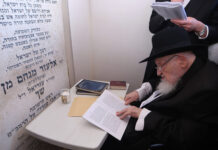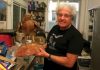




A mashgiach staying in a small apartment inside a factory in a small town in Idaho. A graduate of a Christian college in Memphis who is married to the daughter of a Baptist missionary. A Jew living up a path in the woods in Arkansas.
They’re all learning Daf Yomi.
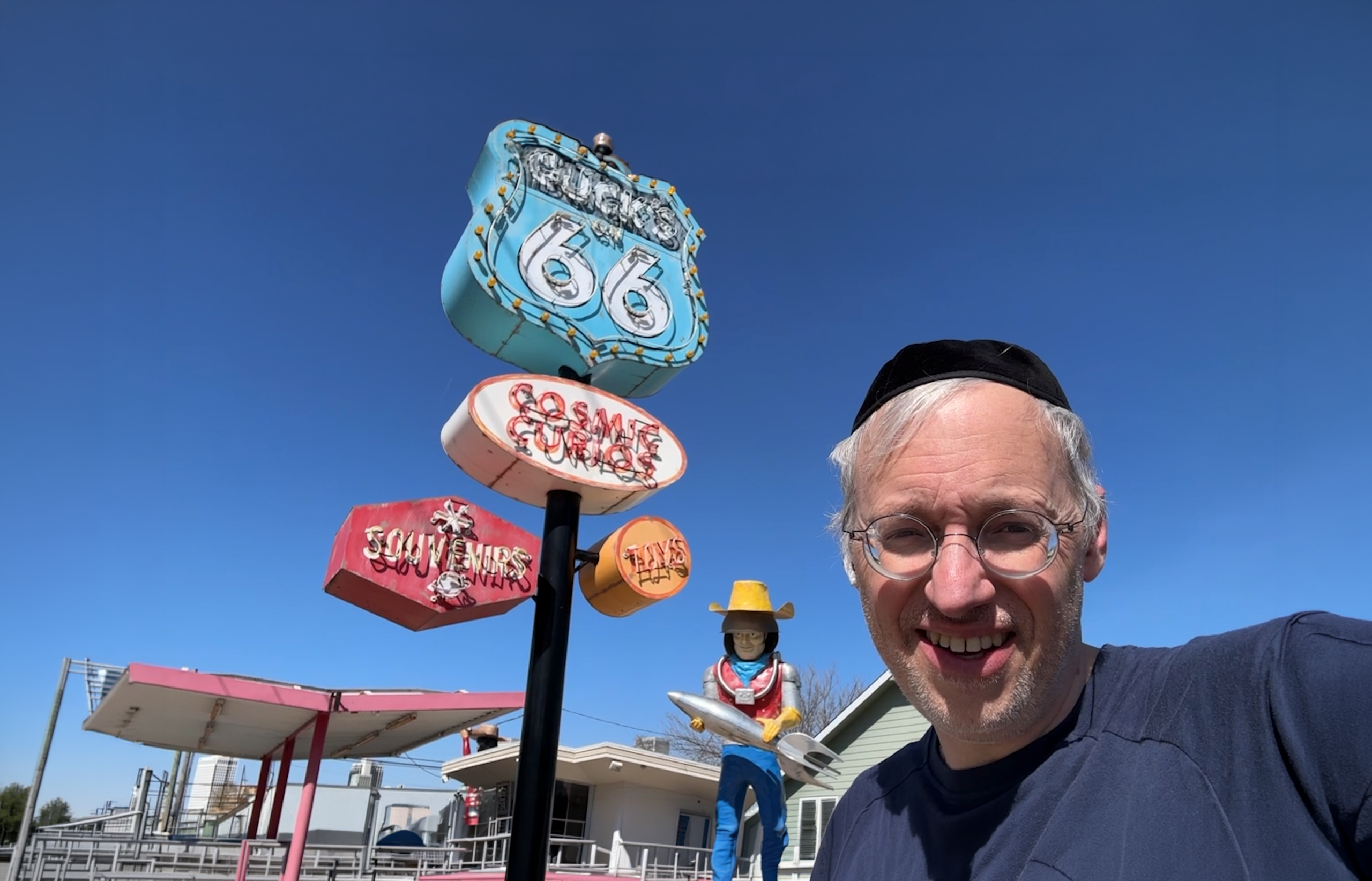
For the last half a year, Aryeh Gelbard, a filmmaker from Flatbush, has been taking trips across America, looking for the stories of people who are learning the daf. Over 50 weeks, leading up to the worldwide Siyum HaShas, he will be releasing short videos on WhatsApp and a website, showcasing interesting people learning the daf in every one of the 50 US states.
He is still in the process of traveling and making those videos, and he is still planning how to find the daf learners he is looking for. I was able to sit down with him and get the tour of both what he has done and what he is planning.
“Torah is taking place in America in places you don’t even realize,” he told me. “There’s Daf Yomi in Lakewood and in Williamsburg and in Monsey and in Passaic and in Chicago. But it’s also happening in Metairie, Louisiana; in Matthews, North Carolina; and in Bozeman, Montana. It’s happening all over the place.
“You’d be shocked that people who are not religious are learning Gemara.”
Enthusiastic about the Daf
One of the first things that Aryeh told me when I first spoke to him was that he is enthusiastic about Daf Yomi. Extremely enthusiastic.
“The daf is my life,” he told me.
That starts with his own learning of Gemara, with multiple daily and weekly chazaros of the daf. When we sat down, he couldn’t help himself; he had to talk with passion about the connection he felt with the Tanna’im and Amora’im, after carefully paying attention to who was talking to whom in the dapim of Shas that he has been learning. Daf Yomi is clearly imprinted on his personality.
But it has extended outward as well. In the past, he’s been heavily involved in the significant growth of major Daf Yomi chaburos.
Aryeh is someone who has been in the world of general Torah learning for a long time. At one point, I noticed his semichah from Torah Vodaas, which is signed by Rav Yisroel Belsky but states that he was farhered for part of the semichah by Rav Avraham Pam—a unique semichah document.
But Daf Yomi, which he started in full three cycles ago, has clearly changed his life; he spends so many of his waking hours involved in learning and chazering it. He can’t stop extolling the power of Daf Yomi and the foresight of Rav Meir Shapiro in establishing it. He has become a walking booster of the energy you get learning through all of Shas with klal Yisrael. And it’s clear by the time I’m done speaking with him that this project, where he is out on the road hunting for the stories of other people whose lives have been changed by the daf, is part of that, his obsession and love for Daf Yomi.
He sees this project as a way of giving inspiration to those learning Daf Yomi and those who may have fallen off from their learning or never started to keep learning. He has also realized that it is bringing people who have little connection to Yiddishkeit but who have connected to Daf Yomi to strengthen their Yiddishkeit. There is a unity of klal Yisrael through Daf Yomi that he believes can be reinforced through this project.
“People don’t realize the effects that Torah Sheb’al Peh and Daf Yomi can have on their lives,” he said.
One fascinating point I learned as I spoke with him was that while he came into it with the advice of gedolim and rabbanim, there was an element of it that he had jumped into with a level of abandon—almost recklessness—that only obsession and love can bring about.
Finding the learners
If you asked me how to find people learning Daf Yomi in every one of the 50 states, I’d immediately know that there are some states where it would be very easy to find people and some where it would be very hard. In New York, Florida or California, there would be no problem, of course. But what about Montana or Idaho?
To read more, subscribe to Ami