



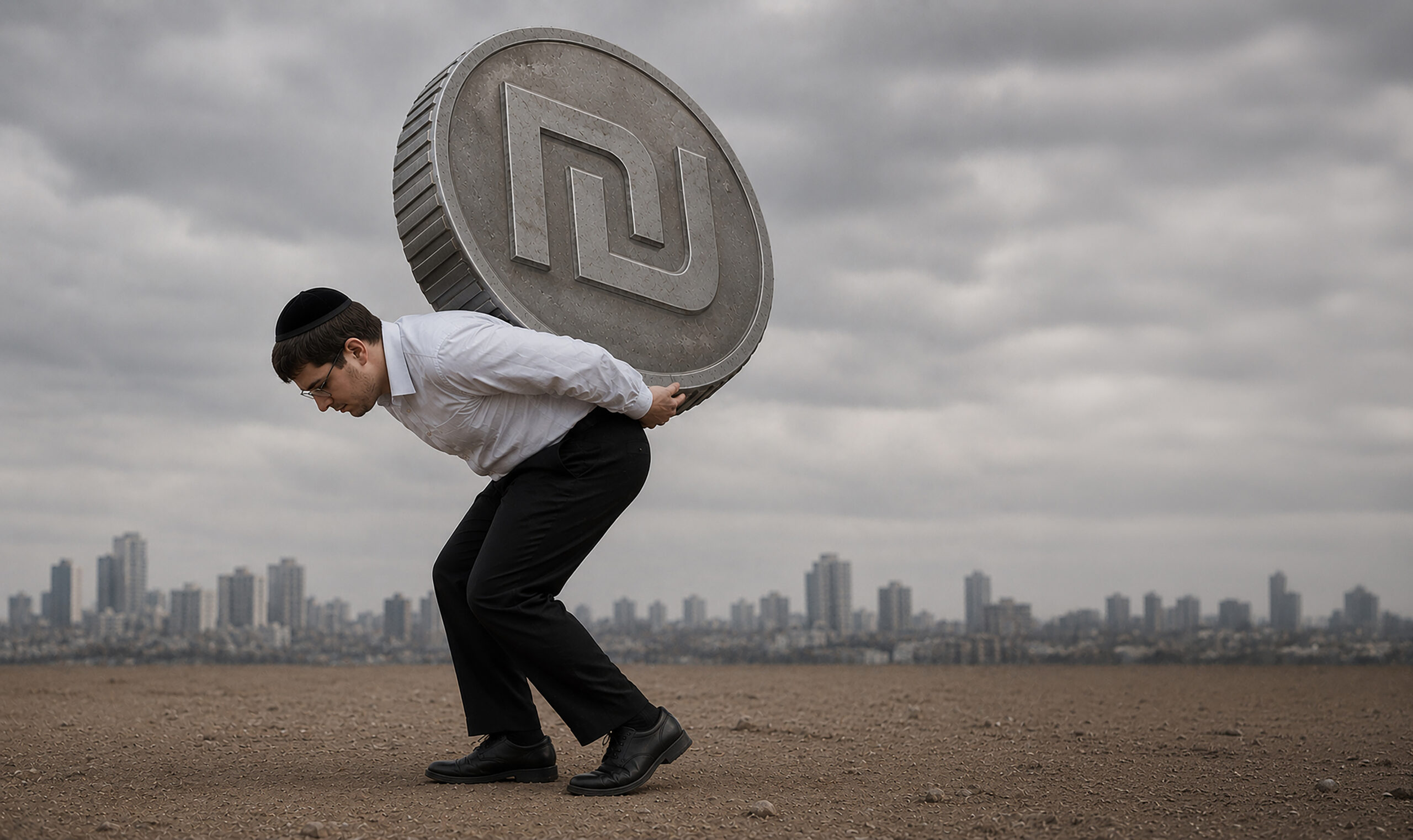
The exchange rate once buried in the business pages is reshaping Jewish life in Eretz Yisrael
Yitzchok Margolis is a typical American living in Yerushalayim and learning in kollel. He described how the strength of the shekel is affecting him and his fellow young couples.
“When my wife and I came to Eretz Yisrael two years ago shortly after our wedding, we did so knowing that my parents had committed to contribute $1,500 a month and my in-laws to another $1,500. On top of that, I was earning a small stipend from the kollel while also doing some tutoring on the side. My wife worked remotely for an American company. Together, our income added about $2,000 a month.
“All told, we had a monthly budget of roughly $5,000. At the time, that seemed manageable. We rented a two-bedroom apartment in the Sorotzkin neighborhood for 8,000 shekels a month, which worked out to about $2,300. Between rent, groceries, utilities, transportation and all of our other expenses, our monthly costs totaled around $4,800.
“We weren’t living extravagantly by any stretch. We watched our spending carefully and counted every dollar, so we were able to get by and even maintain a small cushion for unexpected things. It gave us a sense of stability as we began our married life together. But that’s gone now.”
The tumbling dollar and surging shekel have changed the picture completely. That same apartment now rents for nearly $2,800 a month, while food, utilities, arnonah (municipal property taxes), childcare and other expenses have similarly increased. The same $5,000 that once covered their needs now falls hundreds of dollars short, and the monthly support they receive from their parents in America no longer stretches as far as it used to.
“We really tried to make it work,” Margolis told me. As the dollar weakened, his wife took on additional sheitel work in her spare time, and he even withdrew money from an investment account that had been funded with his bar mitzvah money. “At a certain point, there’s nothing left to do. We aren’t wealthy people. Our parents had sacrificed enough, and we realized we had to go back.”
With a heavy heart, he made the painful decision to relocate to Monsey this summer, where he hopes to join a kollel for the upcoming Elul zman. For now, the dream of building their lives in Eretz Yisrael has been deferred by something as mundane—and as powerful—as an exchange rate.
And Margolis is not alone.
“We know of 20 couples who are also leaving. Some of them are my wife’s friends, some of them are mine. Even couples who receive more support from their parents than we do can’t make it. They had rented more expensive apartments based on that income, and they’re now finding their rent anywhere from $500 to $1,000 higher.”
Across Eretz Yisrael, thousands of American families whose income, savings or parental support are tied to dollars—while their expenses are paid in shekels—are confronting the same reality. What was once little more than an afterthought for most people has become a defining financial force that is reshaping people’s lives. Large organizations and some corporations have also felt the bite of the strong shekel.
Even with the brief fluctuations we saw on Monday as Israel and Iran sparred, the dollar is no longer worth anywhere near the number of shekels it once was, and it’s been hard to adjust to that.
Whatever Happened to 3.6?
When I first came to Eretz Yisrael in 2011, I suffered from a common condition that afflicts many financially illiterate foreigners: treating shekels like Monopoly money. You’d hand over a $100 bill and suddenly walk away with a thick stack of hundreds of shekels. With a wallet bulging with bills, I felt like an instant Rockefeller. Never mind the actual cost of anything; I was rich. Combined with my inability to resist buying food whenever I felt slightly hungry and my questionable mathematical skills, this was a recipe for disaster. I’d glance at a price tag, do some quick (and usually wrong) arithmetic in my head, and make the purchase without a care. Unsurprisingly, I spent much more money than I intended with only the vaguest idea of where it went, leading to the inevitable sheepish calls to my parents in America asking for another deposit in my bank account.
That dependable exchange rate of 3.57 shekels to the dollar that once enabled my carefree spending remained the average for nearly 15 years. Tourists, yeshivah bachurim and seminary students, investors and families supporting kids in Eretz Yisrael could all count on their dollars going a long way. Today, however, a stronger shekel, driven by a mix of market forces and economic policies, has made virtually everything in Israel far more expensive.
To understand the human impact behind the exchange rate, I spoke with leaders of nonprofits, real estate professionals, tourism veterans, young couples and parents overseas. Their stories reveal a seismic shift that is reshaping life in the Holy Land.
To read more, subscribe to Ami