



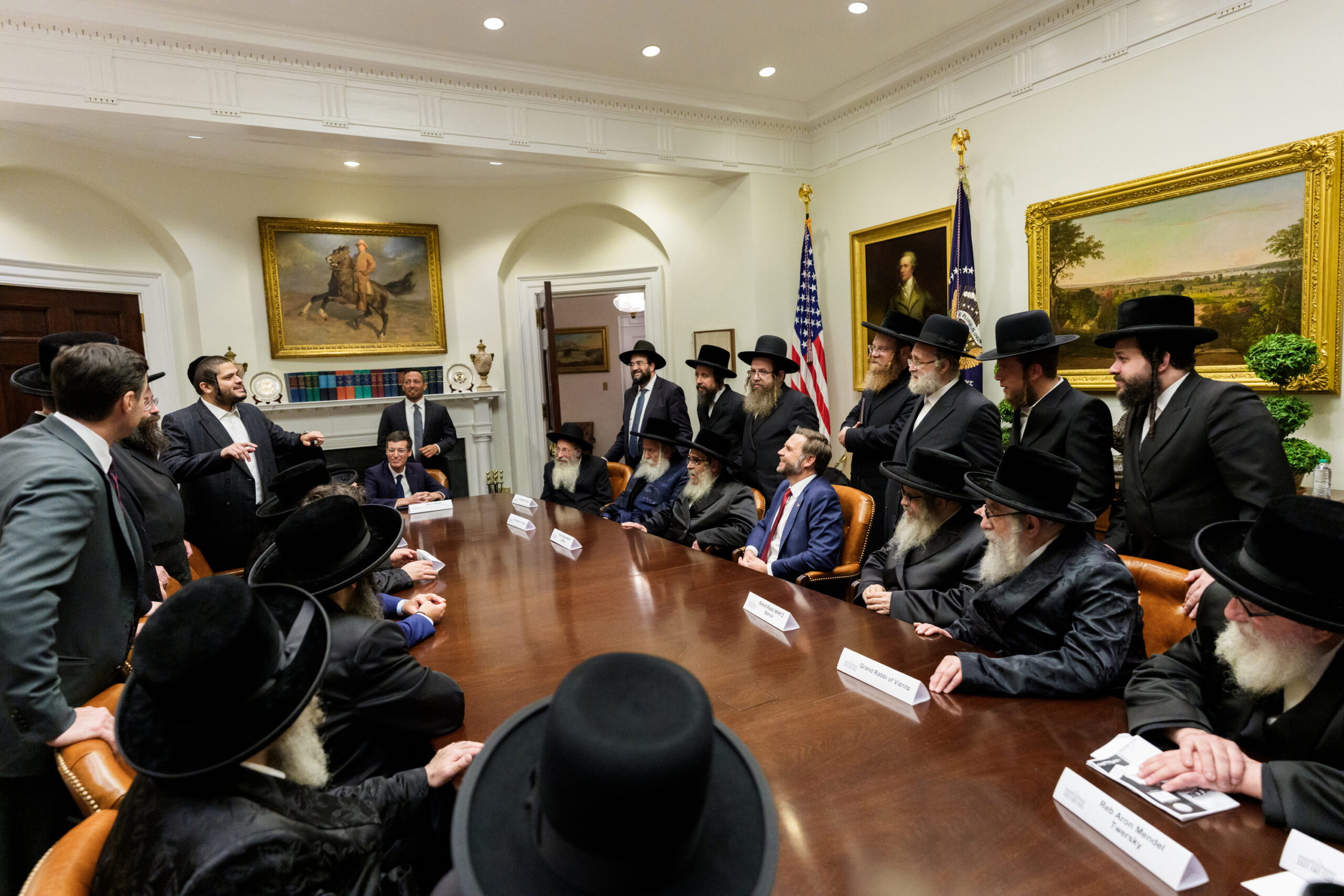
Reflecting on the extraordinary meeting between the gedolim and President Trump in the Oval Office, and on how it came about
It’s always challenging to tell a story like this without sounding as though I’m tooting my own horn. Yehalelcha zar v’lo picha—other people should praise you, not your own mouth. So let me start by saying that I did not make this meeting happen. A lot of people worked on it, pushed for it and made it possible. And, as with anything involving klal Yisrael, we need to have siyata dishmaya. But I was involved from the beginning, and I had a front-row seat to how it came together.
The idea actually goes back to early in the Trump campaign. The Satmar Rebbe, Rav Aharon, had wanted a meeting with Donald Trump once he became president. At the time, education independence was a major issue in New York, before the state changed the laws, and the thought was that the federal Education Department could potentially play an important role. Legally, that is the case.
But after the election, reality set in. Campaign scheduling and White House scheduling are two completely different things. Eric Trump, who had been accessible during the campaign, wasn’t running the White House and wasn’t involved in its scheduling. The idea essentially fell by the wayside.
Then, sometime around the summer of 2025, the conversation started again. There were things that klal Yisrael wanted to accomplish. Education was one. Fairness in the justice system was another. Security funding and federal action on anti-Semitism were additional concerns. There were still issues involving local governments, although not nearly as bad as they had been a decade earlier. The question was how to get a meeting with the president.
People sometimes confuse getting a photograph with the president with actually having a meeting with him. Those are two very different things. There are posts like that on social media all the time: Someone is standing next to the president at Bedminster or Mar-a-Lago, and the caption says that the person “met the president.” Usually, the president stopped for a minute, shook his hand, took a picture and moved on. Sometimes someone is brought into the Oval Office for a photograph and then leaves. That’s not what we were trying to arrange.
When you’re bringing a group of dignitaries to meet the president, it requires much more planning. It has to fit into his schedule. White House advisers want to understand why the meeting is taking place—the president is a busy man, and if the community has concerns, people know how to reach officials throughout the administration to get things done, so why go all the way to the president? Once that was explained to their satisfaction, they wanted to know exactly what our concerns and requests were and what policy issues would be raised.
Another obvious question occurred to us: If the frum community is important enough to warrant an audience with the president, shouldn’t there be broader representation?
That was when the list started growing. Initially, we had the core six: the rebbes of the largest chareidi kehillos in Williamsburg, Borough Park and other major heimishe neighborhoods, and the rosh yeshivah of Lakewood. Once you start adding rebbes from smaller kehillos, before you know it, you’re at 15 people. But, a rebbe has gabbaim who have to accompany him. Even limiting it to one additional person is incredibly difficult. Fifteen becomes 25 very quickly, and suddenly you’re no longer talking about a casual visit, you’re planning a conference.
Logistically, holding the gathering at Bedminster would have made sense. It’s accessible to the rabbanim from New York and New Jersey, and it’s spacious. But President Trump has always viewed receiving dignitaries at the White House as a special kavod, and he wants to give them the full experience. Trump understands that for most people that means meeting them in the historic Oval Office.
Since the Oval Office can only hold a limited number of people comfortably at one time, we had to determine what would be the smallest group that could represent the largest segment of the chareidi and chassidish community. That brought us back to the original six. The momentum stalled in the winter and spring, but Congressman Mike Lawler and Satmar askanim kept pressing. Realizing a mid-year policy meeting was tough on the president’s calendar, we shifted the focus to right before Rosh Hashanah. Framing the meeting as a New Year greeting grounded in hakaras hatov made the timing workable.
To read more, subscribe to Ami