




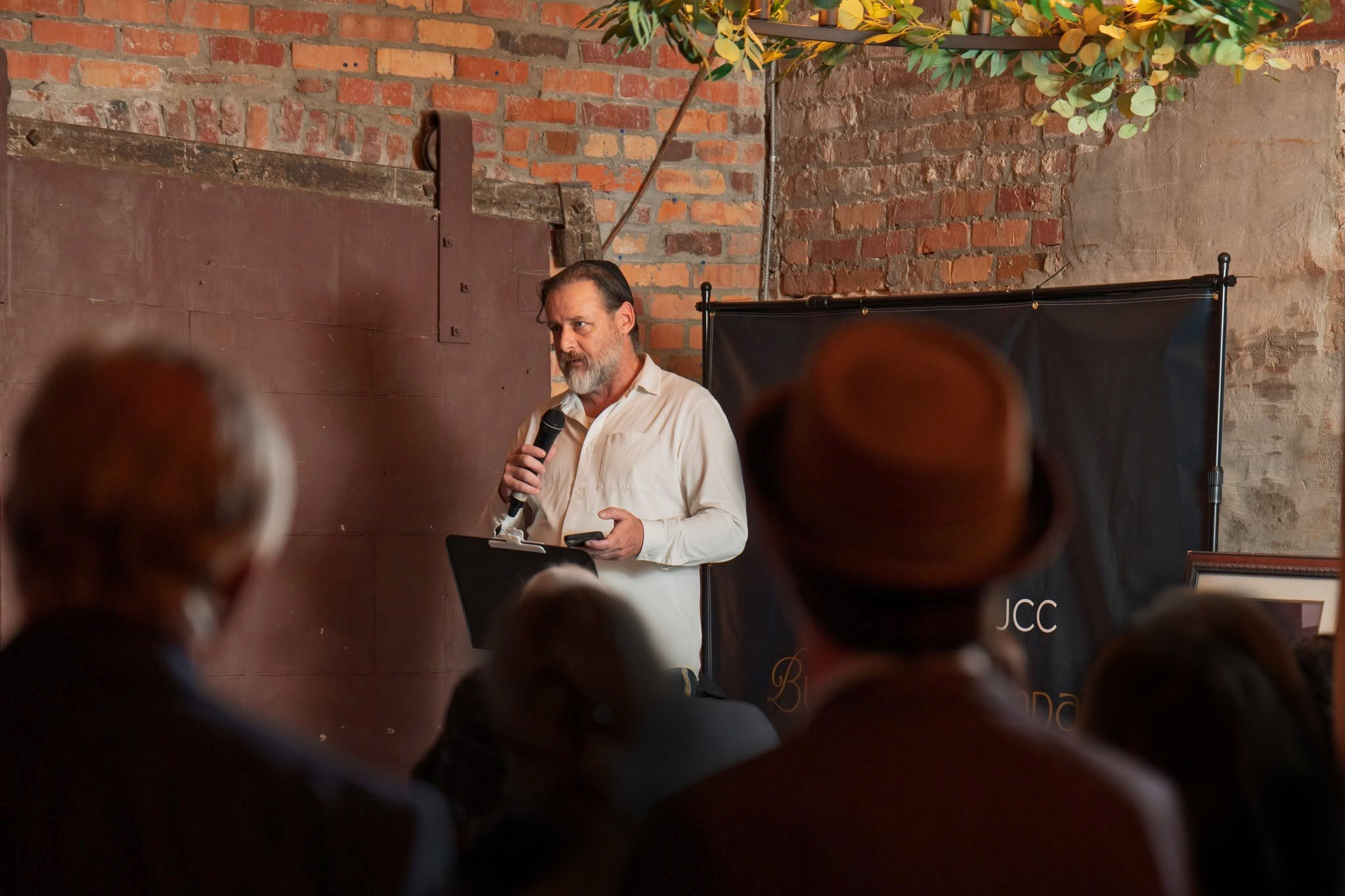
Glenn Esterson’s business is as unique as his backstory. He’s one of America’s top brokers of trailer parks, owns a few as well, and he wrote the best-selling book on trailer park ownership, The Mobile Home Park Manifesto. The advice he gives there can be applied to most real estate management as well.
Raised in a Jewish household, he was misgayer not once but twice, and he’s helping to build Chabad in Wilmington, North Carolina, where he resides. His path to success was anything but conventional: expelled from boarding school as a teenager, he spent a few years in a wilderness program for troubled youth, reform school and prison before turning his life around.
Glenn is soft-spoken, but has a lot to say. We spoke about his life’s journey, the “magic” amount of tzedakah, and how his goal of finishing Shas matches his life’s motto.
Enjoy!
—Nesanel
I was born in Miami and was adopted at birth, though I only discovered that when I was around ten or 11. My birth mother was very young, and somehow she got connected to my adoptive parents’ Jewish community. My parents had been told they weren’t able to have children, but baruch Hashem, my brother, their biological son, was born a few years after they adopted me. So it was the two of us.
“My father, Dr. Joseph Esterson, is a cardiologist. He doesn’t practice anymore, but he teaches full time at the University of Miami. He was raised Orthodox in Pikesville, Maryland, where his father, Dr. Sidney Esterson, was the principal at Beth Jacob, the largest Jewish day school in town. My grandmother’s father was one of the two mohalim in Baltimore in the early 1900s. My mother was raised Reform. Her father was a butcher. My parents met in college and came to a religious compromise, somewhere around Conservative.
“Growing up, we kept strictly kosher until I was about 12, and then it became kosher in the house and “don’t ask, don’t tell” outside. My mother lit candles and we kept Shabbos, but over the years it eroded into having a family Shabbos dinner before everyone went about their business.
“I grew up in Hollywood, Florida. Today, it’s Orthodox in every direction, but when I was a kid, we were one of the only Jewish families on our block. I went to a small Conservative day school—maybe 70 kids in the whole school—through eighth grade. We learned Chumash and Hebrew, we davened every morning, and I had my bar mitzvah in Israel, but that’s where the Yiddishkeit ended.
“I was entrepreneurial from day one. I’d buy a five pack of gummy bears and sell them individually for lunch money. If I could figure out a way to sell something, I was selling it to you. I wanted to be two things when I grew up: a businessman and a cowboy. My parents had no idea what to do with my dream of hanging out with horses on a ranch.
“My brother was an excellent student, but school wasn’t easy for me. In a school that small, someone is going to be the outlier, and I was bigger, louder and more resistant to authority than everyone else. At 14, my parents sent me to a boarding school in Massachusetts. I loved it there, and for the first time I was excelling at something other than baseball. Then one night I went for a walk when I shouldn’t have, took a wrong turn, and I was expelled.
“I spent that summer in a wilderness program in Utah. They drop you in the desert with a few other kids and no supplies, and you walk hundreds of miles for months at a time. I learned to set traps, start fires, sleep in caves and survive on a tiny bit of water a day. And I thrived; I had a knack for survival. I felt like a cowboy, which was not the goal of this program, so they sent me to the Rocky Mountain Academy in Northern Idaho. It was basically a prison set up as a working farm for ‘troubled youth.’ I got there on my 16th birthday and stayed for two years and eight months. Every two weeks you could speak to your parents for 15 minutes on a monitored call, and right before your call, the staff called your parents and told them, ‘Here’s what your kid is going to tell you, don’t believe him.’
“I don’t think my parents knew what it was really like. They were doing their best to be good parents, and I was definitely a handful. Parents visited once a year, and everyone put on a good face, because the consequences for not doing so were severe. It was an abusive place, and the kids weren’t so nice either. You learned to keep your head down, work hard, stay clean and keep the wolves at bay. It was shut down in 2005 after enough reports came out, but I came out at almost 19 with a few bumps and bruises and real survival skills. I knew how to farm, I knew how to make things work in tough environments, and I knew how to communicate with people.
“After a weekend at home, my father asked me to find my own place. I drove cross-country to San Francisco in an old, used Ford Bronco that I bought with my bar mitzvah money—practically my only worldly possession. The next five years were rough, and so was I. My roommate and I came up with a profitable but illegal way of covering the rent, which led to me being arrested. My father got me a good attorney, so I was sentenced to two years instead of four, with one year off for good behavior.
“Hashem gives us some unique paths to walk. Compared to the school in Idaho, jail was easy, and it was actually very good for me. I kept to myself, took correspondence courses and resolved to never get in trouble again. I moved to Northern California, enrolled in college and became a straight A student.
“That’s also when I became a father. My son was born with liver failure and had a transplant at ten days old. I spent the next year sleeping on a tiny blue couch in the ICU, begging G-d to help me. In that hospital you think, “Poor me, my kid is so sick,’ and then you see another kid with ten problems while your kid only has one, and you almost have no room to complain. At one year old, my son’s liver failed again. A second transplant failed in 12 hours, and the third liver came with a warning from the doctor that it would give my son cancer, but without it he’d die in a few hours. We took it. Six months later he had cancer, and six months after that, he beat it.
“Meanwhile, I had a degree now, and I was law-abiding, but I still couldn’t get a job. My parents invited us back to Florida, and my father sat me down with three of his friends: a lawyer, a banker and a real estate guy. I had 50 cents in my pocket. The lawyer said go into real estate law. The banker was so far over my head that I don’t know what he said. And then there was Cy—an old school New Yorker who looked and talked like a mobster and offered to take me around on his route. We went through the roughest parts of South Florida knocking on doors and collecting rents, and by the end of the day he had $20k in his hand. I was impressed.
To read more, subscribe to Ami