


When I received an invitation to attend a hachnasas sefer Torah in Cuba, I was perplexed. Cuba had been in the news constantly in recent months: a country in tragic decline, its economic and humanitarian crisis worsening by the day. Was there even an active Jewish community left there? And if there was, how could a population struggling to put food on the table possibly afford a sefer Torah, which costs tens of thousands of dollars to write?
The answers surprised and touched me. They told a story of Jewish brotherhood, warmth and resilience in a very unlikely place.
Two Jewish brothers from America, Hershey and Nussi Brisk, who are devoted to saving fellow Jews from cremation, joined forces with another philanthropic Yid from Lawrence to support the struggling Jewish community on this isolated island. So what began as a simple phone call quickly turned into a frantic effort to reach Cuba in time for that historic moment: the first hachnasas sefer Torah in Cuba since the revolution nearly 70 years ago. I traveled across the Atlantic to witness it firsthand.
“We are originally from Netanya, where my grandfather was sent by the Belzer Rav, zt”l, and the Chazon Ish, zt”l, to open a yeshivah. The original yeshivah was founded by his father, Rav Mordechai (Maharam) Brisk, the Toshnader Rav, in Transylvania. At the time, it was one of the largest yeshivos in Hungary.”
The Brisk family settled in New York in the 1970s. Eventually, the brothers became involved with the chevrah kaddisha.
“We realized that despite the sizable Jewish community in South Florida, there was no dedicated frum beis hachaim and no proper mikvah for taharah,” Nussi explained. “We established the Eden Funeral Home together with Reb Yerucham Koppelman, who has been involved with chevrah kaddisha work for over 45 years. My brother Hershey later moved to Florida to oversee operations, and he also founded the Kehal Chassidim shul in Surfside.
“Reb Yerucham would always stress the importance of ensuring that Yidden merit kever Yisrael,” Nussi continued. “People might not realize this, but in the State of Florida, over 50 percent of Jews are cremated. Unfortunately, many are unaware of the significance of kever Yisrael, or even when they do know, financial constraints lead them to choose cremation. In many cases, the deceased has even left a will requesting cremation, which further complicates the situation.”
Over the years, the Brisk brothers have helped save many Yidden from cremation.
“Although we’ve been involved in this for many years, recently we felt the need to fully immerse ourselves in it,” Hershey said. “We educate families about the importance of kever Yisrael and involve family members wherever possible. Once a person passes away, it becomes a race against time to prevent cremation.
“We now have representatives in hospitals and nursing homes across the state who alert us when a Jewish patient passes away, allowing us to act quickly. When finances are the issue, we cover the costs of kevurah. In other cases, we work with lawyers and askanim who speak to the family and try to help them reconsider.”
In addition to their work with the chevrah kaddisha, the brothers are also involved in preserving batei chaim around the world wherever needed. One of the cemeteries they were asked to look into was the beis hachaim in Havana.
Jewish Life in Cuba
Jewish life in Cuba began with conversos fleeing Spain during the Inquisition, but the foundations of the modern community weren’t set until the early 20th century. Following the Spanish-American War and the collapse of the Ottoman Empire, a significant wave of Sephardic Jews arrived, establishing Cuba’s first formal religious institutions.
In the 1920s, Ashkenazim escaping poverty and pogroms in Eastern Europe began to arrive, and their numbers increased dramatically in the wake of World War II. Many immigrants initially viewed Cuba as a temporary stopover en route to the United States, but quotas prevented them from entering the US and they remained on the island, building their homes and a strong community there.
Until the late 1950s, Cuba had a vibrant Jewish community of over 20,000 people. After the revolution in 1959, though, most of the community emigrated en masse along with thousands of other Cubans. The majority of Cuban Jewish refugees settled in the United States.
“There are three batei chaim in Havana,” Nussi told me. “The Sephardic, the liberal, and the Orthodox Adath Yisrael cemetery. Many frum families have relatives buried in Adath Yisrael from before the revolution. We were asked by family members to look into its condition, as it has fallen into disrepair. We now have a blueprint of the layout and plans to erect new fences and restore the boundaries. We also work with the Adath Yisrael rav, Rabbi Yaakov Berezniak, to assist with new burials, and we send tachrichim when needed.”
When the brothers first visited Havana, they davened at the Adath Yisrael shul, which is the only one in Cuba that maintains a daily minyan. The congregation was formed in the 1920s by Polish and Russian immigrants as an alternative to the established Anglo-speaking United Hebrew Congregation, which was associated with the American Reform movement.
Adath Yisrael was founded in 1923 as the first Orthodox Jewish community in Cuba. Another community, Knesset Yisrael, emerged for a short time, but the two later merged into a single united congregation. Since then, Adath Yisrael has remained Cuba’s only Orthodox Jewish community.
In 1948, Rabbi Meir Rosenbaum, son of Rav Issamar of Nadvorna, was appointed rabbi of Adath Yisrael and, by extension, served as the chief rabbi of Cuba. During his tenure, he founded the Yiddish-speaking Tahkemoni School, the first and only frum school on the island.
Shortly before the revolution, Rabbi Rosenbaum left for Venezuela, where he continued his rabbinic work, becoming known fondly as “the Caracas Rebbe.”
Despite ongoing financial hardship and crisis after crisis, a small but resilient community remains in Havana to this day. Communal activities and daily minyanim are still held in Adath Yisrael in Old Havana. However, the community continues to struggle with shortages of kosher food and a lack of basic tashmishei kedushah.
“When we arrived at Adath Yisrael, we were surprised,” Nussi recalls. “There were about 18 people present; several were wearing talleisim but had no tefillin on. After davening, I asked Rabbi Berezniak for an explanation.
“He told me, ‘These men can’t afford tefillin. The average monthly salary here is the equivalent of $15–25. Even a professional, such as a doctor, makes only $50–70 a month. A basic pair of tefillin costs around $700. For them, it is simply out of reach.’”
The next time the brothers traveled to Cuba, they brought along 17 pairs of tefillin—enough for the local community and for visiting tourists who might want to put on tefillin.
“When my brother Hershey was called up for an aliyah, he gestured to me to come over,” Nussi recalls. “I’m not a sofer, but when I looked at the sefer Torah, I immediately realized that there were letters cracked and missing. Rabbi Berezniak explained that this Torah was donated prior to the revolution and had been repaired several times by a sofer in Panama. The other sifrei Torah in the shul were pasul beyond repair. This was the only sefer Torah that they could use, b’dieved.”
The brothers immediately took on the task of arranging a new sefer Torah for the community. In addition, they witnessed firsthand the severe lack of kosher food. “There are no kosher supermarkets in Cuba. Twice a year, a container with shelf-stable kosher food is sent from Panama to the community. Rabbi Berezniak, who is a trained shochet, does local poultry shechitah from time to time. But that’s hardly enough.”
The brothers travel at least once a month to Cuba, bringing along suitcases filled with fresh kosher food, medication and tashmishei kedushah. Before the Yomim Tovim, they bring along meat, fish and matzos. Although it is technically legal to bring food into Cuba, excluding fruits, it is still Cuba, and any official can decide to cause problems at a whim.
“We always whisper a tefillah when passing customs,” Nussi admits. “Baruch Hashem, we were never stopped by the authorities.”
According to the Brisk brothers, there is a list of 450 Jews currently residing in Cuba; about 150 are associated with Adath Yisrael. “But we would only meet a small number of members in shul,” Hershey explains. “Transportation is just too expensive. To- address this, we opened a kollel. We provided Rabbi Berezniak with a stack of bills, and every member who came to shul for Shacharis received a dollar per day, which was enough to cover transport and to buy some food. After davening there was a shiur and a breakfast buffet.”
This arrangement worked well until the fall of Venezuela, when oil stopped being delivered. Due to the gas shortages, public transport was reduced to a skeletal service, leading to severe delays and overcrowding. Despite the financial incentive to attend shul, the reduced transport option means that some members of the community would not be able to get back to work on time, which is something that is essential in communist Cuba.
Despite the financial hardships, the Brisk brothers reassured me, they never experienced any crime or anti-Semitism. “As tourists, the locals will not dare to do anything to you anyway. The only lifeline left in the Cuban economy is its tourism,” Hershey points out.
Cuba’s fragile economy is on the brink of near-total collapse after the country suffered yet another blow in its over 60 years of American embargo. Since 1959, the US has imposed a virtual blockade on the island nation. Tourism was curtailed, imports were banned and American businesses were barred from trading with Cuba. Despite the harsh embargo and the downturn of Cuba’s economy and infrastructure, it managed to survive in recent years largely due to the support of Venezuela. In a series of economic deals, Venezuela sent subsidized crude oil to the struggling Cuba, while the latter provided thousands of health-care personnel and other professionals to alleviate Venezuela’s struggling sectors.
With the removal of Venezuelan President Nicolás Maduro and the American naval blockade of Venezuela, these arrangements came to an abrupt halt. Cuba is now isolated from the outside world. Now the everyday chronic shortages have been exacerbated by the lack of fuel and critical supplies. Trump repeatedly threatened that the Cuban regime, which is still adversarial to the United States, is in his crosshairs and would be next in line to fall.
I asked the brothers why no one has tried helping the community before. “Many have helped and did a lot of good, but they were banished by the government. Even Chabad, which operated here for more than ten years, were expelled from Cuba,” Nussi explains. “The government is wary of any big changes or new groups coming in. We are working with the existing community, which is recognized by the government, so it’s not a threat to them. We are not coming in and making massive changes or starting our own thing. Baruch Hashem, the hachnasas sefer Torah is supported by the government.”
Havana: A City on the Brink
When I applied for my visa, I was surprised at how quick and efficient the process was. The Cubans are desperate for tourists. During the Cuban Thaw, between 2015 and 2017, when Obama visited the country and eased some of the restrictions, Cuba saw a rise in tourism of over two million visitors a year from the United States. On June 16, 2017, President Trump issued a presidential memorandum reversing most of Obama’s leniencies, and since then the number of visitors to Cuba has plummeted.
Havana, once a vibrant city filled with hotels and tourists, lies in disrepair. Even after the revolution, a small number of tourists—albeit not Americans—visited steadily, coming to explore its beautiful architecture, unique culture and stunning beaches. But since the removal of Maduro, the cessation of Venezuelan oil supply and intensified American embargo, the Cuban economy collapsed. The country now suffers from daily blackouts, food shortages and limited transportation options.
There are only a handful of daily flights to Cuba, mostly from Miami and several Caribbean islands. There is also a direct flight from Madrid, Spain, which I took. On my return journey, I flew via Miami back to the UK. There is no direct return to Madrid, as the transatlantic flight requires more jet fuel than Cuba can provide. The aircraft lands in Cuba with just enough fuel to make it to the Dominican Republic, where it refuels. This stop adds a few hours to the flight time.
I had no preconceived ideas of what to expect from Havana’s José Martí International Airport. When we landed, the airport was empty, with only my plane on the tarmac. We were just 90 miles from the coast of Florida, yet it was an entirely different world, where basic food and freedom cannot be taken for granted.
Entering Cuba was surprisingly easy and straightforward. Once I exited the terminal building, the plight of the country became immediately apparent. The roads leading into the city center were deserted. Apart from a few motorcycles and bicycles, the roads were free of vehicles. The farther we drove from the airport, the worse road conditions became. To conserve energy, only traffic lights on the main intersections were in operation.
The Brisk brothers booked the modern Iberostar Grand Packard Hotel in central Havana to accommodate the guests who would be joining from Israel, New York and Miami. This is one of the few hotels that are currently open in Havana. Many, including the famous Kempinski Hotel, are closed due to the lack of tourists. Although technically the US ban on American citizens visiting Cuba is still in effect, some exemptions can be made, such as family visits and religious activities, the latter of which was the reason for our visit.
I arrived the evening before the other guests, which gave me the opportunity to explore the city of Havana by myself, without a guide, to see if conditions were as bad as the media portray it.
The hotel is located on the famous Paseo de Marti Boulevard, a long avenue stretching from the seafront to the Capitolio, the Cuban parliament building, lined with derelict neo-classical buildings and a long pedestrian walkway designed with sculpted lions.
As soon as I walked out of the hotel, the locals clamored around me, asking for money and offering to sell me things. Despite the late hour, the boulevard was packed with locals sitting idly on the sides of the road or walking around aimlessly. Due to the daytime heat, the locals stay indoors during the day and come out at night, when the temperatures drop to bearable levels.
The streets are littered with garbage. There are no trash cans; people just dump their refuse on the ground at the sides of the road. Here and there I saw elderly people sifting through the garbage, trying to find something that is still edible.
The once-bright paint on the beautiful buildings has been peeling away for decades. Weed and shrubbery grow through the cracks from years of neglect. The dilapidation has been ongoing for years, but now many of the buildings are actually collapsing or are boarded up and condemned due to structural defects. Even the sewage system has collapsed. A motley crew of local residents were working feverishly with makeshift pumps to empty the overflowing sewage tanks that were spilling across the narrow lanes.
Miguel, a local resident, approached me and offered to show me around. For some reason, he came across as an honest man and I trusted him. I asked him to show me his family home.
We continued along the boulevard past the Capitolio, its illuminated gold-covered dome—the 2019 restoration costs of which were paid by Russia—rising above the city skyline. Despite the shortage of electricity supply and frequent power cuts, this building remains illuminated throughout the night.
Miguel’s building was not similarly illuminated. We went up a narrow, dark and musty stairwell to the second floor, where three generations live together in squalor. A single lightbulb attached to loose wiring barely lit up the small kitchen. The kitchen is outfitted with an outdated stove, an old fridge and archaic utensils. I opened the fridge; it was empty, with only a lone jug of water on one of the shelves.
Miguel’s brother, Rafaelo, emerged from one of the rooms. Severe malnutrition had left him emaciated and lethargic. Miguel told me he spent most of his days asleep. Learning I was a journalist, Rafaelo began heaping praise on President Trump for his actions against Cuba. Seemingly shocked by his brother’s willingness to offer his uncensored opinion, Miguel assured me that his brother was drunk and unaware of what he was saying.
But as Rafaelo seemed unafraid to talk openly, I decided to test public opinion on the streets. On the way back to the hotel, I conducted some impromptu interviews. Most people were hesitant to talk about Trump but had no qualms criticizing the current Cuban leader, Miguel Díaz-Canel. Some were even brazen enough to speak out against Raul Castro, but Fidel Castro remains untouchable.
When I returned to the hotel, Miguel requested as payment only some soap and deodorant—two of the many products that are difficult to procure in Cuba.
The next morning, I headed to Adath Yisrael. The shul also functions as the community center and houses the only mikvah in Cuba. As I neared the shul’s entrance, an elderly local wearing a kippah approached me requesting a donation. His name, when I asked for it, did not sound Jewish, and he could not recall his father’s name. My suspicions were confirmed later when I learned that he is not Jewish. Whenever he sees Jewish visitors, he puts on a kippah, trying to gain their sympathy.
My next mission was to exchange US dollars for Cuban pesos. In the 1990s, following the collapse of the Soviet Union, the Cuban government was forced to introduce economic reforms. Since then it is legal to trade with US dollars, but the Cuban government manipulates the currency in an attempt to keep inflation down. The official rate in exchange bureaus was set at 24 pesos for a dollar. The real exchange rate on the black market was 500 pesos for a dollar. It did not take me long to find a dealer in one of the narrow alleyways who invited me into his home and agreed to give me the actual exchange rate.
Old Havana is across the harbor. The port sits idle and the docks are empty; no imports are coming into this isolated country. Walking the streets, I could see and feel despair everywhere. I have seen extreme poverty across the world, but never have I seen such a sense of hopelessness in people’s eyes.
In the old town square, I met a young man named Manuel who is a computer technician and programmer. Manuel is a highly intelligent man and speaks fluent English. He beckoned me to the center of the square. Once out of the earshot of passersby, he eagerly shared what real life in Cuba was like.
Manuel says that both he and his wife are computer technicians, but they can’t afford to work in that field. He would only earn $14 a month as a programmer. Now both he and his wife work as restaurant hosts, earning up to $200 a month each, with the help of tips.
Manuel does not receive any government help. His rent is $50 a month. Electricity is $10 a month, and gas, which is government subsidized, is only $1 a month. He told me that he is one of the few lucky residents of Havana who can still afford to live there. His heart breaks when he gets a tray of eggs in the supermarket and sees other locals who can only afford a single egg at a time. Manuel made his thoughts about communism very clear: Although capitalism is not a perfect system, he said, communism is a lie and has never worked.
The supermarkets that Manuel refers to are small stores that have barely any stock to sell. I ventured into several of these stores; they offered nothing more than eggs, beans and pasta, cheap cookies, and some knockoff beverages. I passed a bakery that had a few breads to sell, hidden behind a curtain. The bakers refused to let me in.
The few stores that do have more supplies have long lines outside that form early in the morning and last until they close, early in the afternoon, when there is nothing left to sell.
En route back to my hotel, I spotted a school. I hurried inside before anyone could stop me. Perhaps there was some spark of hope left here to lighten the mood. The lobby display boasted an assemblage of communist memorabilia. All the lights were switched off to conserve energy. The school seemed to be half empty, with many more desks than children in attendance. Perhaps there are not many young people left in the country; I certainly did not see many.
The students who were present were delighted by the unexpected opportunity to show off their knowledge of English. After a few minutes of singing with the children, the principal called me out. I was expecting a scolding for barging into the school during a lesson. Instead, she asked for money to feed her family.
Outside, a vintage tanker filled with potable water arrived. A rush ensued, as people came rushing from across the neighborhood with buckets to get their fill. The only thing the government still provides is water, but even that is in limited supply.
On the corner of San Ignacio, a long alleyway that winds through old Havana, I noticed a beautiful baroque building with a large stone mezuzah affixed to its doorpost. The door was open and the building was deserted. This was once the Hotel Raquel, a Jewish-themed hotel paying tribute to the Jews who used to live in this neighborhood. The tall ceiling of the art nouveau atrium is supported by ornate columns. The rooms on the first floor all have mezuzahs and each room is named after a different shevet. The building was awash in a soft light coming through the beautifully restored stained glass ceiling. My short adventure came to a halt when the security guard noticed me and told me to leave. Unlike the neglect common throughout Havana, this building appears to be restored and maintained.
With the tourist industry in tatters, the only reliable income Cuba has left is from the cigar industry. Over 90 percent of the market is owned and heavily controlled by the government. In order to visit a cigar factory, tickets must be purchased from the hotels in advance; there are no ticket offices at the factories themselves. I was first refused entry to the Partagas factory, but I managed to persuade the manager at the H. Upmann Factory— which produces some of the finest cigars, including the Romeo y Julieta brand, Winston Churchill’s favorite—to show me around. Hundreds of employees sit bent over for hours a day hand rolling the finest cigars, with a strict daily quota they must fulfill. Despite the cigars’ exorbitant price, the employees earn a pittance and have to pay for their lunch in the canteen. I even saw them paying to use the lavatories, something the manager tried to deny.
According to the factory manager, since the US sanctions companies that do business with Cuba, China stepped into the vacuum, taking over the global market of Cuban cigars.
After that adventure, I wanted to visit the Sephardic shul, but due to the heat and the lack of opportunities, there were not many people out and about to get me there. It took a while until I finally flagged a rickshaw to take me. Along the way we passed several gas stations sitting empty with no fuel to pump. Some of the nozzles had been torn off, perhaps stolen to use as scrap metal.
The former glory of the Sephardic shul is still visible in its edifice, although the building is beginning to fall apart. A few local youngsters were sitting on the stairs eating lunch. In the lobby there are large posters telling the story of the Holocaust. The women’s gallery and large stained glass windows still bear witness to the original use of this building, but the main sanctuary is now used as a yoga studio.
Prior to the revolution, when Havana was a playground for the rich and famous, they imported thousands of fancy American vehicles, mainly Chevrolets, Buicks and Oldsmobiles. These brightly-colored vehicles, locally known as almendrones (big almonds) for their curved silhouettes, are still in use to this day as shared taxis. An estimated 60,000–70,000 of these vintage cars dot the city streets, offering a unique perspective on the city. My last stop was a drive in a 1959 Chevrolet convertible. It’s a testament to Cuban resilience and mechanical ingenuity that these gas guzzlers have been kept in excellent shape all these years despite the lack of resources.
Any government-owned vehicle—which is the majority of vehicles, unless it displays the letter P—must pick up whoever hails them. Failure to do so may result in heavy fines or confiscation. I passed by the bus depot, where hundreds of buses sit unused due to the lack of fuel. The bus stops are packed with people who are waiting to squeeze onto the few buses that still operate. People utilize any means of transportation to get around, including the rear of dump trucks.
When I arrived at the hotel, I was surprised to see the same staff members who had been there from the previous day. The staff member explained that they have to work full 24-hour shifts to reduce the pressure on the overloaded buses. Once they finish their shift, they return home for a 72- hour break before repeating the cycle—all for $15 a month.
A middle-aged bellboy, wearing an oversized green uniform, accompanied me to the elevator. Once we left the lobby, he whispered quietly that he only earns $9 dollars a month, and that he can’t afford to raise his two children on this paltry sum. The government stopped giving any assistance; even the ration cards are useless, as the stores do not have any supplies. Cuba’s only hope is President Trump, he said. As soon as another staff member entered the elevator, he pressed his lips tightly together and winked at me to remain silent.
In the hotel lobby, I met Rabbi Yaakov Zucker, Chabad shliach to Key West, Florida. Rabbi Zucker was the first one to make an official Shabbaton in Cuba during the Cuban Thaw. He corroborated the sense of despair I had seen on the streets. “When I used to come here, there was tremendous poverty, but there was a spark in their eyes; they had some hope left,” he said. “Now, I look into their eyes and don’t see any life left. I really hope things here will change for the better soon.”
Hachnasas Sefer Torah
I found myself mingling with a group of over 50 people from Israel, Miami and New York who had arrived at the hotel for this unique event. The group consisted of the Brisk brothers; Reb Nachman Fruchter of Hadras Kodesh, who procured the sefer Torah; the sponsor, Josh (Yehoshua) Guttman of Lawrence, New York; and their friends and family.
After a lavish lunch, the group headed out on an official tour of the city. The tour guide, who is fluent in four languages, followed a tight government-controlled script, trying to make light of the difficult situation the country is in.
He directed the bus through the famous Malecón Avenue, a seafront boulevard once filled with upscale buildings. Many of the buildings built in the 1990s after the regime eased regulations now sit empty and unused. In contrast to old Havana, the high-end Miramar neighborhood does have one of the few shopping malls that exist in Cuba, but it more closely resembles a large supermarket, with a minimal amount of products laid out in repetition to fill the otherwise empty shelves. There are no international brands or megastores in Cuba.
The Habana Libre Hotel, a 25-story former Hilton, was launched in 1958 as Latin America’s tallest and largest hotel. Just eight months later, it was seized by Fidel Castro. The iconic hotel that was once the symbol of triumph against capitalism now stands frozen in time, its faded concrete facade and dated sign bearing continual witness to the broken promises of communism.
The only American flag on the island (with the exception of Guantanamo Bay) flutters in front of the US Embassy. In 1977, President Carter reached an agreement with Fidel Castro to reopen both countries’ respective former embassy buildings as Interest Section Buildings, both in Havana and in Washington. Operating under the oversight of the Swiss Embassy, these buildings could not display either the American or Cuban flags. In 2015, under Obama’s Cuban Thaw, both buildings were reinstated as official embassy buildings, although the US does not have an official ambassador to Cuba. Instead, the head diplomat for the mission is the Chargé d’Affaires.
The tour continued past the revolution square to Old Havana, where we continued on foot. As we wandered through the old city, I asked Josh Guttman how he became involved with the hachnasas sefer Torah.
Josh made a siyum on Shas a few years ago, he explained, and to celebrate his accomplishment, he donated six sifrei Torah in memory of the six million kedoshim. He became connected to this mitzvah and since then has commissioned over 20 sifrei Torah for needy communities around the world. He also gives a Torah to every one of his grandsons upon his bar mitzvah. When the Brisk brothers reached out to Nachman Fruchter of Hadras Kodesh, who deals with sifrei kodesh and has helped many communities source a Torah, he connected them to Josh Guttman, who has been involved with many of his projects. When Josh learned about the dire need of the Cuban Jewish community, he decided to help.
Back at the hotel, we participated in the ceremony of writing the final letters. The Brisks covered every detail. Shulem Pesach Korn of Korn’s Torah Truck ensured a successful, full-fledged hachnasas sefer Torah on the streets of Havana, accompanied by a local band and singer Gershy Israeli.
Rabbi Yaakov Berezniak, who is president and de facto rabbi of the community, joined along with his family. Rabbi Berezniak and his rebbetzin, Sara, are both Cuban nationals who underwent giyur in Israel. Rabbi Yaakov’s father, Avraham Berezniak, was the former president of the community, but his wife was not Jewish. The Berezniaks are linchpins of the community. The rebbetzin told me that they are committed to staying in Cuba despite having a young family of three children, aged 14, 11 and two.
“If we were to leave, there would be no community left,” Rebbetzin Berezniak stated plainly. “There is no Jewish school in Cuba. We have afterschool learning in the shul for the few children who are left.” Their 11-year-old son Avraham travels to Panama every few months to learn with Rabbi Peretz there.
Now that I had checked out schools, supermarkets and even the black market, I wanted to see a hospital. Cuba prides itself on its free education and universal free health care system. Strangely, I had not seen a single ambulance in the capital city throughout my stay, which struck me as suspicious in a city with close to two million inhabitants.
Later that evening, I took a taxi to Hospital Hermanos Ameijeira, whose 24-story tower can be seen from many parts of the city. It is considered the largest and most sophisticated hospital in the country, and I wanted to see for myself the condition of the health services it provides. I half expected to find people lying on the floor writhing in pain, but the reality was far worse.
As we drove on the ramp leading into the entrance, I noticed that only a few lights in the building were on. There were no staff, ambulances or vehicles outside. Two guards stood at the door refusing me entry. I showed them that I had hurt my ankle (which was true), but they just kept repeating that the doctor would return in the morning. I pretended not to understand and proceeded into the large marble lobby. Aside from a lone receptionist, the room was deserted. A large poster of Fidel Castro and his brother Raul with current leader Diaz-Canel graced the wall.
I headed up the stairs, with the security guards following close behind. All the doors leading to the departments were shut. I did not see a single patient; the hospital was deserted. The hospital manager came out of an office and asked me to leave. As I headed downstairs, I missed the ground floor, instead entering the basement level. At this point, the guard behind me became aggressive. I don’t know what the basement had to hide, but the guard’s spontaneous reaction was revealing. As I left, the few nurses who had gathered in the lobby after hearing the commotion had to confess that there were no doctors in the hospital that night to treat me or any other patients.
A Historical Moments
The next morning was the hachnasas sefer Torah. I woke up early in the morning and headed out to the beis hachaim on the eastern side of the city. Despite the rush-hour timing, when traffic in any other city would be jammed, the roads were deserted.
I was greeted at the beis hachaim, which was established in 1906, by the sight of a collapsed arch above the locked gate. While I was waiting for the caretaker to arrive with the key, I ventured around the fence, finding many damaged wall sections. Within the gate, conditions were not any better—many of the matzevois were cracked or fully caved in. Now I understood the work that the Brisks were doing to restore this beis hachaim before it’s too late. Rabbi Zvi Kaplan, who led the community from 1928 until 1939, is buried there. Near the fence is a kever containing soap made of body fat of Auschwitz victims with a matzeivah inscribed in Spanish and Yiddish. I don’t know how it ended up in Cuba.
Back at the hotel we were joined by members of the local Jewish community for breakfast. Communication was difficult since they only spoke Spanish, but we managed. Despite years of living under oppression, the spark of Jewish humor and zest for life shined through. Ralf (Shlomo) Hernandez, a retired naval physiologist, was the first to introduce himself. He jokingly introduced two of his friends as his “full-time patients.” I told him to add me to his list. The group laughed heartily and opened up to me.
They all have children or relatives in America, yet they chose to stay in Cuba. Some had a hard time getting a visa, others have personal reasons to stay. Marco Vladimirov, a 59-year old veterinarian, told me that he needed to look after his elderly mother. His cousin Orestes Vladimirov, a music arranger, stayed because his wife was afraid of the culture change. Albert Levi, a mechanical engineer and the only Sefardi in the group, explained that he could not get a visa to leave.
Most community members are elderly. One young man, Abel Hernandez Eskenazi, a black belt karate champion and a member of the Bet Shalom community, joined us for a few minutes. He is a proud Cuban, but he is also proud to be a Jew. He wanted to show his support for this event.
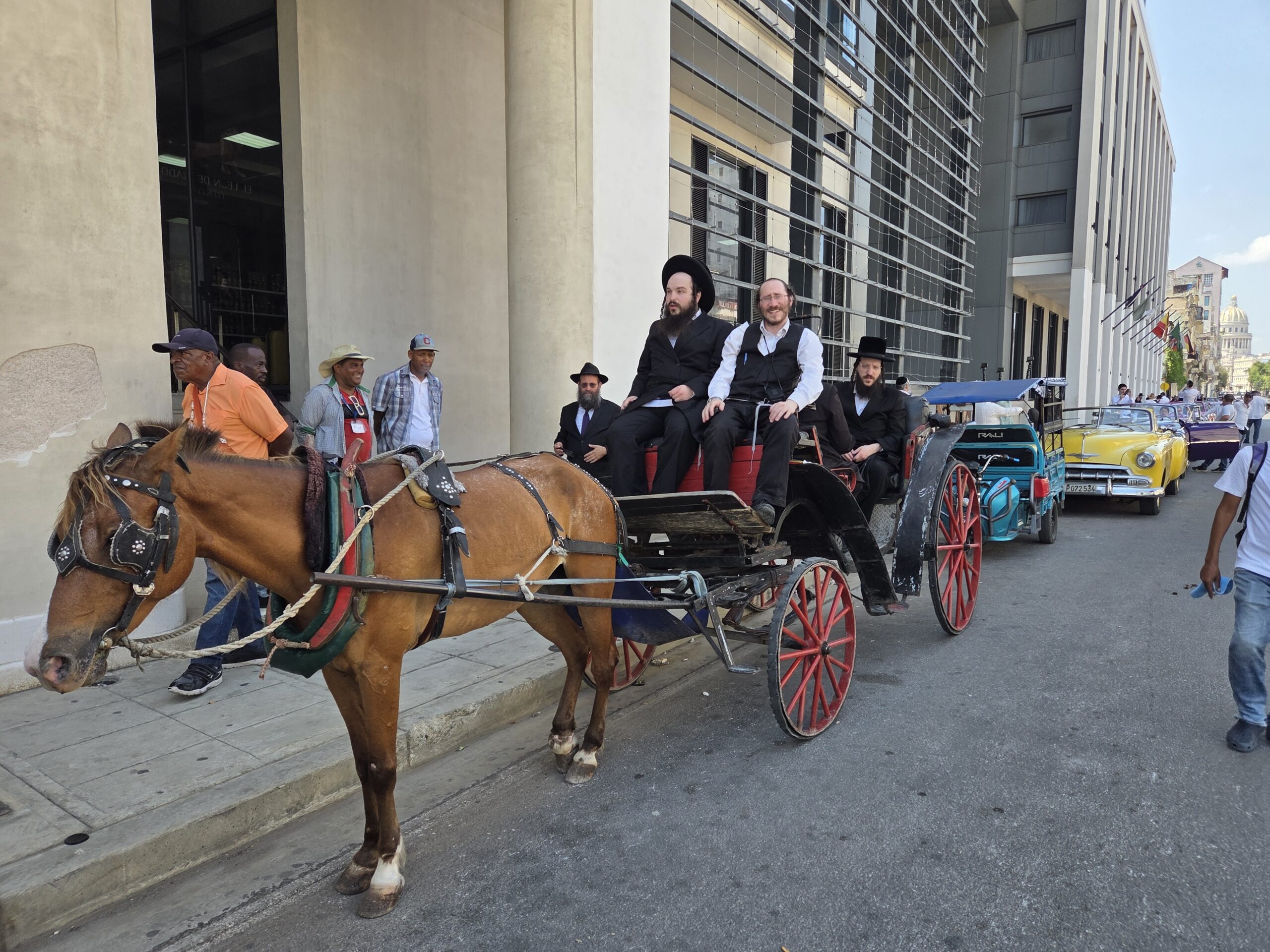
A procession of horse-drawn carriages and 15 almendores led the Torah Trucks— made up of two converted tuk tuks outfitted with speakers and flags—along the main boulevard passing by the Capitolio. Passersby joined in, waving flags and clapping to the music.
Once the procession reached the old town, it continued on foot to Adath Yisrael. Joy filled the air as a diverse group of Jews from across the world linked hands and danced for kavod haTorah. Even the locals, notwithstanding their crushing hardships, were smiling.
Shulem Pesach Korn brought along a large bag of pekalach, but there were no children to give them to. Instead, we gave them to the people who gathered along the route. This turned out to be a mistake, as within moments the bag was ripped and a brawl ensued. People were falling over each other in their desperation to grab something for themselves. It was sad to witness.
The procession continued into the shul, where the old sifrei Torah were taken out to greet the new arrival. The large, vintage air conditioning unit did not help much to cool the sanctuary that was sweltering in the daytime heat, but this did not dampen the spirits. A medley of contemporary and classic Jewish songs were played, some of which the Cuban Jews still remembered.
My brief visit to Cuba exposed me to the unbearable hardships that the country is experiencing. But through it all, the Jewish resilience shined as a beacon of hope. It was remarkable to witness Jews remembering their brothers in need. Despite the language barriers and cultural difference, we remain brothers who look after each other. ●
To read more, subscribe to Ami