



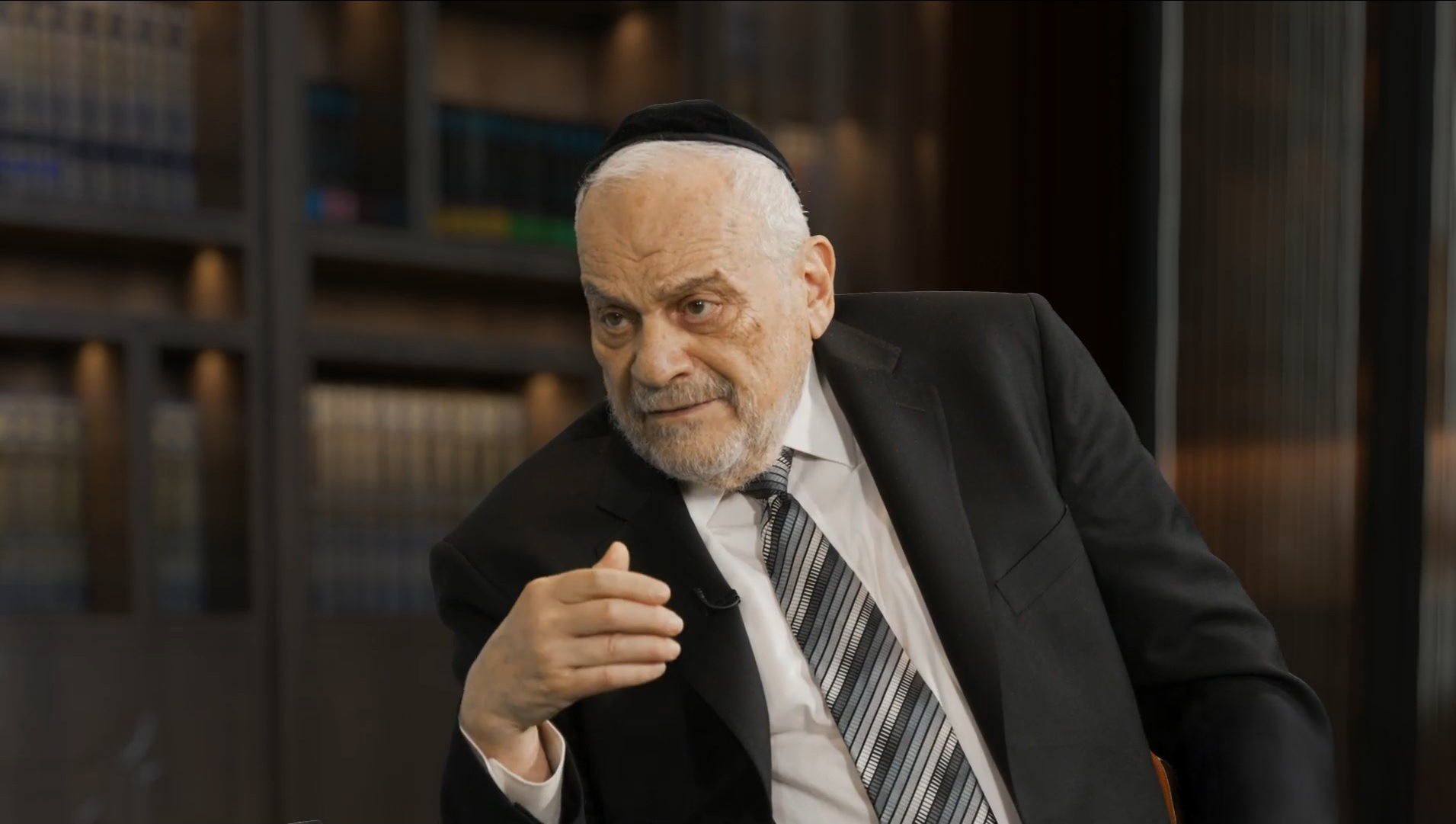
Unfortunately, for all of klal Yisrael, the rich narratives so brilliantly woven by Rabbi Berel Wein, z”l, have reached their final chapter. Rabbi Wein passed away this past Shabbos at the age of 91. Yet his voice—and the wisdom it carried—will undoubtedly continue to echo for generations to come.
American-born, Rabbi Wein served as a vital bridge to the world of Eastern Europe and its legendary Litvishe gedolim, connecting thousands of talmidim across generations through his illuminating stories, profound lessons and captivating narratives.
He often lamented that many American talmidim lacked a living kesher to the past—the unspoken lessons of faith, perspective and resilience that could only be absorbed in the presence of towering Torah figures. Though born and raised in Chicago, Rabbi Wein felt inextricably bound to that vanished world of Lita. He loved to quote Rebbi’s remark in Eiruvin, “The reason I am sharper than my friends is that I once saw Rabbi Meir from the back.” With his trademark blend of humility and longing, Rabbi Wein would add with a wry smile, “I, too, saw Eastern European Jewry—but only from the back.”
That line became his personal credo. He knew that he had not personally stood in Slabodka, Radin or Grodno, yet through the talmidim of those giants, he had breathed their air, felt their fire, and absorbed their middos and worldview. He chose to study at Hebrew Theological College (HTC, the Skokie yeshivah), an institution founded by his maternal grandfather, Rabbi Chaim Tzvi Rubinstein. There, he sat at the feet of luminaries such as Rav Oscar Z. Fasman, Rav Mendel Kaplan, Rav Mordechai Rogow and Rav Chaim Kreiswirth, absorbing both Torah and life lessons.
To this he added the Torah he inherited from his father, Rav Zev Wein—a talmid of Rav Shimon Shkop and Yeshivas Merkaz Harav in Yerushalayim—and from his father-in-law, Rav Leizer Levin, zt”l, a disciple of the Chofetz Chaim whose teachings were deeply shaped by the mussar tradition of Kelm.
Through their voices, he heard the echoes of an earlier generation: the Chofetz Chaim, the Alter of Slabodka, Rav Isser Zalman Meltzer, Rav Chaim Ozer Grodzinsky, Rav Yeruchom Levovitz and countless others. Walking in the shadows of their talmidim and basking in their enduring light, Rabbi Wein became a bridge—carrying forward not only their Torah but also their distinctive cadence, illuminating perspective and unmistakable grandeur.
In his close relationships with their disciples—Rav Yaakov Kamenetsky, the Ponevezher Rav, Rav Aharon Kotler and chasidic rebbes such as the Kapishnitzer and Satmar Rebbes, along with numerous other gedolei Yisrael—he solidified his role as a bridge between worlds. What he gleaned from them, he transmitted to American Jewry with fervor, wit and a profound sense of mission. He empowered countless individuals to traverse that bridge and “look across the river, for there we shall never go…back.”
Born in Chicago in 1934 into seven generations of rabbanim, he witnessed the rise of a vibrant American Torah community—one that bravely confronted the influence of the Conservative movement, which, though powerful at the time, has thankfully withered.
One of the most vivid memories of his youth, which he frequently shared with thousands of talmidim in yeshivos and through his recorded shiurim, involved Israeli Chief Rabbi Yitzchak Herzog’s visit to Chicago in 1946. Fresh from visiting DP camps and meeting with the pope at the Vatican, Rabbi Herzog spoke to the children about the 10,000 Jewish children hidden in monasteries across Europe. His plea to the pope for their rightful return was met with refusal: “We have baptized them, and it is prohibited for us to allow them to return to a different religion.” Young Berel was forever impacted by Rav Herzog, who, with tears streaming, lifted his head and exclaimed to the boys, “I cannot save them. But we have you. What are you going to do for klal Yisrael?”
These words became the guiding force in his life, though his path did not initially lead to rabbanus. Shortly after his marriage in 1955 to Lita-born Yocheved “Jackie” Levin, Rabbi Wein pursued a career in law, graduating with honors and practicing for nearly a decade. Yet the urging of his rebbeim, the words of Rav Herzog, and the profound calling of his soul led him to make a life-altering pivot, dedicating himself fully to the world of rabbanus and harbatzas haTorah.
Instead of advising clients, he brought Torah to the world, exuding a regal rabbinic presence from Miami to Monsey to Yerushalayim and to countless cities across the globe. Whether addressing non-religious crowds in remote areas or enthralling audiences at Agudah conventions or UJA conferences, he never compromised his message, remaining true to the mesorah of his rebbeim. It is no surprise that he is mourned by Jews from all walks of life—from modern Jews in Hollywood to tzadikim like Rav Don Segal, who delivered a heartfelt hesped at his levayah.
With his inimitable wit and penchant for memorable one-liners, Rabbi Wein explained his 180-degree transition: “A lawyer often sees people at their worst. A rav is supposed to see people at their best.” He also credited his move to the urging of his rebbi, Rav Chaim Kreiswirth, who told him, “Jews already have enough lawyers. What klal Yisrael needs is more rabbanim!”
Thus, in 1964, he began his career in rabbanus. In truth, by temperament and lineage, Rabbi Wein was always a rav. Yet the move from law required mesiras nefesh: His first year’s rabbinic salary was less than the income tax he had paid the previous year as a lawyer. Still, he was happier. He took over a storefront shul, which became Beth Israel of Miami Beach—a thriving kehillah.
To read more, subscribe to Ami