



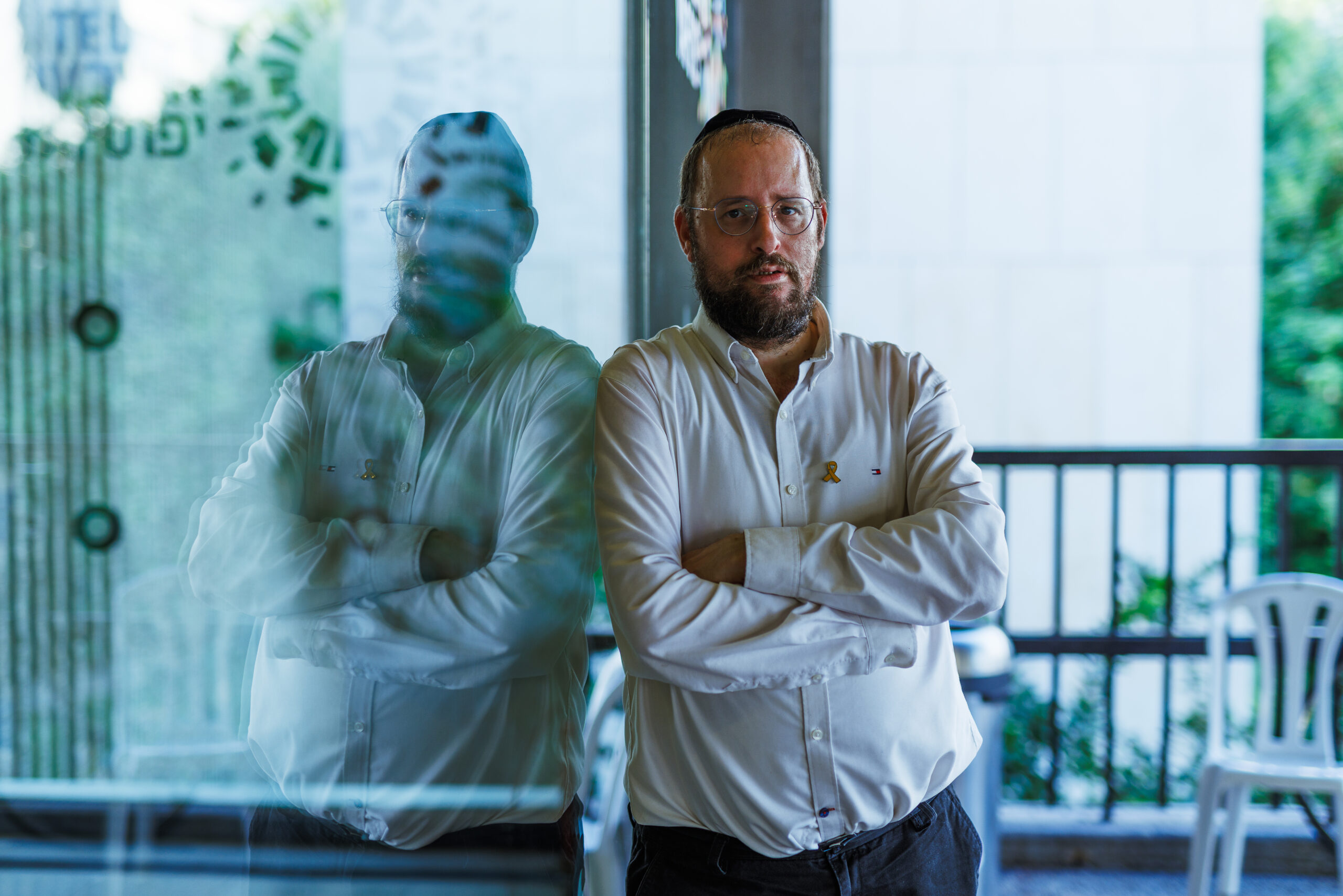
In the wake of October 7, journalist and activist Yisrael Cohen has taken on an unexpected role: serving as the quiet conduit between the anguished families of Israeli hostages and the leadership of the frum world
* * *
Since October 7 shattered Israeli life, the hostages have become the focus of relentless public and political activism, both in Israel and around the globe. For Yisrael Cohen, a prominent chareidi journalist at Kikar HaShabbos and other outlets—and, full disclosure, a close personal friend—the tragedy marked a turning point. From that day on, he devoted himself almost entirely to the families of the hostages. Unofficially, he became a vital intermediary between the families and the leaders of the chareidi community. He brings grieving relatives to the homes of gedolei Yisrael and helps forge a deep, often unexpected connection between these two worlds.
It was in that role that he was invited to speak at Hostage Square in Tel Aviv shortly before Yom Kippur. In a heartfelt address, Yisrael Cohen turned to the chareidi Knesset members with a plea: “It is our duty not to forget the abductees in every tefillah. When we pour out our hearts before the Creator, what we describe—anguish, loneliness, helplessness—is exactly what our brothers and sisters are enduring in captivity. On the eve of Yom Kippur, shortly before we all gather in mourning for the first yahrtzeit of that horrific day, we must not turn away.
“It is incumbent upon our representatives to do everything within their power to cause a ruckus and ‘turn over the tables’ until a full hostage deal is achieved to bring our sons and daughters home. You are their guarantors. We are turning to you on their behalf.”
“My connection with the families of the hostages began about two weeks after October 7,” Cohen recalls. “I was with a friend, and we decided to go to the Hostage Square in Tel Aviv, which has served as a sort of headquarters for the hostage families. While there, we met someone serving as the spokesperson for the families—someone with ties to the chareidi world.”
It was a pivotal moment. Some of the relatives had started voicing a painful question: “Where are the chareidim? Why don’t we feel that they’re with us?”
“There was a sense of a disconnect,” Cohen says. “These families felt that the pain didn’t penetrate. It didn’t burn in the same way. To the families, it felt as if the chareidi public wasn’t sharing the raw, gut-wrenching agony of this national wound.
But it wasn’t only the sense of emotional distance that pained the families. “They didn’t just want sympathy,” Cohen explains. “They wanted partnership. They wanted to see the chareidim not only showing support but actively helping push toward a deal. They didn’t want the chareidim watching from the sidelines. They wanted them at the center, in the heart of the struggle. They felt that if anyone could bring moral clarity and a sense of achrayus, it was the Torah world.”
That’s when Yisrael Cohen realized that the bridge wasn’t going to build itself. Someone had to carry the voices between these two communities.
“That lit a fire in me,” Cohen says. “I turned to the spokesperson and said, ‘Let’s start somewhere real.’”
He floated a suggestion: What if we invite Rav David Yosef to meet with the families?
At the time, Rav David wasn’t yet serving as chief rabbi, but Cohen had known him somewhat over the years and felt he might be receptive.
“He agreed immediately without hesitation,” Cohen says. “Rav David joined us for the meeting with the families. It was a powerful gathering. The meeting was small, but those who participated left feeling strengthened—seen, heard and supported. Rav David reiterated the halachic ruling of his father, which he had issued during Operation Entebbe. He ruled that the mitzvah of pidyon shvuyim overrides future considerations about the possibility of released terrorists returning to terrorism, because the situation of the hostages presents an immediate danger to life that justifies their release.
“I asked him if there was any prohibition against wearing the necklace with the names of the hostages. That had become a symbol among the families.
“‘It’s a mitzvah,’ he replied decisively.
“The families’ desire to connect with the chareidi public was driven by three goals. First, they needed emunah and chizzuk to carry them through a time of unimaginable pain. Second, they sought a sense of national solidarity, which should include Israelis from every segment of Israeli society, chareidim among them. And third, they wanted political cooperation from chareidi leadership in support of negotiations and deals that could bring their loved ones home.”
The spiritual response was taken up by organizations like Kesher Yehudi and through the activism of Margalit Deri, daughter of Shas leader Aryeh Deri. She leads powerful Shabbos retreats for chizzuk, arranges tefillah gatherings at kivrei tzaddikim, and facilitates emotional encounters with gedolim and rabbanim. These efforts aren’t just symbolic—they bring real comfort and connection.
To read more, subscribe to Ami