



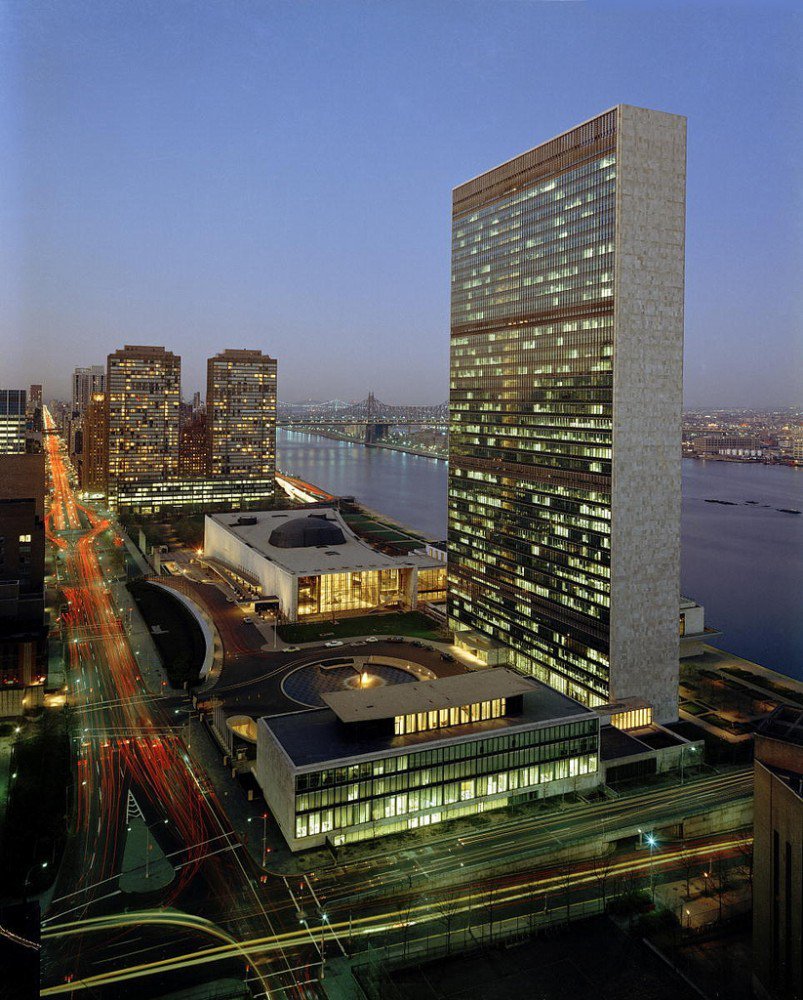
Times of tumult at Turtle Bay
Interesting times these days at the UN.
Its “special rapporteur on the occupied Palestinian territories” accused The New York Times of being too pro-Israel. And an ethnically Palestinian woman, a candidate for the UN secretary generalship, is being defended by Israel’s ambassador.
The repugnant rapporteur, Francesca Albanese, who has made a name for herself as one of the most unbridled and unhinged Israel-haters on the international scene, issued a report that castigated the Times’ coverage of Israel.
Ironically, the paper has previously lauded Ms. Albanese as an expert on the Palestinian issue. Last year, it even published a lengthy, gushing profile of her (written by the Times’ own resident Israel basher, M. Gessen, who famously compared the Gaza Strip to Jewish ghettos under Nazi occupation).
But, apparently, Ms. Albanese went too far this time, claiming in her report, titled “Truth Under the Rubble: Media in the Time of Genocide,” that the paper of record had—shudder—advised “editorial caution” when using terms like “genocide.” What’s more, she charged, the Times had provided “humanitarian camouflage” to Israel via coverage of “safe zones” in Gaza, and it mentioned abhorrent types of violence against Israelis too often.
She also denigrated the paper for daring to write about Hamas’s use of human shields; alleged that the newspaper “downplayed Israeli responsibility”; and, along with other “influential international media” (including the BBC!), “legitimize[d Israeli] atrocities.”
Ms. Albanese dubbed what she considers the “assault on truth” a “mediacide.” (She has previously accused Israel of “genocide,” “cultural genocide,” “domicide,” “urbicide,” “scholasticide,” “medicide” and “ecocide.” No doubt, she’d happily advise suicide.)
But the Times mustered its mettle. A spokesperson for the paper said that the special rapporteur’s report “is not impartial, nor are the sources she relies on.” Take that, Francesca!
The spokesperson also defended the paper’s coverage of Israeli safe zones by noting that “in the majority of cases, our coverage refers pointedly to ‘so-called’ safe zones”—the scare quotes indicating doubt about whether the zones were in fact safe. (In other words, “Hey, don’t diss us, lady—we don’t trust Israel either.”)
In other UN news, human rights groups have urged countries to reject UAE diplomat Lana Nusseibeh’s bid to become secretary general, succeeding incumbent António Guterres, who has regularly exhibited signs of Israel Derangement Syndrome.
To win the appointment, a candidate must secure nine out of 15 votes on the Security Council and avoid a veto from one of its five permanent members: the United States, Britain, China, France and Russia.
Ms. Nusseibeh, currently perceived as a front runner, is a seasoned diplomat who served as the United Arab Emirates’ representative to the UN from 2013 to 2024 and had been the country’s minister of state in its Ministry of Foreign Affairs until taking a leave of absence to focus on her candidacy.
Several human rights groups are urging countries to reject her because of the UAE’s alleged financing of paramilitary forces in Sudan and, of course, its normalization with Israel.
That Ken Roth, former head of Human Rights Watch, called Ms. Nusseibeh’s candidacy “utterly inappropriate” should be proof enough that she’s well qualified for the post.
She has garnered not only the backing of Gulf states but also kind words from Israeli Ambassador to the UN Danny Danon, who, although Israel is not officially backing any candidate, said, “I have known Ambassador Nusseibeh for many years. I served with her at the UN. She’s a skilled diplomat… I think that she has the tools to lead the organization” (although he hastened to add—after all, he’s a diplomat—“like other candidates that also have the tools”).
Whether or not the opposition to Ms. Nusseibeh’s candidacy will amass enough weight to torpedo it, the candidate does check two of three important boxes for the job.
One, she is female (and, if appointed, would be the first woman UN secretary general).
Two, she is an Arab (from a prominent Palestinian family of statesmen—one, in fact, that fled their ancestral home in 1948).
The UN’s box #3, though, presents a problem. She probably can’t commit to treat Israel unfairly.
But if she somehow nevertheless prevails, she will be positioned to be a much-needed counterweight to a certain “special rapporteur.” ●