


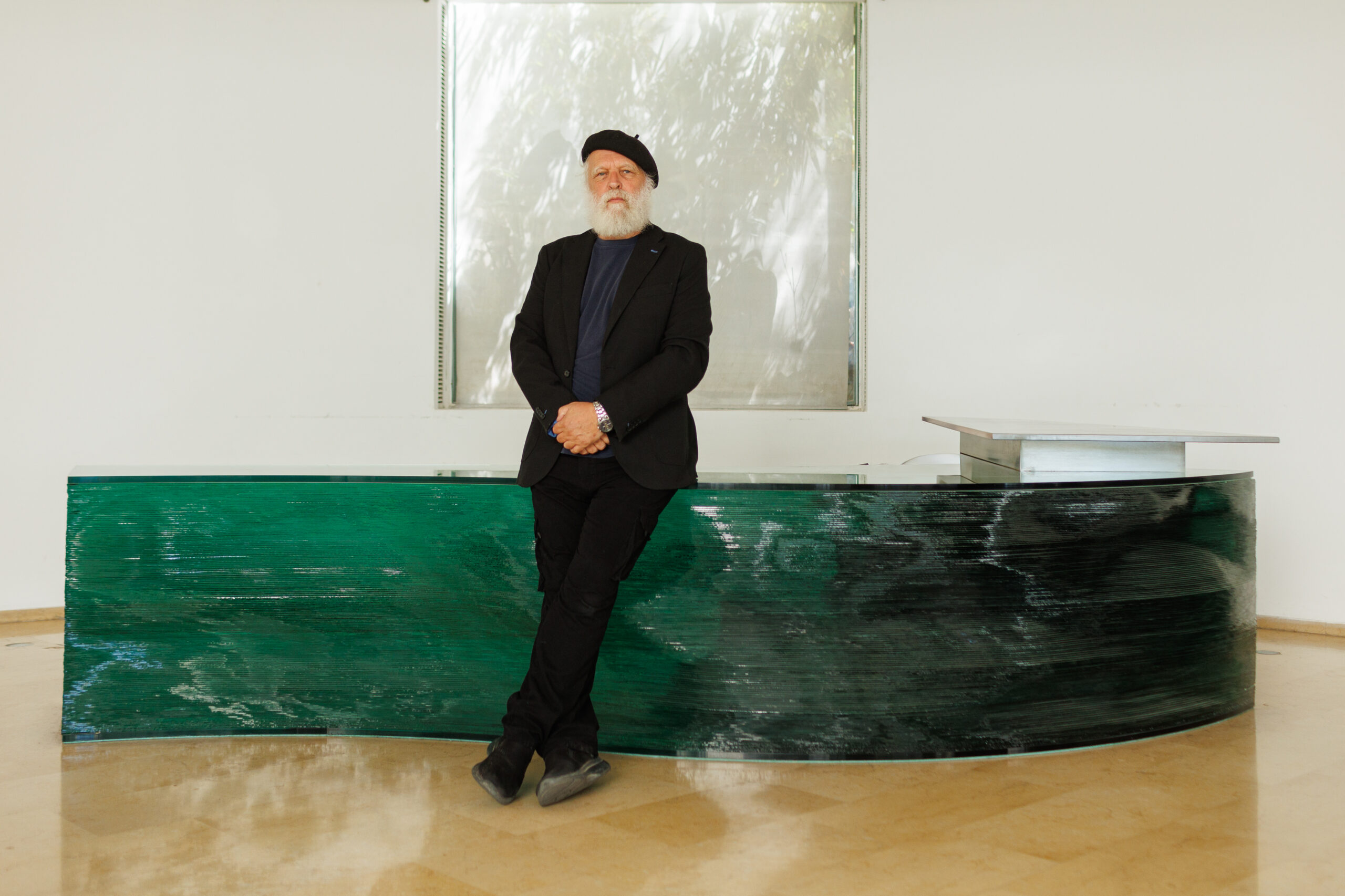
When I initially reached out to Jeremy Langford, one of the most celebrated glass artists in the world, I was interested in talking about his business and his magnificent Jewish-themed installations around the world and in the mekomos hakedoshim in Eretz Yisrael. What followed was one of the most engaging several-hours-long conversations I’ve had in a long time.
Jeremy has the soul of an artist, and every aspect of our conversation was deeply thought out and full of wisdom. All of his works have Kabbalistic themes woven into them.
Jeremy’s life has been inspiring, having found his own journey to becoming frum. He went through many difficulties in his life, both in business and personally, each time rising from the ashes to start anew.
Jeremy also has a machon dedicated to publishing the sefarim of Rav Ashlag, as well as several nonprofits.
His story fits perfectly with Shabbos Nachamu: despite the difficulties, looking to a brighter future, knowing that Hashem is on our side.
Enjoy!
—Nesanel
I come from a show business family. My father, Barry Langford, was a BBC Television director and producer. I was born in London, but the first 15 or so years of my life were constant movement. My father was constantly looking for ‘El Dorado,’ wealth and abundance, somewhere else. Later on in life, I saw the comparison with Rebbe Nachman’s story of the treasure under the bridge. He never looked inside to find what it contained, so we kept moving.
“Because he was head of entertainment at the BBC, I grew up quite literally with all of the ’60s and ’70s rock stars; they were part of my life. My father also discovered and made famous some well-known singers.
“We were moving back and forth between Australia and England until we finally came to Israel when I was 15. I became the back sheep of the family. The entertainment world is the absolute chitzoniyut of chitzoniyut, the very superficiality of life, and I was always seeking something deeper. I couldn’t abide what I called the ‘plastic smile and a knife in your back’ mentality.
“My family was totally secular. We used to go to a Reform temple for about five minutes on Yom Kippur and then go out for lunch. The only thing kodesh in the family was that up until my generation there was never any intermarriage. I’m a pedigreed Yid, and we know that we are Levi’im.
“My Hebrew name is Yehuda, not Yirmeyahu or anything related to Jeremy. In fact, how I got my name is a strange story in and of itself. For some reason, my father decided to have a chareidi mohel perform my bris, which was very uncharacteristic of him. When he told him that he wanted to name me Jeremy, the mohel said, ‘What kind of Yiddishe name is Jeremy? You have to give him a Jewish name.’ So my father said, ‘Then I’d like to name him after my late Uncle Joseph. Let’s call him Yehuda.’ That’s probably one of the reasons I became an artist, because it’s all so confusing!
“When I was a schoolboy—this was back in the days when we used fountain pens—my teacher once told me, ‘Jeremy, you don’t write. You have a trained spider you dip in ink and then let walk all over the page.’ I’ve always needed to express something. My first forays into art were probably around 11 or 12. I used to go to building sites, which in those days weren’t fenced off. I would take the metal rods that were lying around and start bending them into all sorts of shapes. Those were my first ‘sculptures.’
“A few years later, I started dabbling in glass. For some reason, it spoke to me. My father was very disappointed when I didn’t go into show business. One of the best pieces of advice he ever gave me was that whenever I went for an interview or audition and they asked me if I could do something, I should always answer yes and then go learn whatever skill it was. That attitude stayed with me, always accepting challenges and moving on.
“I wanted to know what glass was all about, so I got hold of some of glass and started smashing it with a hammer. Someone had given me an old pottery kiln, so I started melting the glass and making a real mess. On Yom Kippur we say, ‘Ki hinei kazechuchis b’yad hamezageg—Behold like glass in the hands of the glassblower,’ except that I didn’t know what I was doing. But a lot of beautiful things started coming out of those mistakes, and I realized that I needed some education.
“In England, everyone has letters after his name. My uncle called himself ‘Bernard Young, OBE.’ Nobody bothers to question it; it just looks very impressive on a business card. One day I asked him—he was already quite old by then—what it really stood for; it’s supposed to mean Order of the British Empire. He replied, ‘Don’t tell anybody, but it’s actually QBE—the initials of Qualified By Experience.’ That’s basically what I did until I met a certain glass artist in England.
“But even since then, almost everything I know is self-taught and self-developed. I’ve invented techniques that didn’t exist before. For instance, the project at the Kotel couldn’t have been done before I did it. You can’t build a sculpture 30 or 40 feet high with regular glass art. It’s just impossible. And I imbued my team with the same spirit.
“When I came to Israel at the age if 15 I continued to attend secular schools. Judaism, as it was presented to me, left me cold because I was seeking depth. So I decided that I wanted to go to South America and live in the jungle. My goal was to find a place that didn’t sell Coca-Cola. But in order to go to South America I couldn’t just jump over from Israel, so I went back to England first. But my trip was delayed because that’s when I met the glass artist. He was already elderly by then and was very experienced.
“When I showed him a few of the things I’d made, he said, ‘If that’s what you can do on your own, imagine what you can do if you were taught how to do it.’ So I became his apprentice and was trained in the classic glass arts. Nonetheless, I still felt its limitations and wanted to do bigger things. I was always trying to push the envelope.
“After the apprenticeship, I went to South America. I arrived with $150 in my pocket and was there for a year living on very little money. I used to go to a ranchero—sort of like a poritz back in Poland—whom everyone worked for. They were fascinated by a foreigner because this was in the middle of nowhere. I ended up creating glass art for them, which would give me enough money to continue traveling for another couple of months until I went to another ranchero. That’s how I financed my trip around Argentina and Brazil.
“After that, I went back to London and opened a small studio. I started doing work for the Hilton Hotel in Mayfair and also for the British Museum.
“It’s interesting. Although I had run away from show business, a lot of my communication skills and ability to open doors must have come from that early influence. Today, I do zero advertising yet I always have a backlog of work. But back then I had to promote myself. Eventually, I left England and returned to Israel.
To read more, subscribe to Ami