



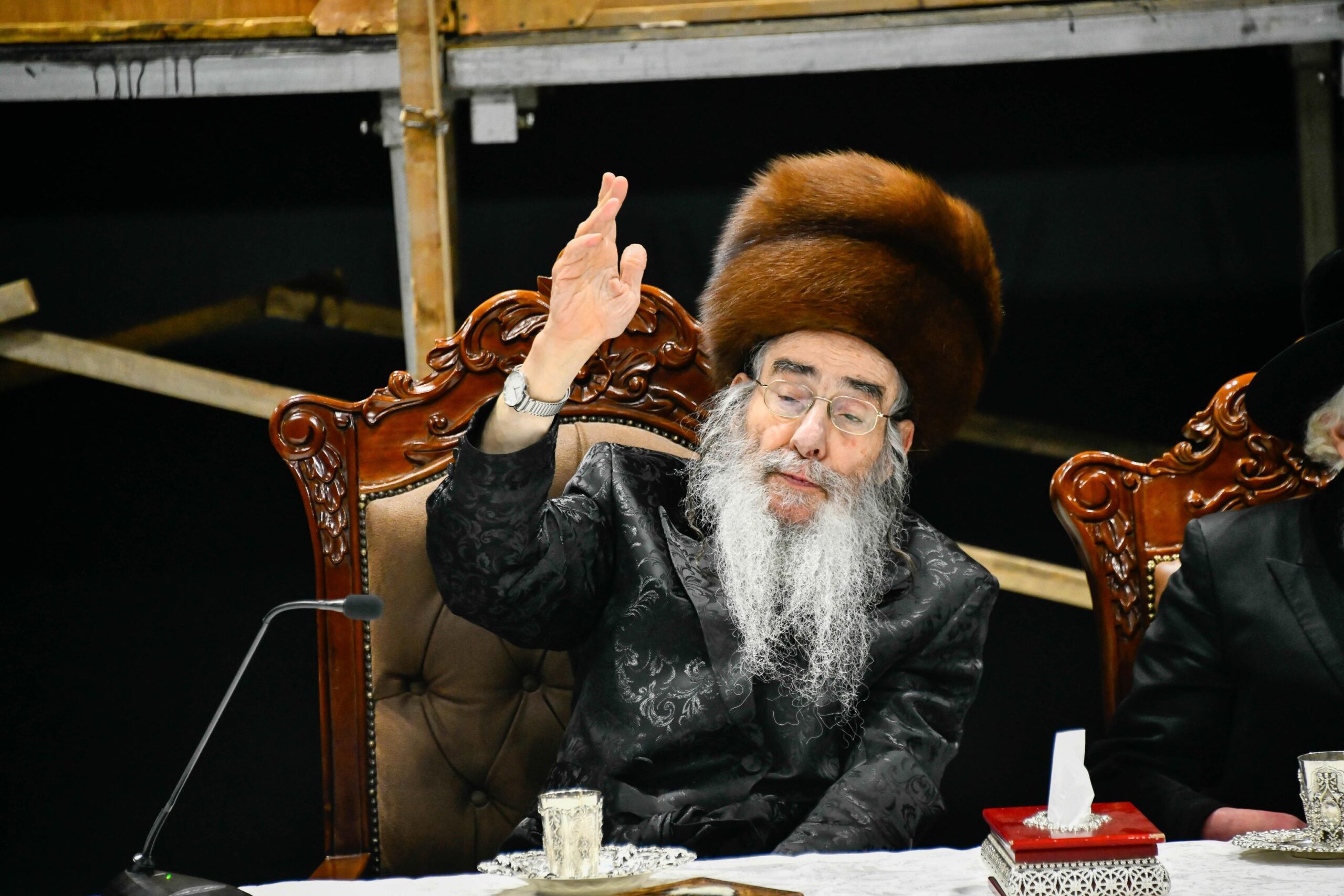
On a steamy Bnei Brak night, I find myself on Rechov Admorei Alexander. Across the street from the headquarters of the Alexander chasidus stands an extension built onto an apartment building, where the Rebbe holds kabbalas kahal. Even at this late hour, a line of people is waiting for a turn to see the Rebbe—to seek his advice, to share their joy, to unburden their grief or simply to ask for a brachah. Speaking with some of the chasidim waiting, I begin to understand why the Rebbe attracts such a broad spectrum of Yidden. “The Rebbe is mamash nosei b’ol im chaveiro. I sometimes feel he takes my problems more to heart than I do.”
The waiting room also seems to double as a shul. There are shul-style tables and benches, a bimah, a sefarim shrank, an amud, and a table and chair for the Rebbe.
The line moves gradually. Most of those waiting appear to be Alexander chasidim, but there are plenty of people from other backgrounds as well. There are a number of biver hats, a couple of Sefardim, and others who clearly come from outside the Alexander world. At the far end, the gabbai sits writing kvitlach and lets people in when the Rebbe is ready for them. The Rebbe gives each petitioner as much time as he needs, and the gabbaim do as they are told by the Rebbe and don’t interfere.
Getting into this line at all took some doing. Alexander shies away from publicity. The chasidus guards the Rebbe’s privacy very carefully, and this was not the first time I had tried getting in to see the Rebbe. On each previous attempt, the answer came back the same, politely and without any wiggle room: The Rebbe does not grant interviews. When I called again before Sukkos, I was told exactly that once more.
“Neither do I conduct interviews with Rebbes,” was my response. I explained that I had not come looking for an interview at all but to ask for divrei chizzuk, hadrachah and divrei Torah that our readers could carry with them into Yom Tov. The Rebbe generously granted my request.
The Alexander Legacy
Rechov Admorei Alexander, right off Rechov Maimon, is where the court has sat since it was rebuilt. There is a beautiful beis midrash, a yeshivah ketanah and a yeshivah gedolah, as well as mosdos hachinuch. Beyond Bnei Brak there are kehillos in Yerushalayim and Modi’in Illit, and batei midrash further afield in Boro Park, Antwerp, Stamford Hill and Zurich. Each week, the Rebbe’s divrei Torah are written down by those who hear them, and they are sent to the chasidim in print.
Today, the Alexander chasidus numbers over a thousand families around the world. While that is relatively large, it’s nothing compared to what Alexander was before the Second World War, when it was one of the largest chasidic groups in Poland, second only to Ger. The Alexander chasidus numbered in the tens of thousands.
The chasidus has its origins in Peshischa. Rav Yaakov Yitzchak, more commonly known as the Yid Hakadosh, was a talmid of the Chozeh of Lublin who began leading his own circle of chasidim during his Rebbe’s lifetime. That circle was, by the standards of Polish chasidus in those years, deliberately narrow. Generally, chasidus catered to the masses, and no distinction was drawn between the simple Jew and the more learned and pious. Peshischa catered to brilliant talmidei chachamim who were great yerei’ei shamayim. After the Yid Hakadosh’s petirah, the leadership passed to his talmid, Rav Simcha Bunim, and out of his beis midrash came the two great rivers of Polish chasidus. One ran to Kotzk, known for its sharpness, for truth without any softening, for burning away whatever was not real. The other ran to Vurka, to Rav Yitzchak Kalish, who focused on ahavas Yisrael, humility, silence and tefillah.
To read more, subscribe to Ami