



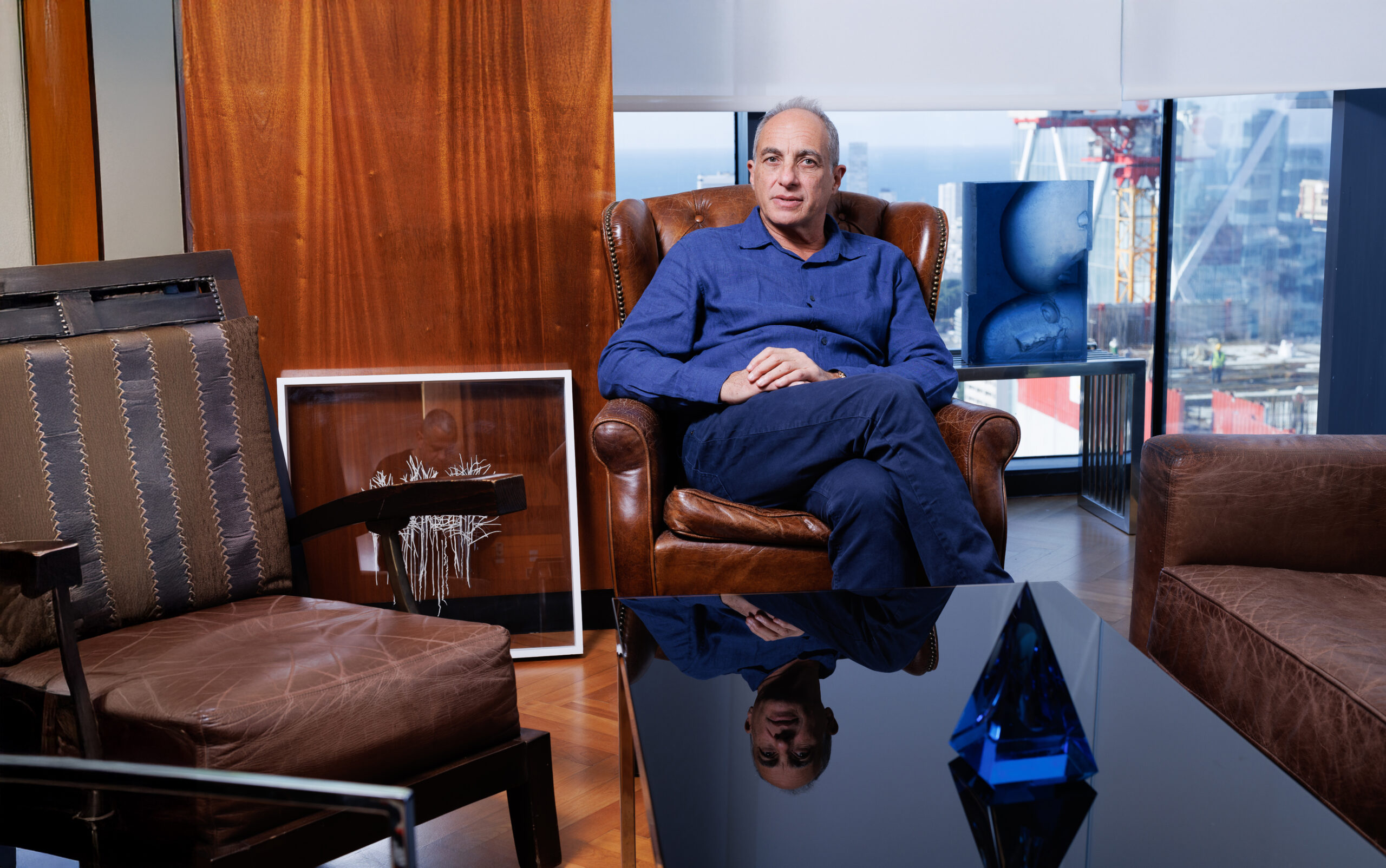
Edouard [Eddy] Cukierman, born in Paris, France, in 1965, is the founder of Catalyst Investments and chairman of the Cukierman & Co. Investment House, which has engaged in over $10.5 billion worth of corporate finance transactions since its establishment in 1993. Mr. Cukierman is also the CEO and chairman of the Catalyst Investors’ Club and currently serves on the boards of Otorio and Curalife. In the past, he served on the boards of Tufin, Orex, MTI, Dori Media Group, Omrix and numerous other Israeli high-tech companies.
Edouard’s father is Roger Cukierman, the ninth president of the Conseil Représentatif des Institutions Juives de France (CRIF) and vice president of the World Jewish Congress. Edouard immigrated to Israel in 1982 and lives in Tel Aviv with his wife and children.
Israel has long been known as the “startup nation” because of its innovations in high tech, but it is now back to being a country at war. Does that reflect your own trajectory and career?
Not necessarily. Ever since I moved to Israel in 1982 we have unfortunately had to face a war every ten years, so it’s not as if we started with high tech and then had war; they always coexisted. In fact, part of the reason why the hi-tech sector has been so successful is that Israel was always at war and had to produce security technology. Also, because the soldiers were exposed to state-of-the-art technology from a very young age, it helped them develop technology for civilian applications as well. In other words, the civilian hi-tech sector was developed thanks to technology produced by the army. There’s also a very strong bond between the Israeli universities and the hi-tech sector.
Another factor in all of this is that Israelis are forced to shoulder responsibility from a very young age. Today’s generation, the generation of my children, have spent most of the last year serving in Gaza and the West Bank, where they are charged with protecting the lives of others who are even younger than they are. My son was practically a baby when he became a soldier and now he is suddenly the commander of a special unit. I heard him telling the parents of his soldiers that he is taking care of them as if he is their father. I found it very moving to hear him talk that way even though he is only 21 years old. You don’t see this type of responsibility at such a young age in other environments. I think that’s part of the DNA of the Israeli entrepreneurs, which partially explains their success.
As a venture capitalist who is trying to raise funds for Israeli companies that need financial backing, have things become more challenging since October 7 and the subsequent outburst of anti-Semitism? You certainly have a unique perspective.
Things have undoubtedly become harder due to the war and the way Israel has been portrayed by the media, combined with the demonstrations that have taken place all over the world, especially in Europe. But I believe that this has also driven us to further develop our capabilities to manage on our own. This is not the first time that Israel is feeling alone and unsupported; we’ve been in this position before. During the Six-Day War in 1967, de Gaulle portrayed Israel as the aggressor and declared an arms embargo and boycott. In every single conflict, Israel has mostly had to count on itself.
Fortunately, the country as a whole is stronger than ever before. In 1948, the United States wasn’t the first country to support the establishment of the State of Israel, but things are different now and America has been very supportive. Of course, we have been very disappointed by some of the European countries, as very few of them have supported Israel as they should have, especially after the events of October 7. So we are now finding out who our friends really are.
The war has definitely affected the ability of many Israeli companies to raise money. In 2021, $25 billion was invested by the venture capital industry in the Israeli hi-tech sector. But over the last two years, it’s been less than $10 billion per year. That’s a big drop. Also, a lot of people working in hi-tech have had to serve in the army reserves—at least 25% of the workforce—so it was a very tough year. At the same time, Israelis are resilient. In 2024 there were more M&A (merger and acquisition) transactions than the year before. The number of unicorns [startups that are valued at over $1 billion] has also been growing. So there are challenges, but we’ve seen many signs of success as well. Those who weren’t called up to the reserves just worked harder. If we were engaged to deliver products we did it, even if it was difficult to achieve those goals.
The result is that there may be fewer investors right now, but there are very good opportunities because the values have gone down. Based on my over 30 years of experience, I think that the best time to invest is when the industry is facing challenges. We’ve seen valuations drop over the past year, but that makes them much more attractive to people who want to invest in the Israeli ecosystem.
Did the valuations go down because of the war?
Part of the reason for the declining valuations is supply and demand. There are fewer international players able to come to Israel and invest here. You can see that in a number of areas. For example, the tech companies that trade on the Tel Aviv Stock Exchange have underperformed in comparison to the companies on the Nasdaq. This is a very transparent way to see the value declining. The multipliers we have today when we invest in a company are much lower than in 2021 or even 2022. Even for a company that has very good fundamentals, you’re going to pay a much lower price today than you would have two or three years ago. If you look at our portfolio, probably less than 1% of the turnover is to the Israeli market. These are companies that are international and do not depend on the local markets for their products.
Is Israel’s ecosystem unique, or is it similar to the rest of the Western world?
I think it’s very different, although there are common elements. The Silicon Valley companies are a melting pot of people from different countries and cultures, which is similar to the way things are in Israel. You can also see the role played by the universities. But again, the big difference is the expertise and experience that people acquire in the army, whether that’s in security, medical devices, vision systems or other areas. And it’s not only their prior access to technology but the attitude and approach they learn in the military.
Some of the technology we invest in comes from the army, even though it’s used for civilian applications. For instance, we were the only venture fund that invested in Mobileye. Mobileye was the biggest transaction ever made by an Israeli company in the history of Israeli hi-tech, having been sold to Intel for $15.3 billion. It is now a market leader in the car industry, and it makes the sensors for the proximity warnings to avoid collisions. When we invested in it, every competitor was able to sense static elements, but Mobileye was the only one that was able to identify moving pedestrians. These days, if you have a missile that is guided by a vision system and a pedestrian suddenly enters the area and you need to divert the missile in real time, you can do it with this technology at the speed of a car. That’s why Mobileye was superior to any other technology around. Most of the engineers came from a background where they had learned to do that.
Do you envision any positive technological developments arising from everything that has happened since October 7?
I am sure that there will be many of them. We’ve seen what the Iron Dome has been able to do to protect the country by destroying rockets and drones. However, the challenge is that the terrorists send a drone that cost them $500 and you have to fire two missiles that cost $50,000, which means that the average cost of stopping a cheap drone is $100,000. It’s completely absurd. That’s why we’re starting to hear about the use of laser technologies. Many other countries have tried to develop lasers that are able to stop missiles and drones, but there is one Israeli company that has developed a solution that works very efficiently. Instead of $100,000, the cost of operating the laser is the cost of the energy, which is less than $5.
To read more, subscribe to Ami