




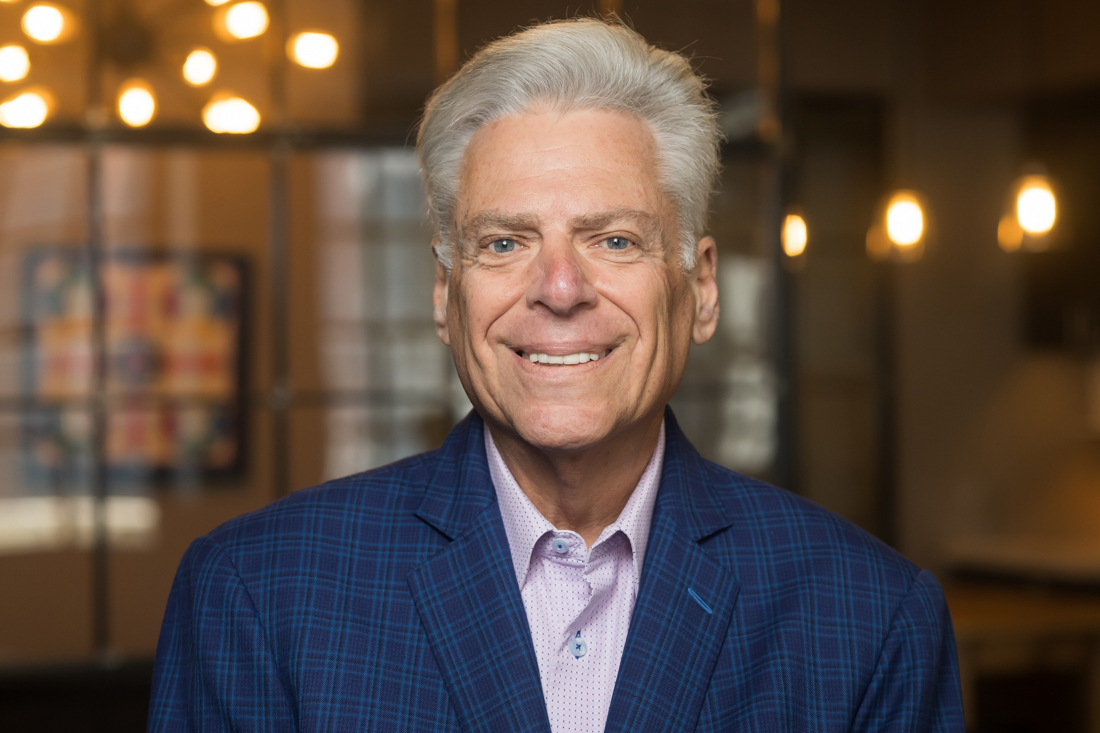
When it comes to sales and growing a business, companies looking to expand recognize that they are only as good as their next sale—especially when that “sale” can be worth millions of dollars. Enter Ron Karr and his company, Velocity Mindset. Ron was already an experienced salesman making serious money when life’s circumstances caused him to reevaluate his career path.
He had already been doing sales training and decided to focus on taking it to the next level, eventually developing what he calls the “Velocity Mindset.”
Velocity is defined as “speed plus direction,” but Ron explains that a “velocity mindset” is a leader’s greatest skill: the ability to work with their team to identify a clear outcome, then reverse-engineer the steps needed to achieve it. The same approach can be applied on a personal level, where an individual creates their own mental board of directors to help guide key decisions.
Although Ron is in demand for his keynote speeches, he also works hands-on with companies, helping them pinpoint what is needed to succeed. He doesn’t just speak about theory—he rolls up his sleeves and helps clients achieve results.
Ron has worked with companies such as UPS, Hertz and Marriott, to name a few. His methodology has proven effective across many industries, which recently led to him being selected as the keynote speaker for the EDN Network of Jewish non-profit leaders.
After reading my conversation with Ron, you’ll be more motivated than ever to stop and think about your business in a different light.
Wishing you a gmar chasimah tovah and a year of happiness and health,
—Nesanel
I was born in 1956 in Doctors’ Hospital in New York City. Both my parents are originally from Poland; my mother was from Warsaw, and my father from Krakow. They both immigrated to Israel. My mother fought in the War of Independence, commanding a battalion of 2,000 women. She came to the US in 1950 and worked for Golda Meir at the UN full time while going to NYU at night; she graduated with an economics degree in four years. She became a leading economist in the US, testifying in Congress on various issues of the day. My father came as a chemical engineer, and he became a plant manager and a chemical manufacturer in New Jersey.
“I lived in Washington Heights for the first 13 years of my life. At one point, there was a three-month school strike in New York Public Schools, and the yeshivah in the neighborhood, Yeshiva Soloveichik on 186 and St. Nicholas Avenue, opened a special English-speaking class for the Jewish students. So I started attending yeshivah. I went for a year and a half, until we decided to leave New York and move to Bergen County, New Jersey.
“I always made money as a teenager; I always had a job. But more than that, I was strongly affected by my father’s trauma. He was a Holocaust survivor and had a very difficult journey. He had to leave his mother behind because she was sickly, and she never made it out. After the Polish Army he was part of was disbanded, he was shot twice. He tried to get to Israel, but the Russians caught him and sent him to a Siberian labor camp for a year and a half. It was a horrific experience that affected him, and me, throughout his life. By the time I graduated, I had very little self-esteem. I had to get myself together. I started in sales, grew within that world, and eventually started my own business. Entrepreneurs usually start with a lot of passion, but I didn’t.
“My father was terminally ill with diabetes, heart failure and kidney failure. My mother, a senior executive at Chase, was caring for him, but it was very difficult for her emotionally. One day, she passed out behind the wheel and nearly died in a car explosion. Suddenly, both of my parents were near death.
“I went back to my executive vice president and said, ‘This job doesn’t make sense anymore. Life is too short.’ I was 32. I never would have left on my own, but the accident changed everything. If you’re not excited about what you’re doing, you need to find something that does excite you.
“He offered to fund me. I told him I was considering making a career in sales training, since that was part of what I did anyway. He said, ‘It’s July. Make this your last day. I’ll keep you on your expense account through Thanksgiving and pay commissions on any deals that come in through the end of the year.’
“That gave me a runway. I landed my first client two weeks later—Maryland Blue Cross Blue Shield—just by cold calling. From there, it grew. I went from basic sales training to advising boards, keynote speaking, consulting with C-suite leaders and coaching executives.
“I had been a top-performing sales rep for ten years. I didn’t get into this because someone asked me to teach them—I got into it because I lived it. I’m not someone who speaks in theories. The case studies I talk about are the ones I was actually part of. I roll up my sleeves and help clients solve real problems.
“Given how I grew up, I became really good at asking questions to get out of tough situations. I also learned empathy, because when you’re trying to diffuse tension or navigate difficult conversations, you have to understand where the other person is coming from. That carried over into sales. I understood early on that if you don’t truly grasp what someone is going through, you won’t ask the right questions. If you’re not asking the right questions, you won’t offer the right solution.
“That became clear in my very first sales job, selling copiers. I was working for Royal Business Machines, and we had just come out with the Royal 115, the first plain-paper copier from the brand. It was a great machine, but it lacked key features. So I’d go cold calling, and people would ask if I could compete with the big copier on the third floor. I’d say no, and they’d show me the door.
“After three months of rejection, I paused and had a personal board meeting with myself in a diner. I walked myself through it. What am I trying to do? Sell copiers. How am I doing it? Talking about the machine. Is that working? No. So what am I really selling? That’s when I realized I wasn’t selling a copier—I was offering a solution to a communication bottleneck. That shift in mindset changed everything. It taught me how powerful the right question can be.
“The next time I went cold calling, I asked the office manager, ‘Would you agree a copier is just a communication vehicle?’ She said yes. So I asked, ‘What are your biggest issues with communication in the office?’ She opened up and described how much time her employees were wasting just going upstairs to make a single copy. It added up to two full-time employees’ worth of lost time. I said, ‘Keep the big copier. I’m not here to compete with it. I’m here to put one of these machines on every floor it’s not on.’ She bought three machines on the spot.
To read more, subscribe to Ami