



The worlds of nonprofit and business have more in common than people think. Both can learn a lot from the way the other grows its organizations.
There are hundreds of thousands of nonprofits, and only a select few manage to become household names and large, established operations.
Enter Rabbi Naftali Miller, co-founder of the rebbi-supporting organization Chasdei Lev, and Dr. Jonathan Donath, founder of Daily Giving, which distributes over seven million dollars annually.
Like any successful startup, both began with nothing more than an idea, which turned into something real.
Rabbi Miller has his hands in many efforts helping klal Yisrael. His “day job” is director of development for Agudath Israel of America. He grew up in a home that deeply valued rebbeim. A rebbi was someone respected and appreciated in his house, and Naftali constantly thought about how to improve their lives.
Rebbeim are responsible for educating the future of klal Yisrael. Rabbi Miller and his group wanted to ensure that mechanchim can focus on education without worrying about how they will make Yom Tov. Together with a few like-minded individuals, he founded Chasdei Lev, an organization dedicated to easing that burden—especially around Yom Tov—by providing food and household essentials at a fraction of the cost. Today, Chasdei Lev supports hundreds of rebbeim year-round with a full professional team.
Like many entrepreneurs who built something while juggling a full-time job, Dr. Jonathan Donath launched Daily Giving while still working as a chiropractor. He had an idea that many people have thought of, but he actually acted on it. He wondered how he could maximize his tzedakah—how to make the biggest impact across many organizations at once. That’s how Daily Giving was born. The concept is simple: Thousands of people give a dollar (or more) a day, and each day Daily Giving allocates that day’s donations to a different trusted nonprofit. Today, over 20,000 people donate monthly, allowing every individual to both support many causes throughout the year and be part of large, impactful daily gifts. What makes Dr. Donath’s “business” even more unique is that he takes nothing for overhead. Every dollar donated goes straight to tzedakah. So how does he cover the costs? Read the article.
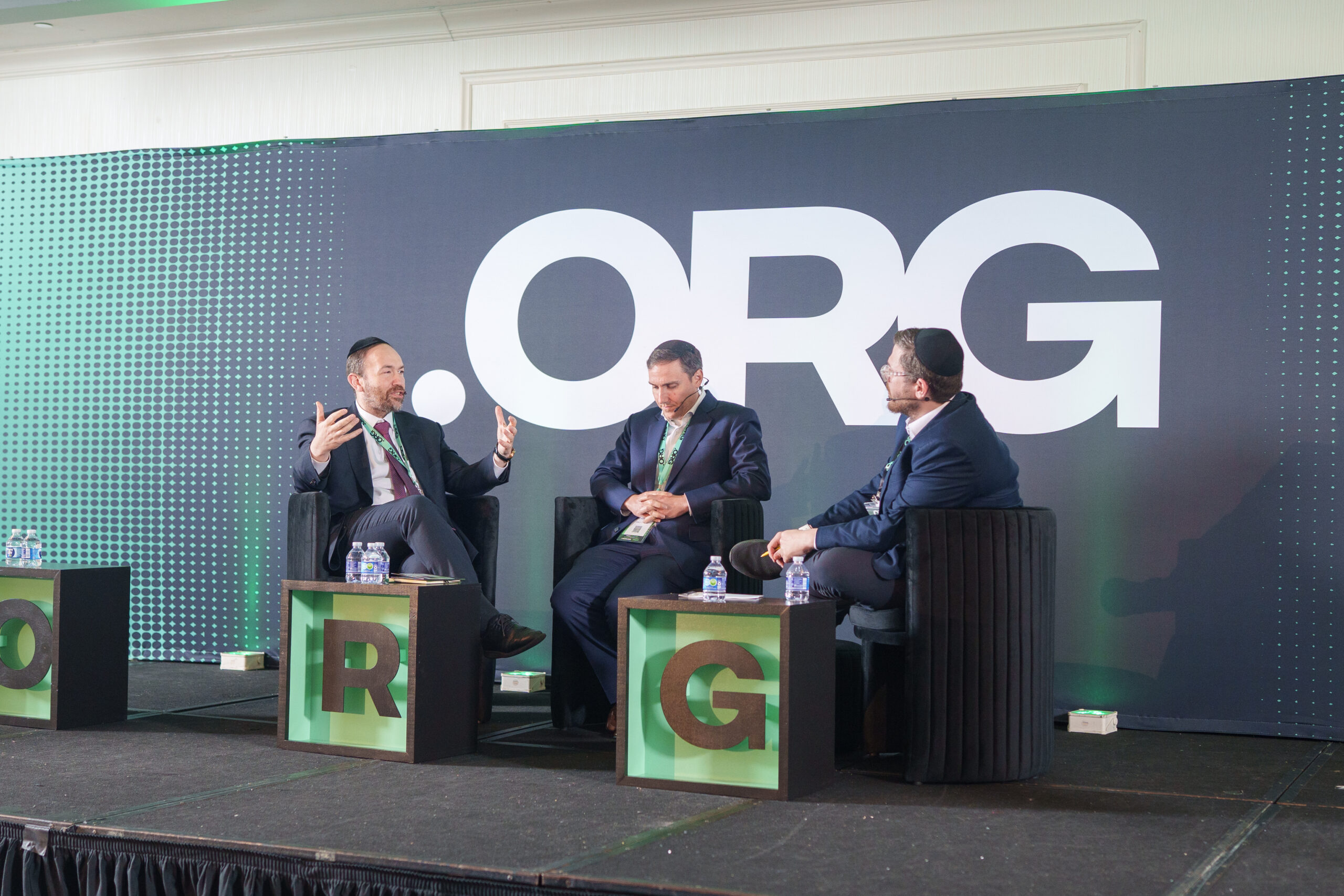
At the recent Powwow .Org Conference for Nonprofit Leaders, I had the opportunity to host a panel with Rabbi Miller and Dr. Donath, where we spoke about what it takes to build an international organization. There’s something here for everyone.
Enjoy,
—Nesanel
Nesanel Gantz: As usual, I like to begin with a brief background and what led you to start your organization. It helps the audience connect with the speaker. Reb Naftali, let’s start with you.
Naftali Miller: I’m from Kensington. It’s a very special neighborhood. In our home, the rebbi was cherished and valued. When I was eight years old, my mother had to pay tuition, and money was very tight in the house. One Sunday my mother told me we’re going on a trip. We went to different factories and asked for samples. My mother took all those samples, went to the flea market and set up a table. She sold the samples, took the money and went straight to the yeshivah to pay my tuition. She said, “The rebbeim need to get paid.”
That was the biggest thing that motivated me to get into this world. It gave me the drive to help others. I always tell people that it has to become personal. People can’t just raise money. You have to be actively involved; you have to feel it. You can’t sell something you don’t believe in.
Nesanel Gantz: How did you get to the position you’re in today?
Naftali Miller: Hashgachah. I was learning in Derech Chaim, and a yungerman there was in a massive car accident. A few of the guys and I put together money to help him out. S’char mitzvah, mitzvah—the reward for doing something good is that you get the opportunity to do something else good. After succeeding in that, I wanted to do more.
The rosh yeshivah called me in the next day. He heard what we had done and asked me to come work for the yeshivah. I ended up working for Derech Chaim for about 18 years. For a short time after that, I worked for ArtScroll. Then Shia Markowitz, who’s involved in Keren Hashvi’is, brought me over to Agudah, and I’ve been here for about seven years.
I started Chasdei Lev while I was still in Derech Chaim. Chasdei Lev is an organization to help rebbeim—to give kavod and show appreciation to the rebbeim and their families. They dedicate their lives to chinuch. We want klal Yisrael to come out and show them that their dedication is appreciated.
Today, baruch Hashem, we help over 8,000 rebbeim across the country. We’re dealing with 477 yeshivos and over 20 million dollars’ worth of purchasing.
Every rebbi gets an order sheet. It’s $320, and that translates to almost $4,000 worth of value. There are multiple partners in it: vendors, yeshivos, buying groups. They all build up to create that value.
Much of the work is done by volunteers. This year alone, we had somewhere between 3,500 to 4,000 volunteers helping for the Pesach season across the country.
Nesanel Gantz: Wow, that’s amazing. We’re sitting here with greatness. You’re also responsible for helping to raise Agudas Yisrael of America’s large budget.
Dr. Donath, you started an organization that just blew my mind. It’s one of those ideas that you hear of and think, “I should’ve thought of that!”
Tell us about yourself. What type of doctor are you and how did you start Daily Giving?
Dr. Jonathan Donath: I’m a chiropractor. I’ve had my own practice for the last 19 years. I always felt like I was one of the rare people who knew my tafkid. I go to work every day and help people who are in a lot of pain. Probably 90 percent of my patients are not Jewish, and I get to make a kiddush Hashem every day.
About six and a half years ago, I was listening to a shiur by Rabbi Alon Anava. It was a two-hour video. First he spoke about his past, how he wasn’t just secular but he would davka eat cheeseburgers on Yom Kippur. Eventually, he got involved in crime and was arrested. But he overdosed on drugs and was clinically dead. The rest of the shiur is him describing what it was like on the other side.
In one part, he explains that he was in a terrible, black abyss of pain and suffering, and he realized that he didn’t have one single mitzvah to elevate him to the next level.
After I finished his shiur, I walked into my local Maariv minyan and put a dollar in the tzedakah box like we’ve all done thousands of times. And an epiphany hit me like a ton of bricks. I’ve never felt anything that strongly, before or since.
The epiphany was: No matter how much or how little tzedakah I give, I still get a mitzvah for that $1. I thought, What an amazing deal! Then I thought, How can I guarantee myself this mitzvah every single day no matter what, for just a dollar?
I went home and started Googling “automating daily tzedakah giving,” but I didn’t really find anything. I called my website guy and asked him, “What do you think of this idea?” He said, “It’s great.” I said, “Can you build me a website for it?” He said, “Absolutely.”
I called my friends and set up some meetings. My next idea was to try to get Rabbi Paysach Krohn to speak about Daily Giving. I wanted to blow this thing up.
My heart was beating out of my chest when I called him, but I got the idea across. Once he heard that no one else was doing it, he suggested we form a rabbinical council so people would know the money isn’t going to my kids’ college fund, which I thought was a good point.
We got a council together, and we automated a platform to get Jews all over the world to give a dollar to tzedakah together every single day. Every day, we give the entire amount of money to a different incredible Jewish nonprofit.
We now have over 21,000 Jews from 43 countries all giving a dollar of tzedakah together every day. And we don’t take a penny. One hundred cents of every dollar goes to tzedakah. We give out almost $8 million a year. With Hashem’s help, we’ve given out over $23 million in the last six-plus years.
We fundraise our entire budget—about $1.2 million—separately so we can give the full dollar to tzedakah.
Nesanel Gantz: Why did you take on that model—giving the entire donation to tzedakah and raising your budget separately—and how do you manage it?
Dr. Jonathan Donath: Knowing what I know now, I wouldn’t necessarily recommend this model to everyone. Raising the overhead takes up so much of my time. I think that if I didn’t have to raise $1.2 million a year, I’d be way more effective at my job of getting more daily givers.
When I speak to different philanthropists, I explain it’s an incredible ROI (return on investment). If my customer acquisition cost is $100 to get a new daily giver, that’s $100 to get another Jew to give thousands of dollars to tzedakah they wouldn’t have given otherwise.
We have over 90% retention. Donors love being part of it so much, they never want to stop.
Now, not every organization has that kind of dynamic. Also, we’re a fund of funds. We’re giving to other tzedakos that have their own overhead. So we felt, and still feel, very passionate about the model. But it’s definitely hard. I feel very conflicted at the thought of changing it, especially when the fact that we don’t take anything has become part of our identity.
To read more, subscribe to Ami