



As I descend the stairs from my plane, I am greeted by a gentle late-afternoon breeze as it cools down the day. I have just arrived on the Greek island of Zakynthos in the Ionian Sea, having chosen this destination because of its beautiful landscapes, natural caves and unusual beaches. There is obviously a reason why its former Italian rulers called this island Fiore di Levante, Flower of the East.
But there’s another reason why I’ve decided to visit this place, which is connected to its unique history. Incredibly, Zakynthos was home to a Jewish community that survived the Holocaust completely intact. Not a single Jew was deported or murdered, and I was eager to find out more.
In order to explore the island effectively, I had made arrangements to hire a 4×4 buggy to be collected at the airport, which would take me through the island’s hilly terrain. As I kind of expected, the operator isn’t waiting for me outside the terminal building despite agreeing to do so. When I call him, he says that he is “only two minutes away,” waiting at a red light. I am not surprised when he turns up almost an hour later. Welcome to Greek time. Having visited Greece previously, I’ve already experienced what their concept of time is like.
My first stop is my accommodations. I’ve booked a guesthouse in the hills outside of Zakynthos, also simply known as Chora, “the town,” to the locals. When I arrive, my elderly host Spiros is delighted to see me and eager to show me around. He explains that the guesthouse was built in the distinctive Venetian style, as the Republic of Venice once ruled the island and shaped its appearance. (In those days, however, it was known by its Italian name, Zante.) The light-colored stucco and bright red terracotta tiles are a beautiful contrast to the deep blue sea below.
Spiros, who is originally from Corfu, a Greek island to the north that I visited last year, now lives in Athens, the country’s capital. Like many of the islanders, during the tourist season, from April until October, he moves to Zakynthos with his family to take care of his guests. He leads me to my room, where he has set out a glass of homemade wine and a plate that contains a thick slice of bread and two red eggs for Páscha (Easter in Greek). I explain to Spiros that I’m Jewish. It takes him a minute to understand, but then he recalls the Jews from his childhood in Corfu.
He then tells me with a wink of the eye that he is about to show me his swimming pool. He opens the wooden shutters and leads me out onto the balcony. The sea is spread out majestically behind the lush green olive groves below. Across the water I can see the Peloponnese Peninsula, which is part of mainland Greece. On my left to the north I can see the majestic mountains of Kefalonia, the largest of the Ionian islands.
As I am about to leave the guesthouse, Costas, Spiros’ son-in-law, stops me. Costas is a Greek journalist. “Are you Jewish?” he asks. When I confirm that I am, he tells me proudly that his uncle is Jewish. “My aunt was staying in London back in the 1970s when there was a dictatorship in Greece,” he says. “One day, she was protesting against the regime outside the Greek Embassy in London and was arrested. A Jewish lawyer named Ben Bemberg helped her. They got to know each other and eventually got married. I even stayed with them for five years when I was studying in England. Did you know that Zakynthos has a unique chapter in Jewish history?” he asks me abruptly, changing the subject. I tell him that this is actually one of the reasons for my visit.
Costas insists that he has to show me how Greek coffee is prepared before I head into town. When I tell him that it looks and smells just like Turkish coffee, he replies, “I guess you’re right. The Turks ruled over Greece for many years, and while the Greeks suffered greatly under their rule, it wasn’t all bad. After we finally kicked them out, we kept the good parts—the food—which we simply renamed.”
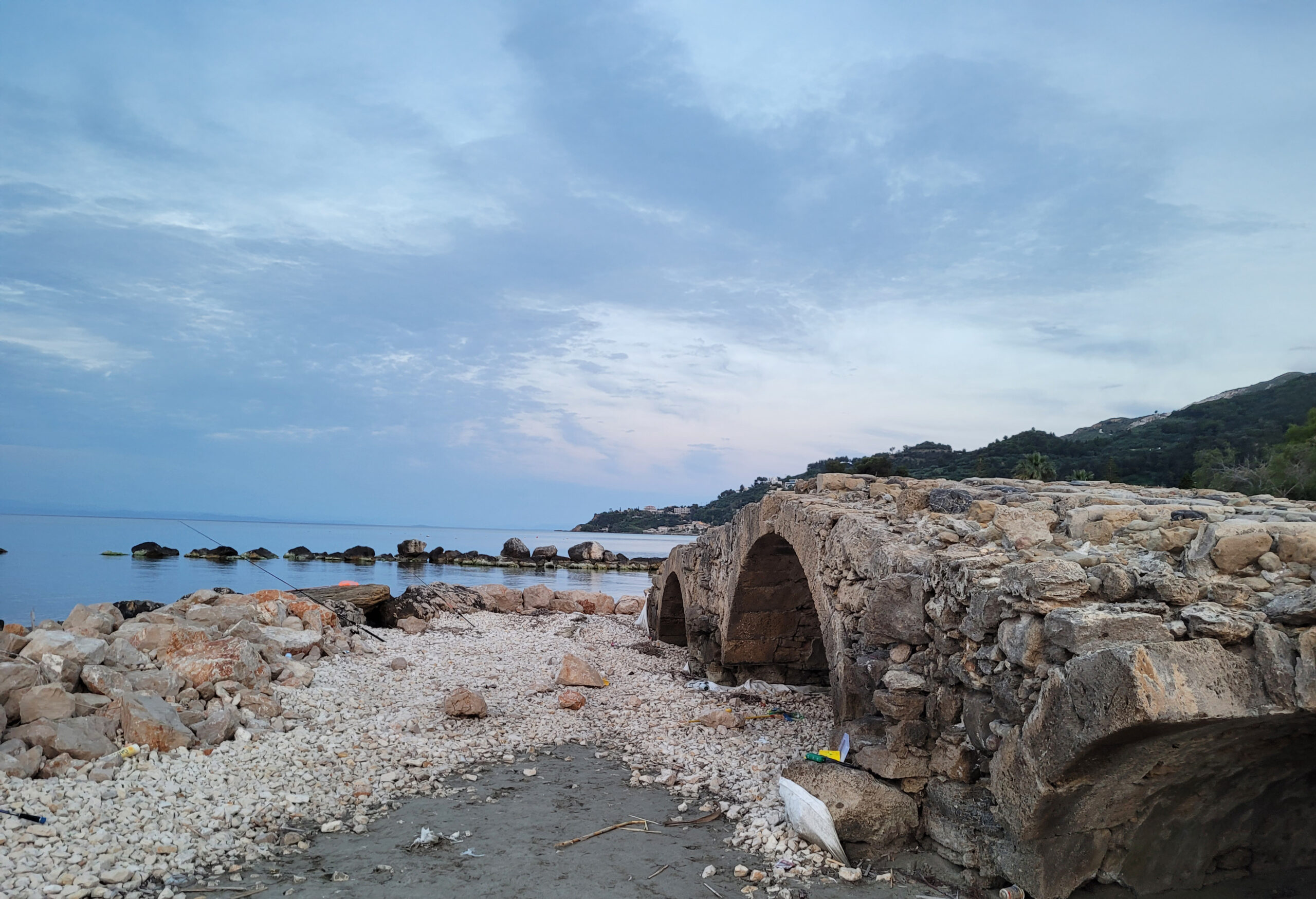
On the way into Chora, I stop at the Argassi Venetian Bridge, which was built in 1805 during the era of the Septinsular Republic, which united seven Ionian islands under its semi-autonomous rule. Although the arched bridge is over 200 years old, it doesn’t seem to be well cared for and is rather eroded; nor does it appear to be of interest to the locals or tourists. But a group of young boys excitedly show me the spot under the bridge where they hang out. They’ve just finished catching some striped seabream and are barbecuing it. In other locations around the world, this lovely bridge would surely be protected and promoted as a tourist site.
The sun is slowly setting over the horizon and it is time to daven Minchah. There aren’t any Jews left on the island, but the location where Beit Haknesset Shalom once stood is still known. I rush with my buggy through the narrow and winding alleyways of the city asking locals where I can find the site where the shul once stood. Interestingly, they all seem to know the answer.
When I reach my destination, there is an empty space where it used to be. In 1953, Zakynthos—which is located in a seismically active fault line in the Ionian Sea—was struck by a major earthquake along with several other surrounding islands. An estimated 800 people were killed and most of the buildings on the island were destroyed, including the historical Beit Haknesset Shalom, which was built in 1489. Many structures still lie in ruins to this day. The few remaining Jews left for Italy, the United States and Israel to rebuild their lives. The shul was never reconstructed, but its imprint remains as a testament to the Jewish history on the island.
To read more, subscribe to Ami