




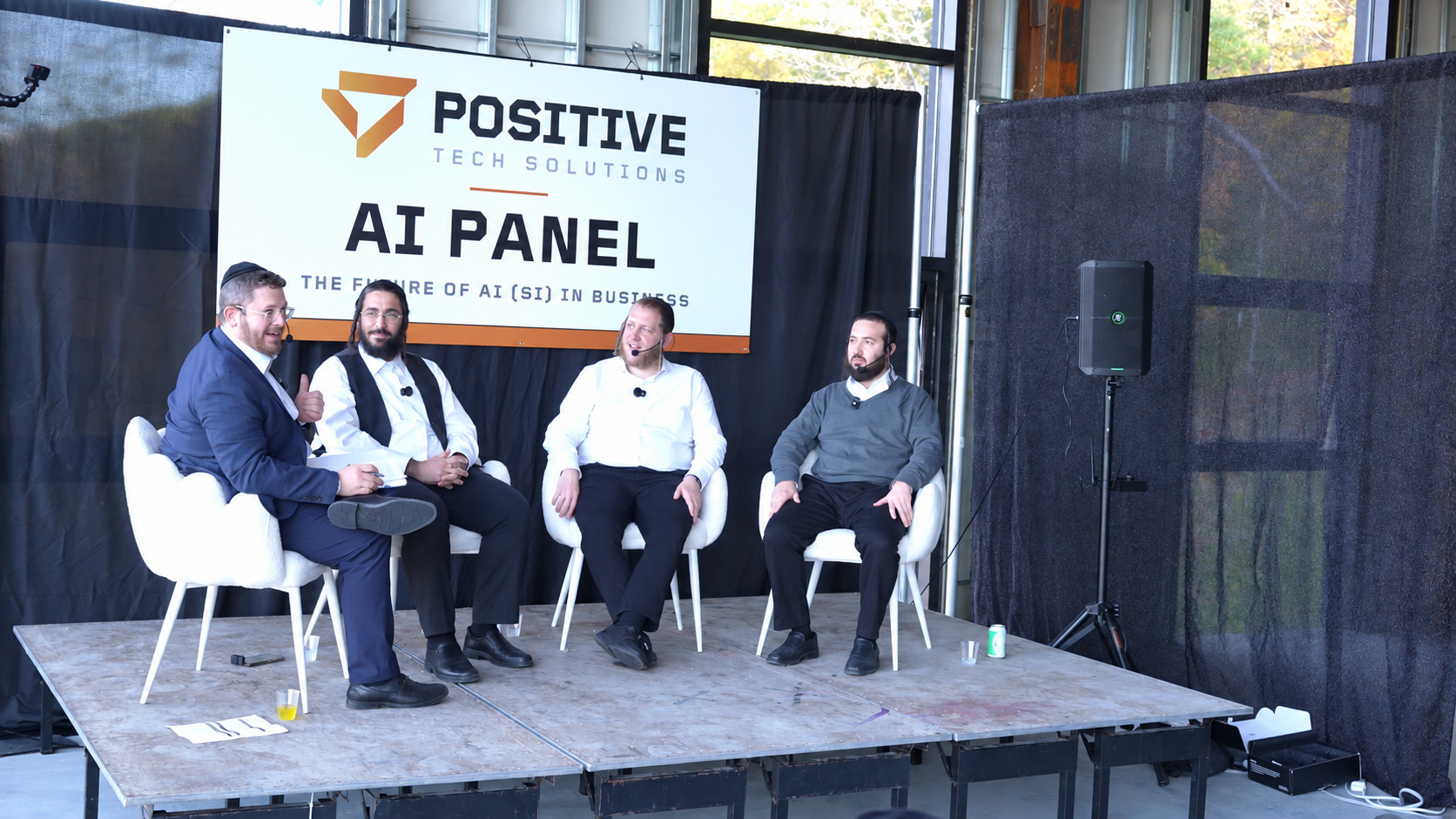
Nesanel Gantz: Let’s start with the big picture. Does every business today have to use AI? What mindset should a company have?
Yaakov Meir Levi: Using AI is a huge risk. Your information is being shared, and you don’t always know how it’s going to be used. But it’s an even bigger risk not to use it. Saying no is not an option anymore. If you say no, someone else is going to eat your cake. So you have to embrace it in every area of the business, and you have to use it wisely.
Using it wisely also means knowing where to stop. People come to us wanting to automate a task, and we look at it and see that it has ten steps. Eight of them are perfect for automation, but the other two are just ego. To automate that last bit might take 80 or 90 hours of work, and it’s only going to save you two or three hours a year. Someone has to bring reality to the table and say, “We’re going up to here, and this is where we stop.”
Very often, the conversation actually stops before it starts. People want to automate, but they don’t know what. You can’t automate something you can’t define.
Nesanel: Shmily, in general, is AI helping companies or hurting them?
Shmily Strasser: It can absolutely help, and it can absolutely hurt. If you do it right, it will help.
Nesanel: That sounds like a politician’s answer.
Shmily: No, it’s the truth. For example, you could be trying to write something, and you argue with the AI for 20 minutes about it. At some point, you’re going to give up. But if you set it up correctly so that it understands you, your business, your processes and what you want out of a sentence, you can get what you need in ten seconds. The difference is in the setup.
Nesanel: Akiva, a lot of employees are afraid to use AI. I had an employee who admitted she was spending half an hour on tasks AI could do in a second because she was afraid she would lose her job. How do you deal with that?
Akiva Schiff: There are definitely employees who won’t use it, either because they’re scared of exactly that or because they don’t know how to use it or what to use it for. But if you use it the right way, you become much more productive. You get your work done, and you have time for other things. That makes you more valuable to the company, not less. An employee who uses AI well is worth more than one who doesn’t.
Nesanel: The flip side is that people stop using their brains. Do you see that?
Yaakov Meir: Absolutely. This morning I spoke to someone at a big company. They have a person in senior management whose job is to help the team with complicated questions. The employee started complaining that he no longer answers them himself. Everything comes from Claude. He pastes in the question and sends back the answer without even reading it. If he worked with Claude, he would be unstoppable. Instead, he became Claude.
Shmily: I don’t think it’s always a problem. When calculators came out, people were afraid no one would know how to do math. In school they told us, “What will you do if you don’t have a calculator?” Now the reality is that you’re never without a calculator. AI is here to stay. Everyone still needs to know how to think. We just have to think differently.
Nesanel: There’s a fundamental difference, though. I might not need to know algebra, but I should know how to write a nice message to my wife without AI.
Shmily: You’re still going to have to know how to ask the AI to write it.
Nesanel: Let’s get practical. We received this question: What’s the best way to set up AI in your day-to-day routine, for business and personal use, so that it saves time instead of wasting it?
Shmily: I would split it into two parts. There’s the part where you ask Claude or ChatGPT to do specific things, and there’s the part that runs automatically, the repetitive tasks. For example, I have Claude connected to my email. Every time an email comes in, if it thinks I need to reply, it drafts the reply. Once an hour I come in, review the drafts and send them.
Nesanel: I like that. That’s a practical, sensible application I haven’t heard of before.
Shmily: For repetitive work, it’s essential to sit down for a few minutes and think about what you do over and over again—for example, I reply to emails and generate quotes—then think about how AI could fit into each task.
For everyday conversations, I would strongly suggest getting a paid AI subscription if you don’t have one yet. You get the more capable models plus many added features, such as scheduled tasks, which most platforms don’t offer on the free tiers. Then connect it to your tools—your email, wherever your files live, whether it’s OneDrive, SharePoint or Google Drive, and your CRM [customer relationship management].
After you’ve used it for a while, go into the chat and say, “Now that you know me and my systems, help me figure out what I do repeatedly that you can help me automate.” You’ll be shocked by what it comes back with.
To read more, subscribe to Ami