



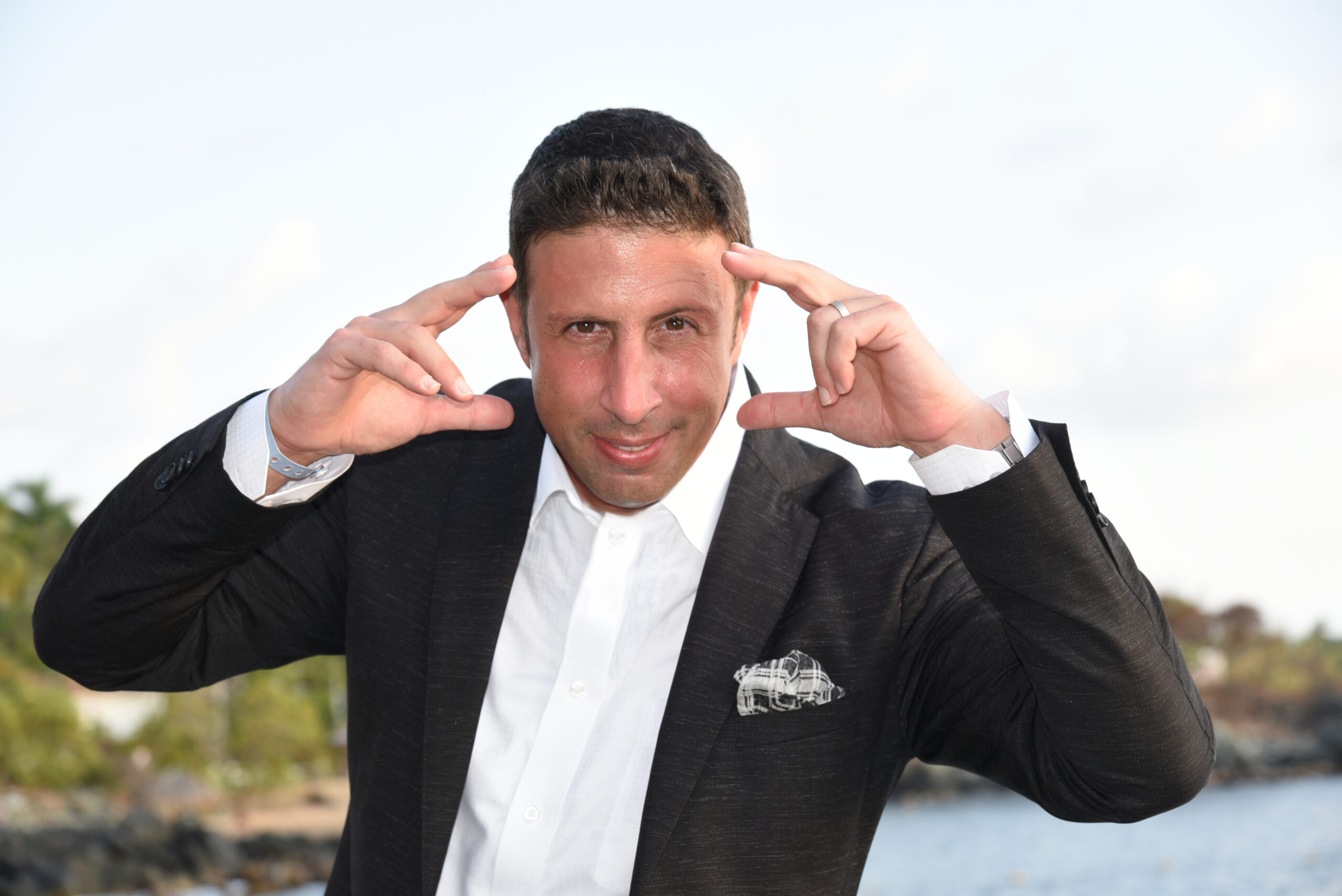
After several hours of interviewing magician and mentalist Coby Elimelech, at last I was finally treated to a trick.
“They say good things come in threes,” he began. “Give me a number between one and three.”
“Three.”
Using his phone, he pulled up thousands of random words and asked me to choose three. I did. He wrote my choices down on a mini blackboard:
GLANDS
DEMAND
ONION.
He repeated, “Good things do come in threes,” and then he circled the third letter of each word. A-M-I. I chose three words out of thousands, some shorter and some longer. I could have chosen any of the others. My mind was blown.
A minute later, he asked me to think of a childhood friend, wrote something on a chalkboard and showed me a name he could not possibly have known. I’ve been a fan of magic my whole life, and I know how most magic tricks are done, but I was still amazed.
Coby Elimelech has been performing magic since before his bar mitzvah, and he turned his hobby into a thriving career of mentalism. Under the stage name Coby Jacobs, he does 500 shows a year, half of them in person and half from a nine-camera studio in his house. He logged 250 flights on Air Canada this year alone. He doesn’t do small gigs; 90% of his work is corporate keynotes for companies in the United States that have no idea that the guy messing with their heads davened Shacharis in an airport lounge that morning, ate an instant soup on the plane, and learned Daf Yomi on the drive to the performance site.
We spoke about the correlation between mentalism and business, why he went straight for corporate instead of smaller events, his booking and pricing strategies, and why he tells people on airplanes that he’s an accountant.
Enjoy!
—Nesanel
I was born and raised in Toronto to a frum family, one of four boys. My father was in real estate and a few other businesses, and I would go with him to work sometimes. We weren’t spoiled, but we were comfortable. My mother worked for the Canadian government for 25 years, in Human Resources Canada. I went to Or Haemet, a Sephardic elementary school in Toronto, then to Ner Yisroel in Toronto for high school, and then to Mikdash Melech in Eretz Yisrael for two years.
“I started getting into magic when I was eight or nine, and it wasn’t just dabbling. Even before my bar mitzvah, I was all in and doing shows. In my early teens, I did a lot of kids’ birthday parties, and kids are pretty smart. They have no mercy. If they see something they shouldn’t, they call you out. It got me comfortable performing in front of an audience, and it forced me to find my own style and point of view very early.
“There were two or three parties every weekend. At 13, 14 or 15, three parties at a few hundred dollars each every weekend was good money. Every Sunday I snuck out of yeshivah during recess to do parties. My parents knew what I was doing, and they knew I was good at it, so they encouraged me. But they also wanted me to get a real job at some point.
“I read every magic book and absorbed everything, and I saved every penny from the shows to buy the latest and greatest tricks available. Back then, you didn’t buy magic online; you went to magic shops. When I was ten or 11, I would walk into Tannen’s, the iconic magic shop on 42nd Street, and see the greats standing around talking shop. Baruch Hashem, I was able to recreate that atmosphere. My entire basement today is a magic studio, with tens of thousands of magic tricks as well as memorabilia of the trade.
“When I was about 19, I went to see David Copperfield. I went backstage after the show and performed a trick that really impressed him. He liked the thinking behind it and invited me to perform for his crew on the tour later that week. I’ve been to his private museum of magic in Las Vegas, which holds the largest collection of magic history in the world. We developed a friendship and now speak regularly and share ideas. The most important thing I learned from him wasn’t a trick, though. It’s to keep working at our craft. He recently put a new routine into his show and did it about 500 times. I complimented him on it, and David said, ‘No, we’re just getting started; we’re still figuring it out.’ Five hundred times, and he’s still figuring it out. That’s the whole business. Getting 1% better here, 2% better there.
“After Eretz Yisrael, I went to York University in Toronto for a couple of years and studied business. I got married at 23. My first job was at a foreign exchange company trading currencies, selling and delivering. For three years, I worked there during the day and did magic shows at night. I always knew that performing was going to be my life; I was just trying to find a way to make it work.
“I did a few bar mitzvahs and did a show for Chaverim once, but I was never really in the Jewish velt. I had a vision. I wanted that full hour on stage. I wanted corporate America. These companies bring in keynote speakers every single day for 20K to 50K, and the hard stats say attendees don’t remember two or three talking points the next day. I saw that as a problem for them and an opportunity for me. I thought that if I make it fun, engaging and magical, and then take one core company value—teamwork, communication, collaboration—and embed it into the show metaphorically, they won’t forget it a year later. All the top Jewish speakers do that naturally. In every shiur, they take current events and embed them into the maasim and stories. So that progression was natural for me.
To read more, subscribe to Ami