




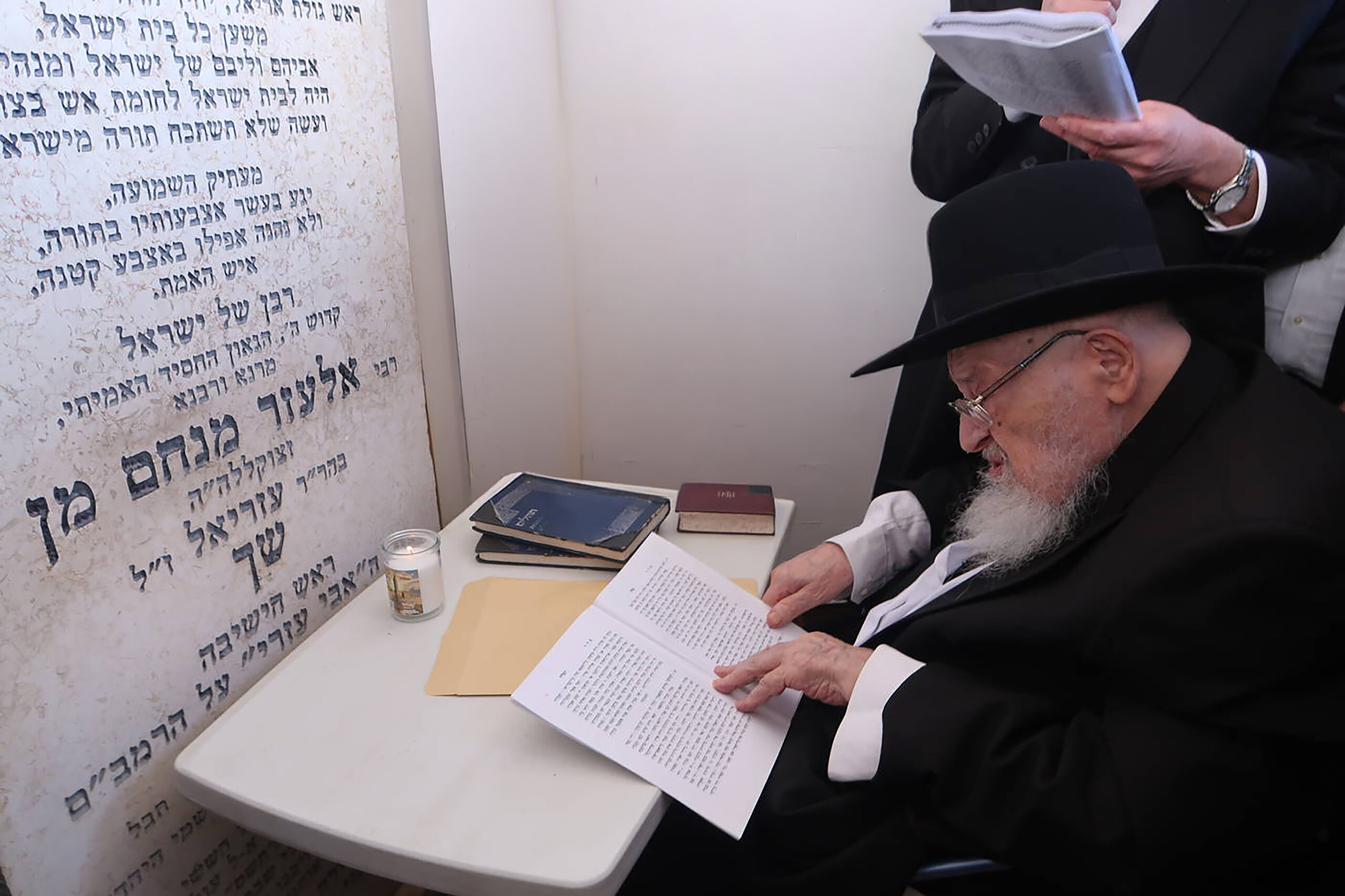
It’s Shabbos morning in the Lithuanian village of Vabolnik, and the local market is bustling. In one spot stands a young boy, loudly trying to prevent the Jewish fish merchants from doing business. He boldly approaches would-be customers before they can make a purchase and exhorts them, “You must not shop here today! It’s Shabbos kodesh!” Eventually, the police arrive and arrest the boy; ultimately, he is brought to trial. One day, this boy will grow up to become Rav Elazar Menachem Man Shach.
“Please sit down,” says Rav Meir Tzvi Bergman as soon as he notices me standing near his table. Though he is in his late 90s, I find Rav Meir Tzvi poring over a gemara, with a pile of sefarim next to him. He is a talmid of the Chazon Ish and has served as the rosh yeshivah of Yeshivas Rashbi for decades. He is also the son-in-law of Rav Shach.
With Rav Shach’s 25th yahrtzeit approaching, I’ve come to hear about the gadol hador from the perspective of someone who was zocheh to see him in his private moments, not just the public moments that klal Yisrael witnessed.
Rav Meir Tzvi chooses his words carefully, as is his manner. “There are people you can describe, and there are people you can only try to point toward. My shver, Rav Shach, zt”l, was the second kind. I was zocheh to sit at his table for decades, to watch him up close in moments no one else saw. Still, I feel that whatever I say falls short. But I will tell you what I saw and what I heard from his own mouth, and maybe you will get an idea of who he was.”
Personal Tragedy
“If you want to understand Rav Shach’s deep dveikus to Torah, you have to look at how it held him up during a time when a person has nothing else to hold onto. My shver had a daughter, Miriam Reizel, who passed away in Vilna at the age of 14. She was a child of rare gifts, with an extraordinary sharpness.
“One story that my shver told about Miriam Reizel took place in the home of Rav Chaim Ozer Grodzinski, zt”l, where his family spent time. Rav Chaim Ozer was the av beis din of Vilna, and his home was a hub for the entire Jewish world, with sh’eilos streaming in from all over. Among the things people sent him were mezuzos written by the finest sofrim. Rav Chaim Ozer would examine them and give his opinion on the level of their hiddur. Once, when Miriam Reizel was sitting in his house, several open mezuzos were lying on the table. Suddenly, she pointed to a subtle error in one of them, a mistake that had escaped every eye in the room. Rav Chaim Ozer was astounded by the sharpness of her eye.
“My shver loved her very much. But then there was a gezeirah from shamayim. She took ill with typhus, and within a short time she returned her soul to the Eibershter. The loss weighed very heavily on him.
“When Rav Chaim Ozer heard of the tragedy, he came to be menachem aveil. When he saw the depth of Rav Shach’s pain, he said to him one sentence, and only one: ‘Lulei Soras’cha shaashuai az avadti b’onyi—Had Your Torah not been my delight, I would have perished in my affliction.’
“This was not lip service. It was full of meaning on a personal level. Rav Chaim Ozer himself knew the pain of losing a daughter; when he spoke, it was from his own experience. He was telling my shver that in times of darkness, only Torah, which is a person’s shaashua [delight], gives him the strength not to lose himself in his grief. Those few words entered my shver’s heart and were engraved there for the rest of his life.
“Many years later, when Rav Shach was about to move from Rechov Raavad in Bnei Brak, the family began to pack his belongings. He told them that there were only two things that had to travel with him in his own hands—his tallis and tefillin bag, and a picture of Miriam Reizel. When they asked him about it, he answered, ‘This picture is my reminder of lulei Soras’cha shaashuai.’”
Rav Meir Tzvi clarifies Rav Shach’s reason for keeping the picture. “It was not to remind him of his daughter. It was a constant reminder that the pain is not forgotten; rather, it is lifted and sweetened by the toil and delight of Torah. Every time he looked at the picture, he would remember the words Rav Chaim Ozer had said to him.”
To read more, subscribe to Ami