




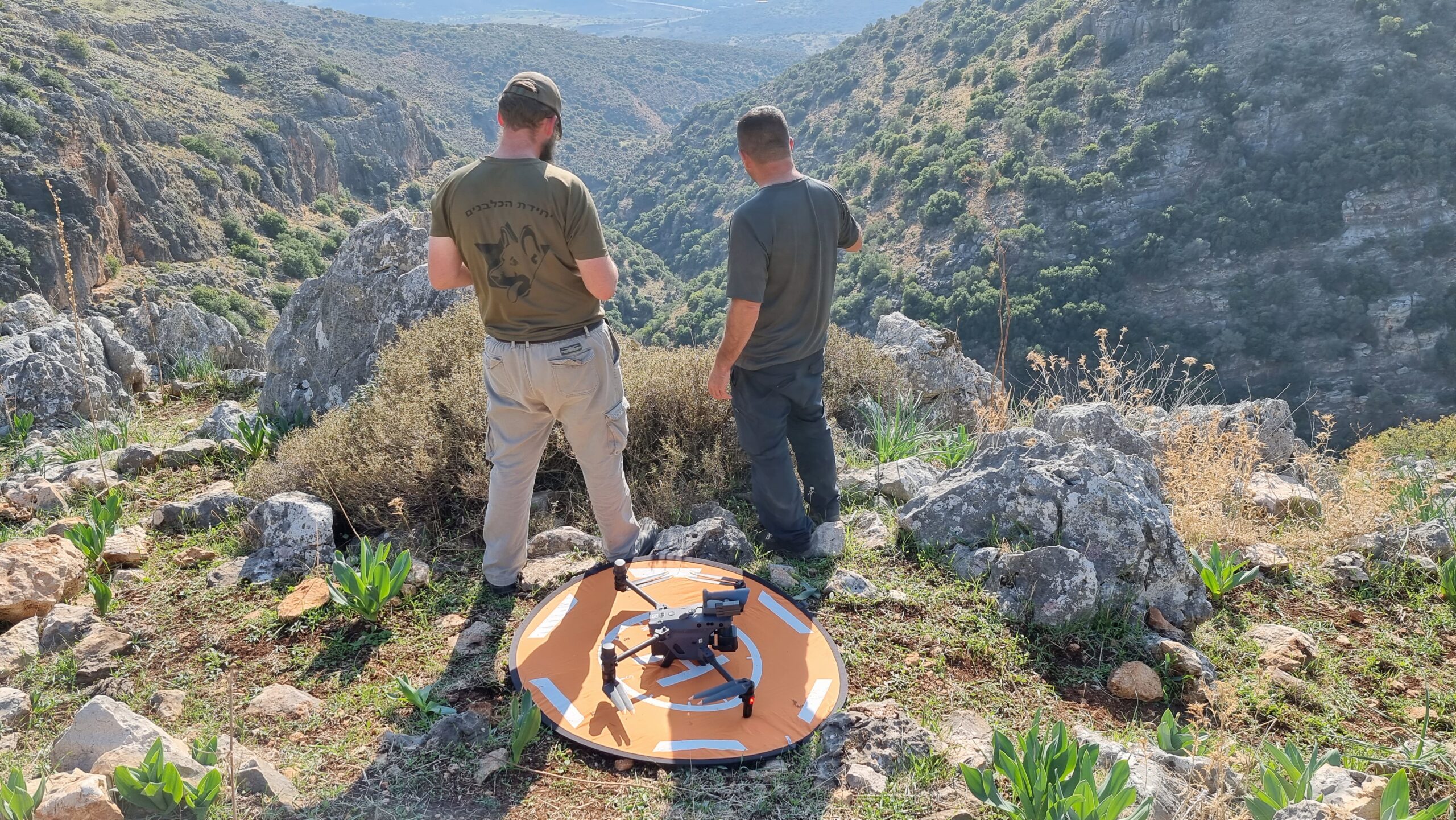
As Israel searches for new ways to counter Hezbollah’s growing threat, one unconventional initiative is drawing attention. The Israel Dog Unit (IDU), founded and directed by Mike (Yekutiel) Ben-Yaakov, has launched a pilot program to train dogs to detect incoming drones through their acoustic signatures before they become visible or most human beings can hear them.
The initiative seeks to provide soldiers with earlier warnings during combat operations, particularly at night and in poor weather conditions. It comes as Israel expands its efforts to counter increasingly sophisticated Hezbollah drone attacks while continuing military operations in southern Lebanon. Ben-Yaakov, whose organization is best known for search-and-rescue operations and locating missing people, believes that specially trained dogs may offer a simple but effective layer of protection alongside existing technology.
To learn more about the project, its prospects and limitations, and the broader work of the Israel Dog Unit, I recently spoke to Mr. Ben-Yaakov.
Unfortunately, you have your hands full. Your hands were full both before and after October 7, and they’ll probably still be full until the coming of Moshiach.
There’s never a dull moment, but it also seems that Moshiach is on his way.
I dream about getting a full night’s sleep every day, but it never happens. Then I tell myself, “You know what? I’ll catch up on my sleep between 10:00 and 11:00 in the morning, before this and before that,” but that never happens either. The work is nonstop.
What’s disturbing your sleep? Who or what is waking you up in middle of the night?
There are families of missing people and police precincts around the country that call us when they have a missing person case. There are 4,000 people reported missing in Israel every year. Obviously, we don’t go out on ten or 15 cases a day, but we are definitely watching, observing, publicizing and jumping in if we really think there’s a risk to someone’s life.
Last week we were called out, but it was nebach too late. We found the guy dead. But he would have probably never been found if not for our team because he was in a very precarious location, face-down in a river off the beaten path. We deal with these things every day.
What do your dogs do in a case like that where the missing person is so inaccessible?
It’s not just dogs. It’s dogs, drones and sometimes even horses. We use all the various means at our disposal. Each one complements the other. Dogs have sniffing capabilities that people don’t have. We use tracking dogs if we have the person’s scent, and we also have air-scenting dogs that can sniff people out if they’re alive. We divide the area into sections and go out searching with the dogs. Our job is to save lives and do whatever we can to get to the person.
It’s not that I love dogs so we have to work with them. G-d gave dogs a special ability to smell and to work together with people as a companion like no other animal, and they also complement technology, but at the end of the day we do whatever is best to find the missing person. If it’s best to send a dog, we send a dog. If it’s best to send a track drone with a dog so they can search forest areas, that’s what we do. And if it’s best to send in a horse because it can go much further and work for much longer periods of time, then we will do that.
What does the horse do?
A horse has a person riding on top of it, which allows him to be high up and cover a lot of ground. Mules are even better in some situations because they can go into hillier territory. A drone can obviously cover a much bigger area, but even if it has a thermal camera, it won’t detect someone in thick brush or under a tree, so you have to actually be there. And of course, a dog can smell things you won’t see if you’re just walking by from a distance.
How many dogs do you have at the moment?
Right now we have over 100 dogs in our programs, but not all of them are search-and-rescue or tracking dogs. We also have cadaver dogs that can detect the smell of blood and decay. In addition, we provide security dogs to dozens of Jewish towns in Judea, Samaria, the Negev and the Galilee. Our dogs are sometimes the last line of defense for farmers up in the hills in isolated areas.
We also help the IDF. Over the past few weeks 15 soldiers and civilians have been killed by Hezbollah suicide drones, also known as unmanned aerial vehicles (UAVs). These drones are very primitive but also very effective, and right now Israel doesn’t have a solution. They’re testing all sorts of technology, but in the meantime we keep reading in the papers about another soldier or civilian being killed. That’s why we’re trying to train dogs to be able to detect drones, not because of their superior sense of smell but because of their ability to hear tones that people can’t perceive. They can also hear sounds from greater distances.
If we can train a dog to be able to indicate when the drone is 200 or 300 yards away as it’s rushing toward a strategic asset, the soldiers will be able to defend themselves and maybe even down the drone. Early warning is critical.
We got a few drones that are similar to the ones Hezbollah is using and we just started our testing today, getting the dogs to indicate when they hear something. All four of the dogs we tested did pretty well. Hopefully, we will be able to increase the distance when the dogs react and we’ll have a prototype in the near future.
So this is still a work in progress rather than something you’ve already implemented.
Correct, although according to articles it’s already been implemented in India. We’re trying to get in touch with the people there who are involved. They’ve been using these “drone dogs” at the Pakistani border, and we want to replicate that. We’re trying to work as quickly as we can because this is a real problem. It’s the number one killer of IDF soldiers right now. All of the fatalities in recent days were due to these drones.
Why doesn’t Israel import some of these already trained dogs from India?
The Indian Army currently has only four of them, but they’re in the process of training 14 more.
I’ve reached out to strategic partners of ours around the world, and I’m bringing them to Israel to work closely with us so we can move forward with this project. I just spoke to one of our people from Holland who is now working in Spain. “When do you want me to come?” he asked me. “I can come in July.” “How about tonight?” I replied. “We’ll pay for your ticket.” “I don’t think I can do that,” he explained. “I have to be back in Spain next week. My son and grandson are coming to visit me from Holland.” “We’ll get you back in time,” I assured him. “Just come for two or three days and give us some tips. We’ll brainstorm.”
We’re talking to people all over the world as well as other experts in Israel because time is of the essence. Israel is investing millions of dollars in all kinds of technology, but so far they haven’t come up with any foolproof method of detecting and neutralizing these drones. I hope we can play a role in this historic mission. It’s a race against the clock.
To read more, subscribe to Ami