



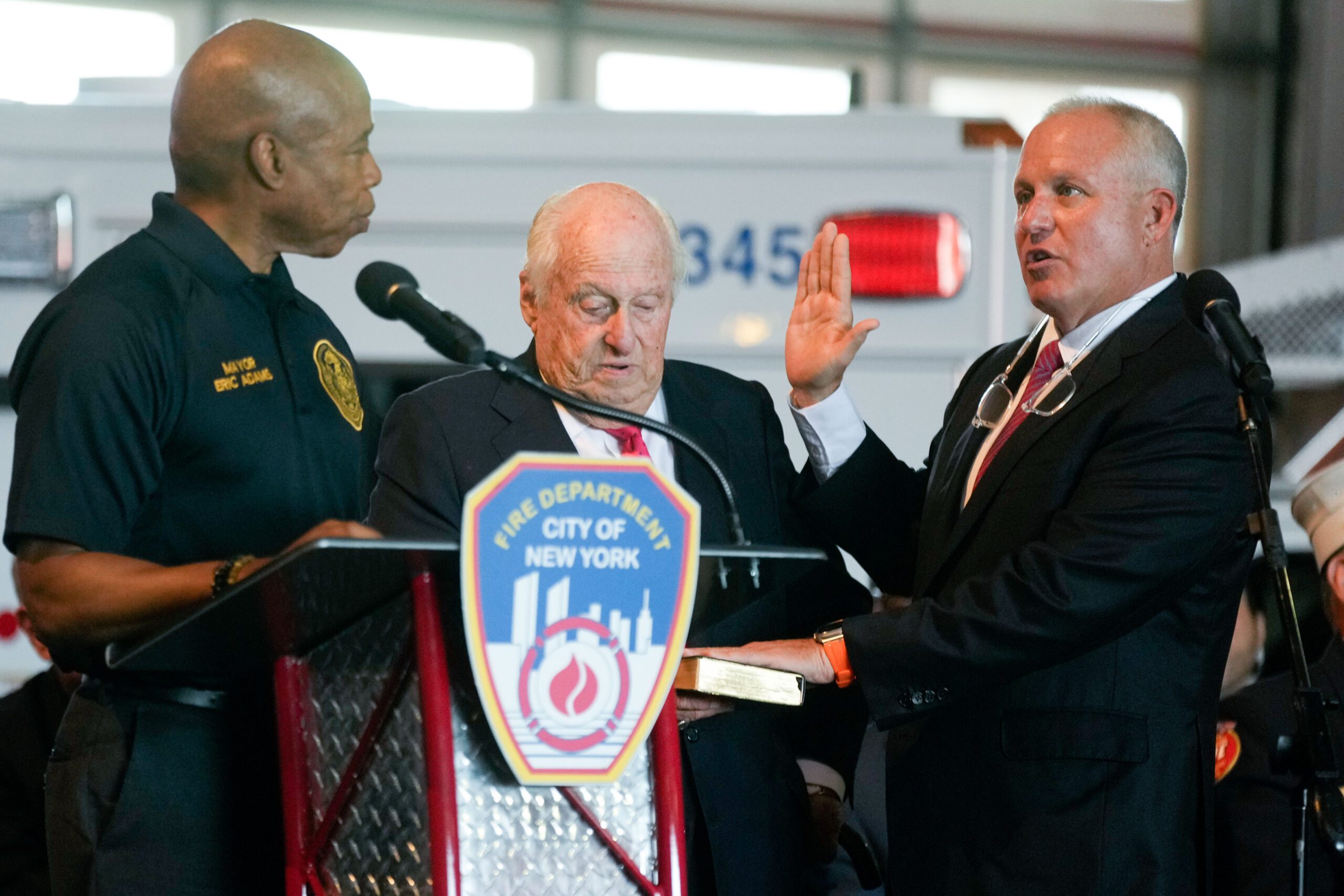
Robert S. Tucker is a Jewish American businessman, philanthropist and public safety official who served as the 35th commissioner of the New York City Fire Department. Appointed by Mayor Eric Adams in August 2024, he brought decades of experience from both the public and private sectors, including leadership roles in security organizations and longstanding involvement with the FDNY Foundation. Mr. Tucker oversaw the day-to-day administration of one of the largest fire departments in the country, leading initiatives that city officials credit with strengthening departmental performance and reducing fire-related deaths.
Shortly after Zohran Mamdani’s election as mayor last November, Mr. Tucker submitted his resignation with his departure effective on December 19, 2025, citing ideological differences and concerns about serving under the incoming administration, particularly with regard to the mayor’s anti-Israel rhetoric.
Looking back on your decision to resign rather than serve under Mamdani, what are your thoughts today?
Leading the greatest fire department in the world was the honor of a lifetime. I was enamored of the FDNY even as a little boy. Achieving this job was a dream come true, and to have served in the position for only 494 days wasn’t exactly what I planned. That being said, I miss the people but I don’t regret the decision.
I understand that serving as fire commissioner would have placed you on the new mayor’s executive team, which you didn’t want to be on, but it would have also allowed you to serve the people of New York. What led you to give up this opportunity?
To be honest, I don’t think that’s a fair question. The mayor is the chief executive officer of New York City and you work for him. That was the question that was presented. Did I want to work for him? My answer was no, so I resigned. It’s the mayor’s prerogative to appoint whomever he wants, and he has appointed Lillian Bonsignore, who now works for him in his administration. We all get to decide in this free democracy whom we want to work for and whom we don’t want to work for.
Now, what kind of day-to-day impact does the mayor have on the fire department? The answer is that it’s minimal, as the only power he has is over the fire commissioner. Everyone in the FDNY works for the fire commissioner, and the fire commissioner works for the mayor. If the mayor doesn’t like what’s going on in the fire department, he has only one option: to fire its commissioner.
The point is that it’s not about his impact on the FDNY, it’s about whether or not I wanted to work for him, and I didn’t.
When you resigned, you mentioned that part of your decision was based on the mayor’s anti-Jewish rhetoric and actions. Were there any additional factors?
His comments about Israel and the Jewish people during his campaign—and more importantly, prior to his running for mayor—hurt me very deeply. As a 55-year-old adult, I get to decide whether or not I believe that someone’s values are aligned with mine.
At the core, Eric Adams was a very hardworking, extremely experienced New Yorker who was a police captain. He was pro-Israel, pro-public safety, pro-law enforcement, pro-NYPD and pro-New York. I went to work for him because all those things aligned with things I care about.
I’ve interacted with the former mayor several times, and his love for the Jewish people—as well as the way he expresses it—is truly exceptional.
You have to understand that for all of Eric Adams’ bad decisions, the fact is that he left New York City in extraordinarily good condition. We got through a pandemic as well as a migrant crisis that could have brought the city to its knees financially. The city is thriving. The City of Yes for Housing Opportunity is in place. Crime is at an all-time low. You can’t get into a restaurant, a Broadway show or a hotel. The new mayor inherited a city that’s in very good shape.
You stated publicly that you wanted to see what the new mayor will actually do, not just what he says. He’s only been in office for a couple of weeks. What’s your impression so far?
I hope that Mayor Mamdani does a very good job. It’s in the best interests of all of us that New York City should be safe and strong, so I want him to succeed, and I will be cheering the city on. I own a big business here. I live here and my children live here. So far, I think the jury is still out. He somehow found $4 million for a pilot program on public bathrooms. Okay, I’m not sure that’s what I would do if I were the mayor in my first week of office.
When I looked at your resume, I wondered why you were willing to accept a government position with all its bureaucracy and the need to be accountable to others after having such a successful business career. What convinced you to say yes to Eric Adams?
I had always been a supporter of the FDNY through its various foundations and was also a summer intern. When I was a kid, I used to chase firetrucks on my bicycle with a little scanner from RadioShack. So when you’re asked by the mayor to serve in a senior executive role in the administration to help straighten out a mess in the fire department—which you will recall is what I inherited—you say yes. He said, “I need you to turn the department around, improve morale and make sure that people can rely on the FDNY and EMS if they need them.” I agreed immediately.
Mind you, I had been passed over for the job before. You may remember that there was an article in The New York Post saying that the next fire commissioner was going to be Robert Tucker—and a week later my predecessor Laura Kavanagh became commissioner. But even after that, I didn’t hesitate for a second. There was no pause between the mayor’s request and my answer.
The job exceeded my expectations. The people in the FDNY are some of the best human beings I’ve ever met.
It’s interesting to see an increasing number of business leaders, including the current president, choosing to serve in public office.
There is no greater aspiration than to serve the public, especially if you’ve already been successful at something else. This city has been very good to my grandparents and parents, as well as to me and my children.
You said that you inherited a mess and that the work wasn’t fully completed when you left. Looking back, what do you feel that you were able to accomplish during your tenure?
First and foremost, we substantially boosted morale in the FDNY. We’re also starting to have real collaboration between fire operations and Emergency Medical Services operations. We’ve taken on a project to design and build a state-of-the-art dispatch system that will finally combine the two systems to further merge these divisions of the FDNY and hopefully drive down response times, which is crucial.
EMS has been greatly neglected over the years, starting from the woefully inadequate pay its employees receive. That is why this is one of the biggest crises in New York City today, and I am sure that the new fire commissioner will continue to prioritize this issue. Every commissioner sets his or her own agenda. Commissioner Bonsignore is a 31-year veteran of the EMS—rising to the rank of chief—and comes with a unique set of skills that will enable her to be very good at solving this problem.
Had you stayed on, what would you still have wanted to accomplish?
Aside from getting a raise for the EMTs and paramedics, I would have completed building the new dispatch system. I would have further emphasized the need to look at how we train people. I would have also worked on recruiting in order to make sure that we are never in a situation where we don’t have enough firefighters, EMTs or paramedics. I would have looked at our budget to prioritize the things that are the most important for public safety. I would have built new firehouses in communities that I believe are woefully underserved, like the far West Side of Manhattan. How can you build Hudson Yards or develop Willets Point and not build firehouses? I would have wanted to highlight these mistakes that were made and try to rectify them.
There’s still a lot of work to be done. Being fire commissioner is no joke; it’s a real job.
Thankfully, there were no major crises during your tenure, certainly nothing on the scale of 9/11.
I don’t agree with that, because we’re dealing with something every day. We had a tourist family killed in a helicopter crash and multiple five-alarm fires. Please G-d, there will never be another day like 9/11. But we did have to deal with 345 Park Avenue, which was one of the darkest days in the city’s history with an active shooter killing people in the lobby of a Midtown high-rise building. Fortunately, we were standing on the shoulders of the great men and women of the FDNY who did the hard work that day.
You’re a highly successful entrepreneur. What lessons did you carry over to your role as fire commissioner?
I’ve been protecting people for 25 years as head of T&M USA, a security and investigative services company, and before that I was a prosecutor in the Queens DA’s Office, working for the late great Richard Brown. I’ve been in the public safety space as a CEO for my entire professional career.
Can you share a bit more about your family background?
My grandfather, Richard Tucker, was the chazzan at the Brooklyn Jewish Center, and he became the leading tenor at the Metropolitan Opera. He was probably the greatest American cantor and tenor ever. My father, his oldest son, has lived and worked in New York City his entire life. He attended my inauguration, and he was also there when I walked out. We see each other all the time. He’s an important part of the city’s cultural fabric thanks to the foundation he runs to perpetuate his father’s memory.
Was your father also a businessman?
Yes. He still works at JPMorgan Chase.
G-d bless him.
Thank you.
What advice do you have for your fellow Jewish residents of New York City under its new mayor? Many Jewish students have already expressed concern over his revocation of executive orders that they felt provided them protection.
I think we have to watch what happens very closely, but we also have to give the mayor a chance to settle in. He just moved into Gracie Mansion a few days ago. We have to be mindful of the fact that this is one of the hardest jobs in the world, and he doesn’t have a lot of work experience. There’s a huge amount of anti-Semitism in New York City, and we cannot allow it to spread. We must make sure that we put ample pressure on the mayor and his staff, including NYPD Commissioner Jessica Tisch, for whom I have a lot of respect. She has to make it clear that she is going to protect everyone, Jews included.
On his very first day in office, Mamdani took various actions suggesting that he doesn’t just talk the talk, he intends to walk the walk. Did his actions raise your concern?
I don’t think he needed to do that, but I’m not going to judge his mayoralty on his first 15 days. I’m a fairer person than that, and I want to give him a chance to do a great job. At the same time, I am also skeptical and cautious, and I am not going away.
Can you describe your business in a nutshell?
We employ former Secret Service and FBI agents and NYPD officers to protect people and facilities, and we investigate matters under litigation for big law firms and corporations.
So it’s an information gathering kind of organization.
Yes. We are finders of facts.
I understand that you have major business interests in Israel.
I do. I own the largest security company in Israel, which is also called T&M.
I find that surprising, as I would have thought that the Israelis are highly skilled at information gathering and wouldn’t need a New York import.
Well, everyone there is Israeli, including the CEO. It’s a fabulous company with some of the smartest and most capable people to come out of the IDF.
I assume that it’s not government related.
We work with the government in Israel as well.
So in a way you’re still serving the people.
I am.
Thank you very much. I’ve really appreciated this interview. ●
To read more, subscribe to Ami