




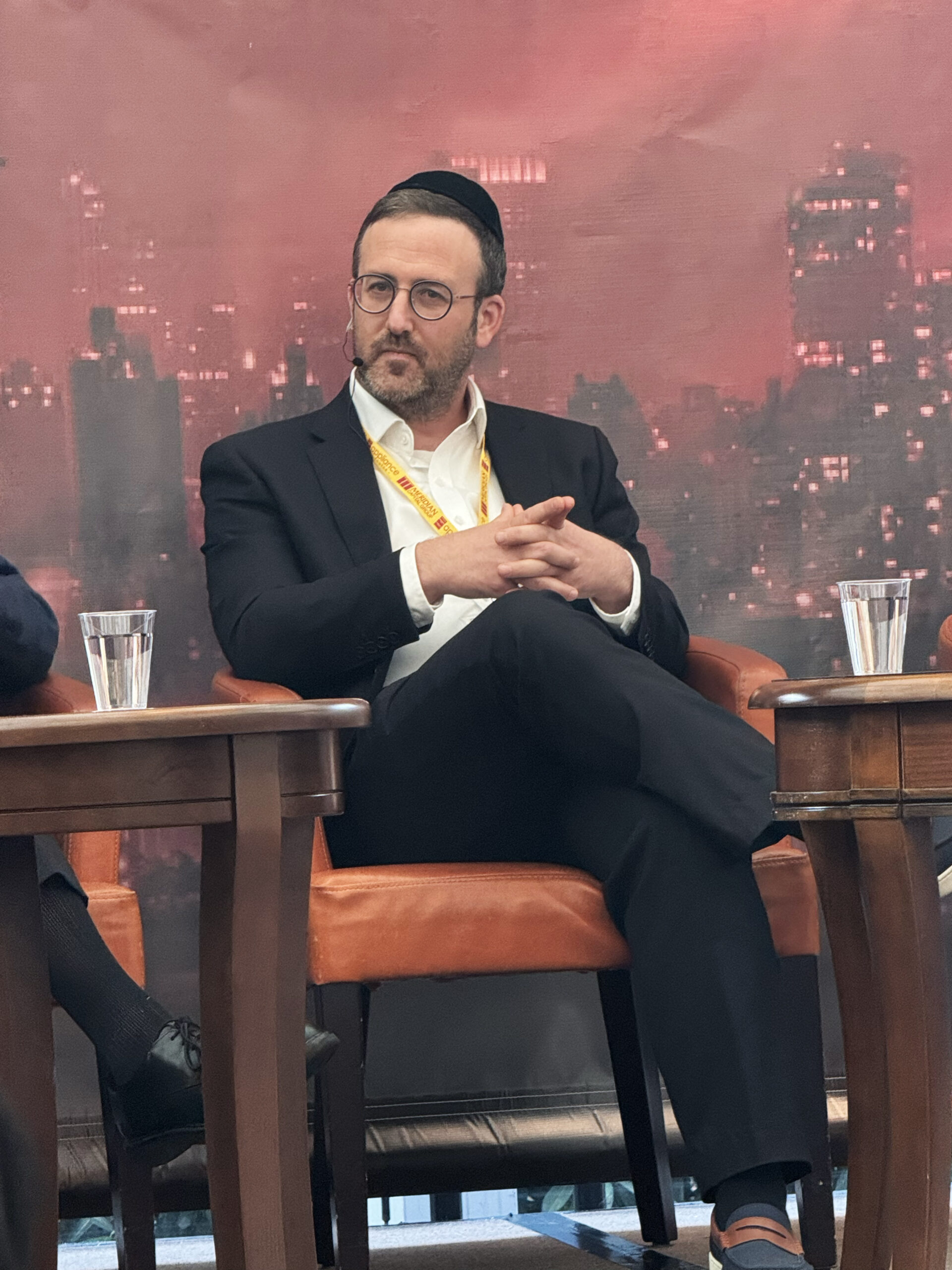
If you have walked into a new yeshivah building anywhere in America over the last few years, there’s a good chance you’ve already been inside one of Yudi (Jeff) Akerman’s projects without realizing it. His firm, Rise Architecture, has designed roughly 150 yeshivos across the country, plus schools, factories, apartment buildings and, relatively quietly, an entire new neighborhood in Okeechobee, Florida, that is now under construction. That’s all driven by a yungerman who insists, again and again, “I do not run my business. The Eibershter runs my business.”
On paper, Yudi looks like a classic driven founder. He runs Rise Architecture, with close to 50 employees and 500 active projects in 18 states, and partners in a second company, Jack Jaffa Permit Services, that pulls in serious revenue. He is in the middle of developments in New York, New Jersey and Florida and is quietly spinning off new verticals, including a measuring company and a bank structure in the US Virgin Islands.
Yet the lesson he stressed during our interview was the opposite of ego. Yudi believes that the day he focused more on his learning and less on his business was the day his business turned for the better. It’s a conversation that will make you reconsider what you hold important in your life. Enjoy!
—Nesanel
I was born in Brooklyn, New York, one of six children. My father is from Israel. He came here when he was three years old, so for all intents and purposes he is a New Yorker. My mother is also a New Yorker. Her parents came from Poland or Hungary. I don’t know how much that still matters these days, but it does have some influence on your life.
“I bounced around a little bit in yeshivah. I started in Skolye until it shut down. Then I went to Chasam Sofer, but I didn’t last very long. After that, I went to the Yeshiva of Brooklyn, then to Maor Hatalmud, and eventually to the Yeshiva of Far Rockaway. I was there for 11th and 12th grade and stayed through third-year beis midrash. I went to the Mir for six months, found it wasn’t for me and went back to YFR. I stayed there through college and for a couple of years after my marriage.
“I connected a lot with the new rosh yeshivah, Rav Perr. The first year he was there, he was my 12th-grade rebbi. I also had a close connection with Rabbi Brunner and Rabbi Brown, the head mechanech of the beis midrash.
“My father used to buy businesses, fix them up and sell them. The last business he bought was a candle factory, Old Williamsburg Candle Corporation. He acquired it when I was a little kid and sold it when I was already in my 20s and he was in his 60s. By then, it was his main business and one of the largest candle manufacturers in the US; it’s still around.
“My father started out by pouring the candles by hand. He worked really hard to build the business. He focused on relationships and got Walmart and Dollar Tree to buy from him. He flew to every part of the country and every part of the world, including Saudi Arabia, to save a penny on the candles. A half a penny in manufacturing can equal a lot in sales.
“By the time he sold the company, they were selling 12 truckloads of candles a week. My father realized that to continue growing the company, he’d have to buy a fleet of trucks to control his own deliveries; basically, he’d have to step up to a national level. That kind of business requires 24/7 immersion, and he didn’t want that kind of life, so he chose to sell instead.
“We didn’t have much money when I was a kid. The candle factory didn’t become really profitable until I was beginning high school. That led to me having a bit of an unhealthy relationship with money—finding it difficult to part with—that I had to unlearn.
“I was not entrepreneurial at all as a teenager. My brothers were much more into that. My younger brother in particular was the entrepreneurial one. He was always buying and selling. One of my kids is also like that, but I wasn’t. I was and am a little more nerdy. I still like LEGO, the architectural LEGOs specifically. I like puzzles. If you give me a hard puzzle, I can sit there for hours figuring it out. That’s exciting to me.
“After learning in Eretz Yisrael, I went to New York Institute of Technology for an undergrad degree in architecture. My mother suggested it; she thought I would be good at it. I was always artistic. I can still draw, even though I don’t get to do it much anymore. I always understood colors and layouts. Typical architects are not really focused on those things. I was always good at the interiors part, the design side.
“I never got a master’s degree in architecture, because in that field you don’t really need one. It was a five-year program. I stayed in Yeshiva of Far Rockaway for the first three years, but NYIT required that you attend full time after year three. I took summer sessions and finished the program in four and a half years, and I graduated in 2010. I was married for three years at that point.
“I managed financially in those years with help from my parents and in-laws. I had a small job on the side designing things for an architect. I started there while I was still in school, a few hours a day, so it didn’t pay much. My first real design for him was a restaurant in Great Neck, where he gave me full rein. We did something outlandish and crazy. We designed a wall made of 360 layers of plastic, with two of the layers being larger so the sink was embedded into the wall itself. We did a custom terrazzo floor with embedded bamboo shoots. A guy from Vegas flew in to do it. It was a $30,000 art installation on the floor.
“After school I went to look for a job, but it was during a downturn in the industry, and it was very hard to find anything. I went to a bunch of different architects. I even interviewed at a firm, Smiros and Smiros in Great Neck. It was a two-and-a-half-hour drive from where I lived. The guy there told me, ‘You aren’t taking a job here, because you are not driving two and a half hours. You have to be out of your mind to do that.’ I still couldn’t find a job—not many firms were hiring, and I also didn’t look that hard—so I went to work for an expediter named Yona Love who offered me a job.
“At that point, I just wanted to get my feet wet in the industry. It might not have been the ideal place to start, but it turned out that starting there instead of straight architecture pushed me to where I am today.
To read more, subscribe to Ami