



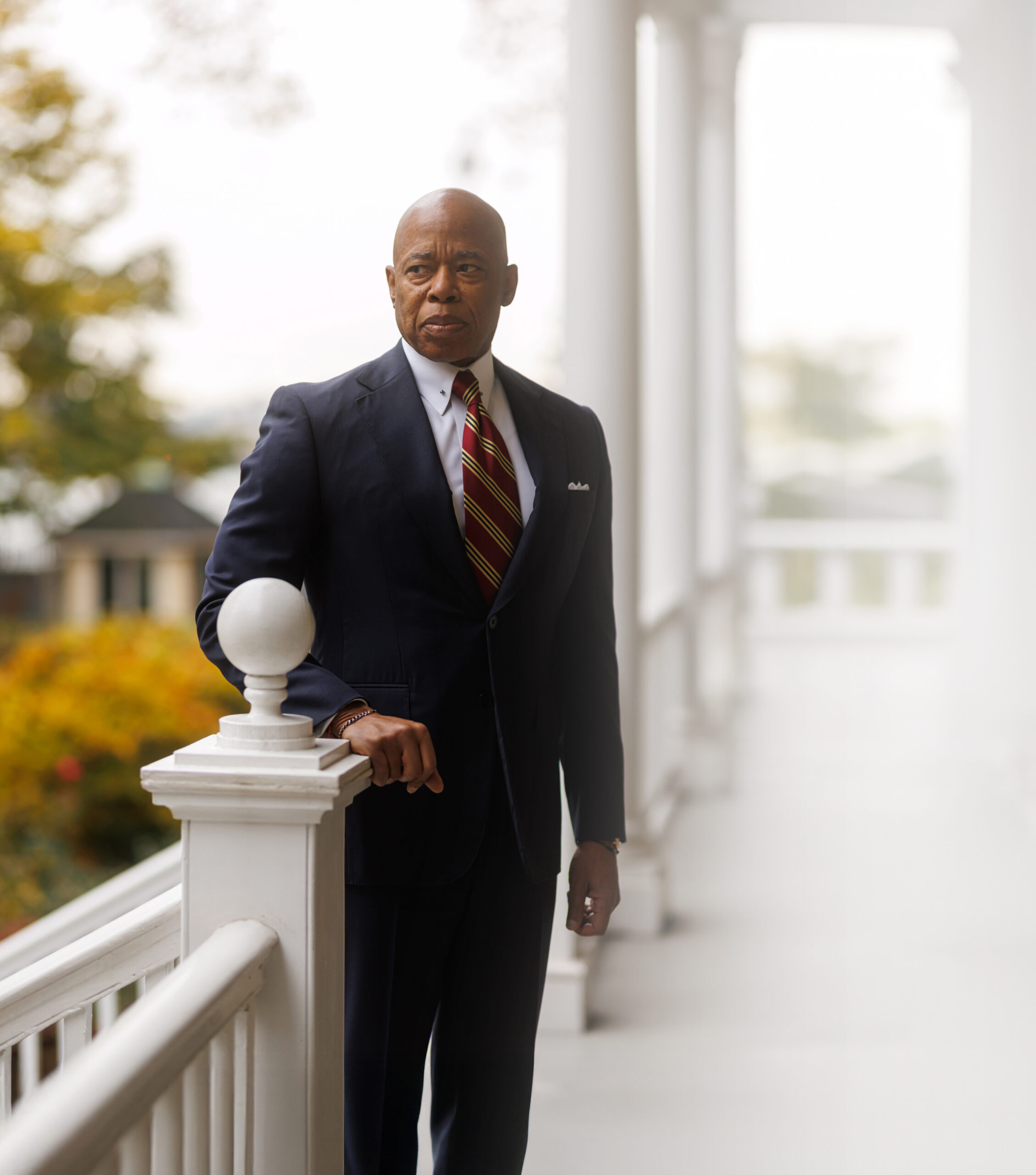
This Monday morning, I had the privilege of sitting down with Mayor Eric Adams at Gracie Mansion, his stately residence overlooking the East River in Manhattan’s Carl Schurz Park. Built in the 1790s, the mansion blends elegance with history. Its federal-style architecture, polished wood floors, sunlight-filled rooms, and carefully curated art offer a window into New York’s rich past.
As this would be my last visit with him as mayor, the meeting carried extra meaning. During our conversation, Adams appeared calm and reflective, speaking candidly about his tenure and the strong bonds he developed with the city’s vibrant Jewish community. At the same time, he expressed concerns about the challenges that may arise under a socialist administration, noting his successor Zohran Mamdani’s stated plans to defund the police and criticisms of Israel.
Yet Adams tempered his critique with measured optimism, expressing hope that Mamdani would grow into the responsibilities of office. The interview revealed a mayor proud of his accomplishments, while expressing apprehension about the complex challenges facing New York, and especially its Jewish community, under a Mamdani administration.
Yesterday I spoke with Hank Sheinkopf, whose opinion I respect very much. We were talking about your tenure, and he used the words “hakaras hatov,” which means recognizing and appreciating someone who has done you a favor. I think that’s the highest compliment anyone can get. As Jewish New Yorkers, we owe you a tremendous debt of gratitude, and I would like to express that on behalf of myself and our readers.
That’s very kind of you.
You still have another six weeks or so to go, but what do you consider your greatest accomplishment thus far?
Right now, it’s all about finishing up the last few important items that we’re doing. You can do a lot in a short period of time. It’s all about whether I’ve lived up to what I promised, not only to the people of this city but to my mother. She made a great sacrifice and put her life on hold. When you raise a son under the circumstances that she did, on the verge of poverty and raising six children basically on her own, you want her to see that I am the son she wanted me to be. Most importantly, over the last 18 months I’ve learned that I am the man I always wanted to be: overcoming Covid, overcoming the crisis of crime, the crisis of migrants and asylum seekers, the lawfare that came on the federal level. I got up every day and did my job.
I’ve never been a politician, but you’re still working to get your policies in place while you already have a successor who has pledged to work against what you accomplished. What does that feel like as a human being?
It’s a great question and one that I have been asked often. The mayoralty is a relay race. Giuliani ran his mile and then handed the baton to Michael Bloomberg, who handed it off to de Blasio, who handed it off to me. Once you hand off the baton, you have to allow that mayor to run his race. That is going to be his legacy. I think that mistakes were made when Mayor de Blasio didn’t continue some of the things Mayor Bloomberg put in place. I didn’t want to make that same mistake, so I built on and improved what de Blasio did around pre-K and other important items.
If Zohran decides he’s going to come into office and take away the containerization of garbage and recycling and now have the rat problem grow again, that’s his legacy. If he states that he’s going to empty the jails of 3,000 dangerous inmates and put them back into the communities they preyed on, that’s his legacy. If he states that he’s going to run millionaires—who pay 50% of our taxes and pay for our police officers, firefighters and the needs of people—out of this city, that’s his legacy. He’s going to have to embrace a certain level of political maturity when he becomes the mayor. At that point he’s no longer protesting, he’s governing, and he has to make those decisions.
I gather from what you’re saying that you have a sense of optimism that his bark is worse than his bite, and that he won’t implement many of his promises.
No, I am not optimistic because unlike others, I’m aware that not only did the people of this city elect an individual, they elected an organization—the Democratic Socialists of America—who hate our way of life. According to him, he’s going to be carrying out their policies, and their policies call for the decriminalization of certain behaviors. Their policies are not friendly to yeshivahs, which is something I advocated for. Their policy is to call for a globalized Intifada, which means to kill Jews everywhere. Their policy is one that is hurtful and harmful to working-class people. They put it under the guise of helping them, but we all know that socialism has never worked. There is nowhere on the planet that you see socialism being successful. I am, however, hopeful, and that’s the difference. I’m hopeful that when he gets into office he’s going to realize that we need everyone, and you can’t divide the city. The person who drives the limousine should have a respectable way of life, and the person who sits in the back of the limousine should have the same thing. That’s the symbiotic relationship we must develop.
To read more, subscribe to Ami