




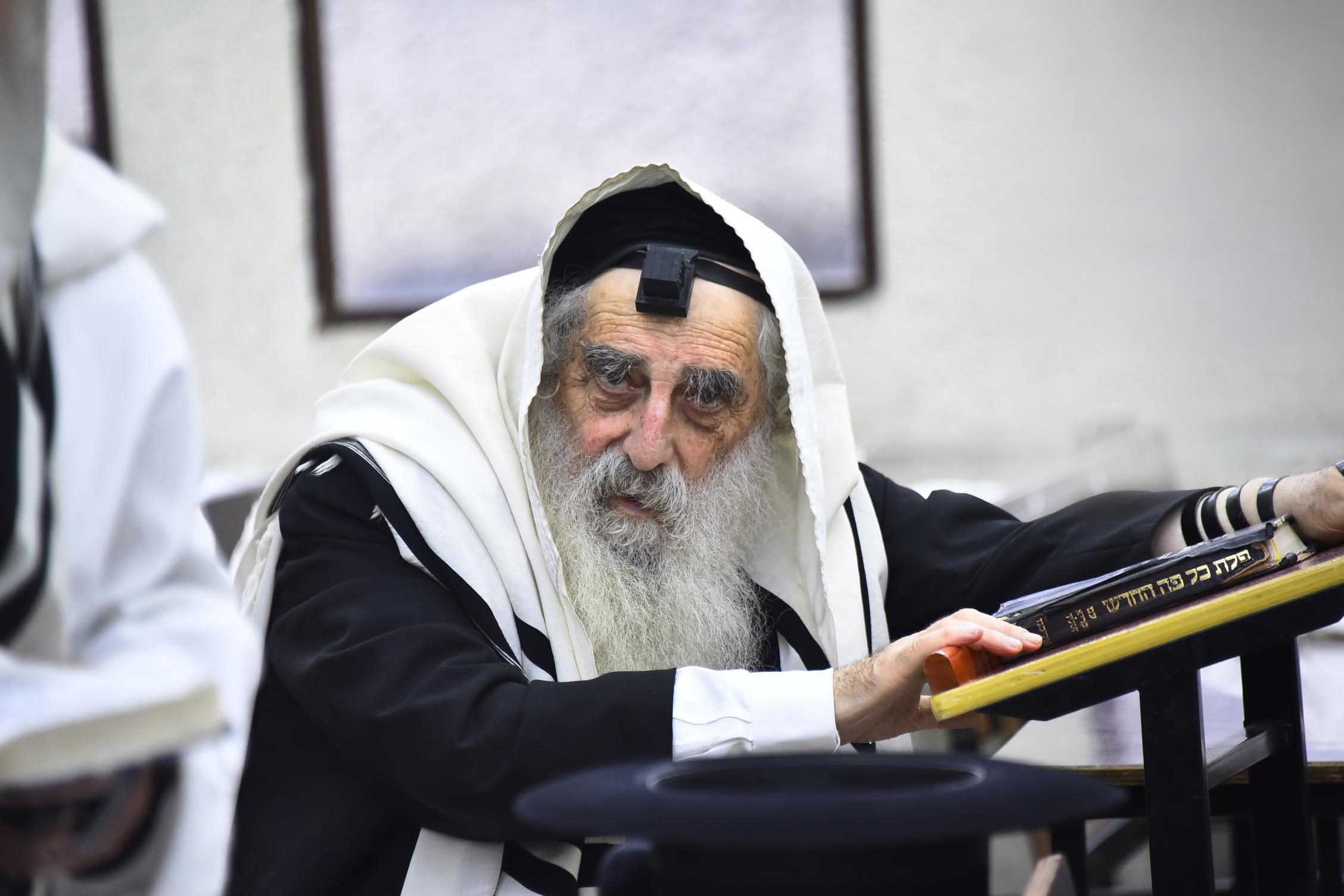
“Mir zenen shoin zeks doiros in Eretz Yisrael—My family has been living in Eretz Yisrael for six generations,” Rav Menachem Tzvi Berlin begins. “The Netziv’s father is one of my ancestors.”
We are sitting in the rosh yeshivah’s office in Yeshivas Rav Chaim Ozer on Rechov Shlomo Hamelech in Bnei Brak. It is one of the few yeshivos still going strong a couple of days before Tishah B’Av.
Rav Berlin tells me that his father owned a large pharmacy in Yerushalayim. “All the gedolei hador would patronize the store. They davened Minchah Gedolah there every afternoon. Rav Shach could come. So would Rav Zelig Reuven Bengis. Rav Yoshe Ber Soloveitchik was there every single day. That’s what Yerushalayim was like back when I was a child,” he reminisces.
Rav Menachem Tzvi’s office is a reflection of his personality. The room is plain and has a naked lightbulb screwed into the ceiling. There’s a rickety desk with two chairs set up in front of it. The only things on the desk are a telephone and a well-worn copy of Mesilas Yesharim.
“In Yerushalayim, if a child found a gold watch, everyone knew he would put up a sign: ‘To whomever lost this watch, I will return it upon receiving simanim.’ One time I asked a boy who had found a watch, ‘Tell me the truth. Would you rather that Berel comes and gives you the simanim so you can return this beautiful watch? Or would you prefer that he never shows up so you can keep it?’”
Rav Menachem Tzvi’s eyes shine brightly with the memories of the Yerushalayim of yesteryear. “Listen to what this Jewish child said. He answered, ‘I could have a watch for 120 years, but if I return it I gain something for eternity.’ He was eight years old. Those were the kinds of values we had. That was the ruach, especially in the Geulah neighborhood near Zichron Moshe in the old Montefiore section where we lived.”
Rav Menachem Tzvi adds another story to illustrate the type of Yidden who lived in the Old Yishuv in the early part of the 20th century. “As a bachur I once wrote up an exchange in learning I had with Rav Hirsch (Tzvi) Pesach Frank. It was a serious discussion. This was over 60 years ago. I was too embarrassed to write my full name, so I signed it Tzvi Berlin. It was published in Kol Torah in 5720 (1960).”
More than four decades later, Rav Yosef Cohen (a grandson-in-law of Rav Tzvi Pesach and the father of Rav Dovid Cohen of Yeshivas Chevron) called Rav Berlin and wanted him to come over. “When I got there he handed me a newly printed kovetz on Pesach that contained a response to my write-up. Well, once I was there I wanted to hear some of his zichronos, so I said, ‘Rav Yosef, please tell me a story.’ This was only a few weeks before he passed away in 5761 (2001). He agreed and told me that I should publicize the following story:
“‘There was a time when housing was so limited that an apartment could have ten regular rooms for people to sleep in and two communal rooms, one a kitchen and the other a utility room,’ Rav Yosef Cohen began. ‘A man with no children had recently passed away, leaving a sick wife behind who wasn’t able to care for herself. Her neighbors rose to the occasion and used to pass food to her through a window. Once a week, a woman would come to help her out a bit and maybe even daven Minchah so she could say Amen. When the holy Maharil Diskin, who was a relative of this woman, came to Eretz Yisrael, he was told that he could visit her on a Wednesday afternoon. He brought along his shamash and she poured out her pain. As he rose to leave, the woman said, “Reb Yehoshua Leib, please daven that I should live.” She didn’t ask for a refuah shleimah; she knew it wasn’t in reach. After they were outside, the young man who had accompanied him asked, “What kind of a life is that, spending an entire week locked in a room with no one to talk to and barely able to daven?” “Yungerman,” Maharil Diskin replied, “once a week this woman gets to say amein to the Ribbono Shel Olam. To her, it’s worth an entire week of suffering.’”
“Can you imagine such a moiredike thing?” Rav Berlin says, his voice reverent. “When I gave a hesped for him I mentioned that story. It was a moving hesped.”
“Where did the Rosh Yeshivah learn as a child?” I ask him.
“I learned in a cheder called Yavneh and then later in a yeshivah ketanah called Tiferes Tzvi. We would come in at nine o’clock to learn. Each boy brought his own piece of bread, and the kitchen would provide a small glass of tea or hot chocolate. Rav Eliyahu Lopian would come and daven with us every morning.”
Rav Berlin’s voice softens. “On the first day he came to daven there was a shliach tzibbur, but Rav Eliyahu was the real baal tefillah. When he shouted, ‘Lo bigvuras hasus yechpatz’ and ‘V’lo sasuru,’ the walls trembled. He was the one leading the davening.”
He leans in. “After davening,” he continues, “without anyone saying a word, one of the bachurim took it upon himself that he wouldn’t walk in the street wearing his eyeglasses. That was his kabbalah: ‘v’lo sasuru acharei…eineichem.’ I know it sounds unbelievable, but everyone did things like that in those days. It was a different world,” he says with a sigh.
“Did the Rosh Yeshivah have any connection with Rav Bengis?” I inquire.
“Not really,” he replies. “I visited him once or twice. Rav Bengis was a week older than Rav Isser Zalman. When people asked Rav Isser Zalman to sign the certificate for the Agudah’s hashgachah for shechitah, he would reply, ‘As long as Rav Bengis is alive I can’t do anything.’”
“Where did the Rosh Yeshivah learn as an older bachur?” I ask next.
“Truthfully, I wanted to go to Ponovezh. But the Brisker Rav told me, ‘If you’re learning well in Yerushalayim, it’s better to stay in Yerushalayim. Do you think you can dorm in a yeshivah and still get a good night’s sleep?’ So I learned in Chevron,” he says with a chuckle. “But I had a chavrusashaft with Rav Dovid Soloveitchik. We went through several masechtos together.”
To read more, subscribe to Ami