
Balancing a life of work and Torah learning is something every ben Torah strives for, yet most find it nearly impossible. The pressures of earning a living and supporting a family often take a toll on consistent learning. It’s an area that calls for encouragement and chizzuk.
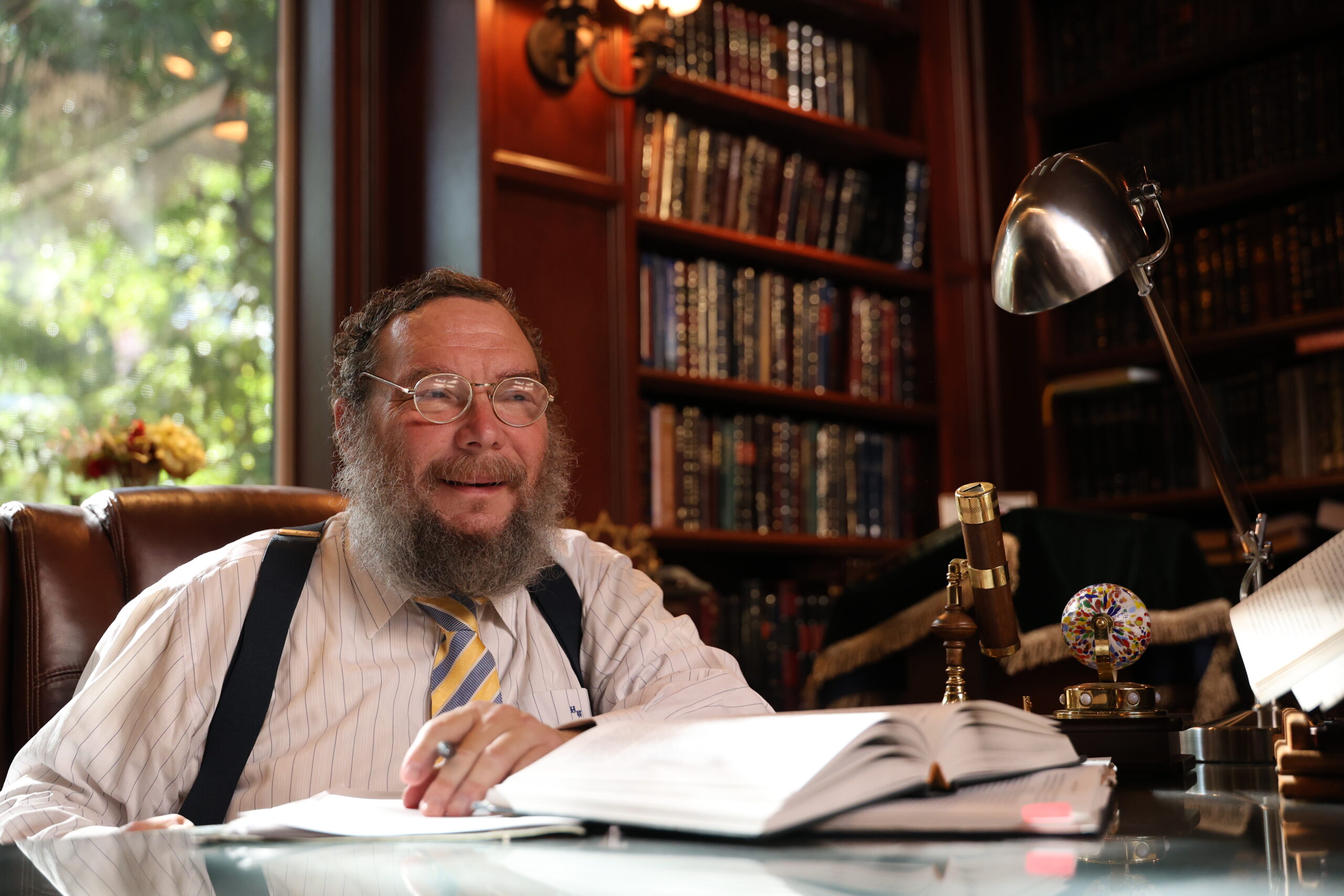
Rabbi Moshe Weiss, founder and rav of Chabad of Sherman Oaks, California, is the ideal person to give that chizzuk. Over the past four decades, while serving as the community’s rav and expanding its reach, Rabbi Weiss has also built a successful career in the health care industry.
In fact, with a brachah and the guidance of the Lubavitcher Rebbe, Rabbi Weiss sees both his business and his rabbanus as part of the same mission.
As he told me during our conversation: “I always believed that the secret to any success I had was the learning I started each day with. Primarily because it shows people how important Torah is. They knew I was successful in business, and nevertheless, I was sitting and learning every day.”
A talmid chacham of stature, Rabbi Weiss’ sefarim, Matza Tov, have been widely sought after for their deep lomdus and pilpulim.
Rabbi Weiss is the son of the legendary Reb Berel Weiss, the renowned philanthropist from Los Angeles. His story is, in many ways, his father’s story as well—one of dedication to Hashem, to tzaddikim, to Torah learning and to tremendous tzedakah and chesed.
I hope that after reading this article, you’ll be inspired to carve out a little more time for Torah, no matter what your work life throws your way.
Enjoy!
—Nesanel
I was born in Los Angeles, California. My father, Reb Berel Weiss, was a world-renowned baal tzedakah and a true ben Torah. He was a tremendous machnis orach, a warm and chasidish Yid, and a very special person. His reputation for chesed was legendary—he helped countless people not only with generous donations, but also in innumerable quiet, personal ways.
“Really, you could write two full books just about my father. He grew up in a tiny village in Romania called Bătarci, just 15 kilometers from Satmar. They used to say the town had only 40 talleisim—married men. And yet, from this small place came many great and prominent Yidden. The village’s melamed was Reb Yosef Luger, a deeply emotional Yid whose children today are prominent Satmar chasidim. Every day after cheder, Reb Yosef would tell stories—sipurei tzaddikim. Despite all the learning my father did—he knew Chullin and Beitzah by heart—what stayed with him most deeply were the stories. Reb Yosef would say, ‘Kinderlach, I’m telling you stories about the tzaddikim from our region, but far away, in a place called Russia, there are very, very great tzaddikim—the einiklach of the Baal HaTanya and the Shulchan Aruch Harav, about whom the holy Maggid would say, ‘Hilchesa K’Rav.’ And whenever he said those two words, he would lift his hands with emotion. From a young age, my father dreamed of one day traveling to Russia to see the great tzaddikim of Lubavitch Reb Yosef spoke of with such awe. Reb Yosef eventually led my father toward Lubavitch, even though his family was Romanian chasidish, not Lubavitch.
“My grandfather, Reb Yona Weiss, was a Kossoner chasid, and he sent my father to learn in Kosson. When World War II broke out, my father was still a teenager. He and his father were deported to Auschwitz. My father watched as his father was taken away. Later, he would learn it was to the gas chambers. My father called out, ‘Tatte, Tatte…’ A Polish prisoner nearby whispered to him, ‘Bachur’l, remember this date because today is your father’s yahrtzeit…’
“After surviving the horrors of the Holocaust, my father needed somewhere to rebuild his life. He had uncles and aunts in Los Angeles who sponsored his immigration in 1949. He once told me that one of the reasons he chose to go to America—even though he was still young and wanted to continue learning—was to be able to find and connect with the descendants of the Baal HaTanya. He eventually brought over the other surviving members of his family and helped them settle and build businesses. During those years, he married my mother, who came from a wonderful Vizhnitzer family from Romania, the Wircbergers.
“In Los Angeles, my father became close to Rav Shmuel Dovid Halevi Raichik, the shliach of the Frierdiker Rebbe. He became like a father to the immigrants. He had a way of speaking to them. They cried to him, brought him their pain and gave him kvitlach to take with him when he traveled to the Rebbe. A few years ago, the Central Chabad Library published an archive of photos people had sent to the Rebbe over the years. I was stunned that so many people from Los Angeles who I never would have thought had any connection to the Lubavitcher Rebbe had sent their pictures. That was all thanks to Rabbi Raichik.
“Through Rabbi Raichik, my father received a brachah from the Rebbe, to which he later attributed his success in business. In 1962, my father traveled to see the Rebbe in person, to thank him. From then on, he was ‘hooked.’ My sister later married a prominent Lubavitcher bachur, Rabbi Sholom Ber Levitin, and today they serve as the head shluchim of the Pacific Northwest. My brother also went on to learn in Lubavitch. So by the time I came along, it was a done deal: We were full-fledged Lubavitchers.
“In those days, there were barely any Lubavitchers in Los Angeles, just Rabbi Raichik and maybe one or two others. But my father felt a deep connection to the Rebbe and to Chabad. At the same time, he remained close to many, many rebbes. The first time the Munkatcher Rebbe came to Los Angeles, he stayed at our home. The Vizhnitzer Rebbe, Rav Mottele, visited, as did the Satmar Rebbe and the Sigheter Rebbe. The Skulener Rebbe stayed with us twice, for two full weeks. In fact, until my father’s passing 14 years ago, nearly every rebbe who visited Los Angeles stayed in our home.
“My father, my uncle Moshe Weiss and a few other fine Yidden were among the founders of the chareidi community in Los Angeles. They also started the Toras Emes Day School, a beautiful and high-level yeshivah where many children, including me and my siblings, were educated. While they weren’t the only frum Jews in Los Angeles at the time, they laid the foundations for what became the chareidi kehillah. My father was the first Yid to move into Hancock Park, which today is filled with thousands of Yidden.
“My parents got married in Germany after the war. My mother, Miriam, was a Holocaust survivor, originally from the city of Borșa (pronounced bor-sha), Romania. The way she survived was nothing short of miraculous. One day, she was supposed to board an ambulance heading into Klausenberg. Someone—I don’t remember who—told her not to take the ambulance and to travel to Klausenberg on her own. She listened, made it there safely, and later found out the ambulance never arrived.
To read more, subscribe to Ami