




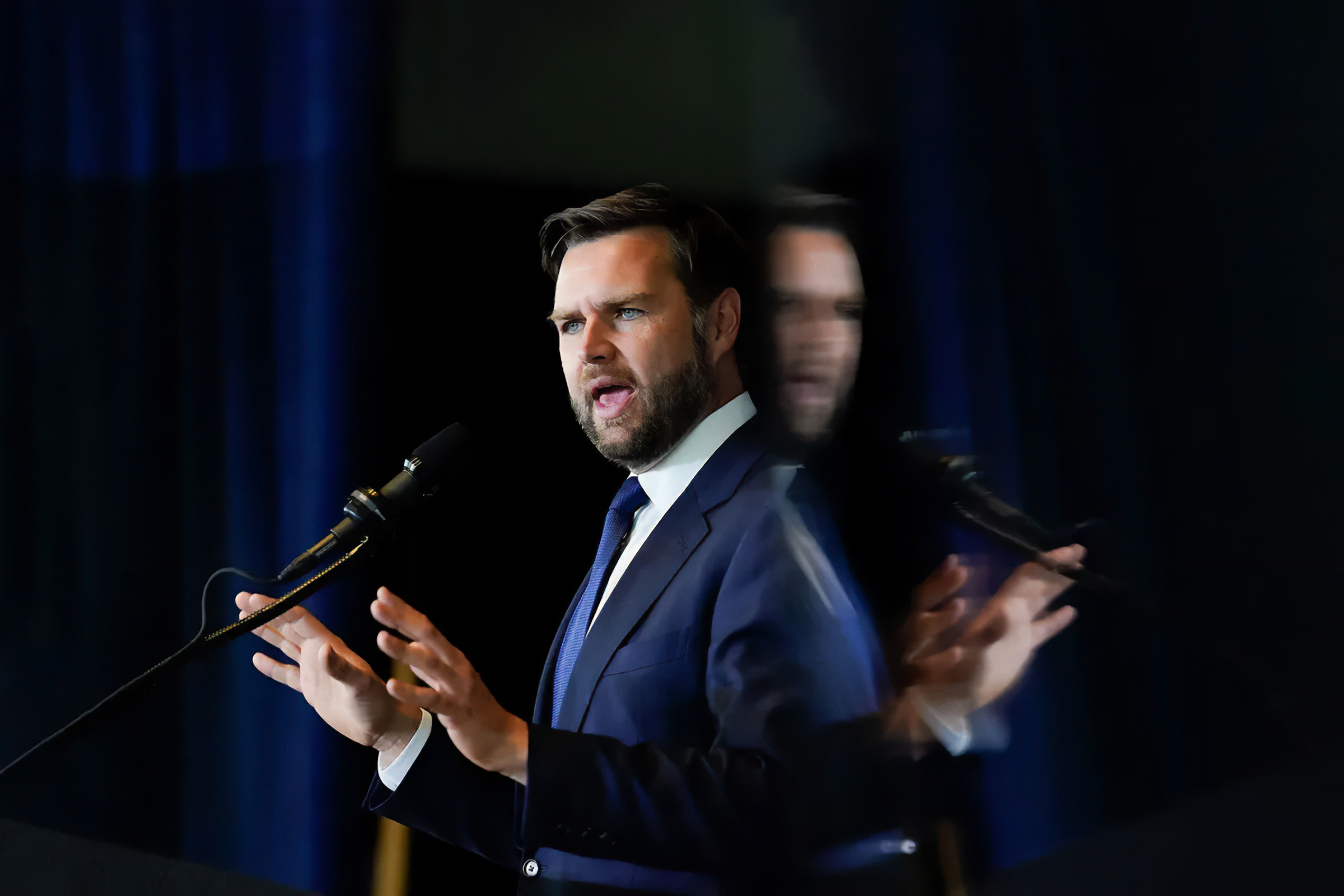
Being able to speak to the Republican vice-presidential nominee on October 7 feels very providential.
I appreciate that, and I certainly hope so.
I know you have been unwavering and outspoken in your support of the State of Israel and the Jewish people ever since the horrific terrorist attack by Hamas on that fateful day. I would like to ask you for your thoughts on that today, exactly one year later.
Obviously, it is a solemn and sad day. The thought that is on the top of my mind—and has been on the top of my mind pretty much since that happened—is that we have to bring the hostages home, and that’s especially true for the American citizens.
My frustration is twofold: that the hostages aren’t home, and that the American media have shown a bizarre unwillingness to focus on the story of these people. Of course, all life is precious, but as an American senator, I am most focused on American citizens. I can’t believe that it’s not a constant national scandal that there are young Americans who have been brutalized for a year. There is no sense of urgency from the American leadership or the American press corps, which is just astonishing to me. That’s what I take away from this: sadness about the hostages and a certain disbelief at the lack of urgency and focus from our own administration.
And there are so many other thoughts and considerations. Over 1,000 families are mourning the loss of a loved one in Israel. A lot of innocent people lost their lives, people with beautiful faces who are never going to smile again. I think it’s impossible to have a day pass without thinking about them. Then there are the broader political concerns about where this war is going, when it will end, and whether Hamas will be eradicated as a fighting force. Does it become a broader regional conflict? There’s a lot going on, and I’m thinking about all of that today, but at the forefront of my mind is the loss of life of people who should be home with their families right now but aren’t.
You did phenomenally well in your debate with Tim Walz, and I would like to congratulate you on that. The first question you were asked by the panelists was about Iran, which had just launched a barrage of missiles at Israel. We are still expecting an Israeli response, and I would like to know what a Trump-Vance administration would support in that regard, and what you would advocate for right now as a sitting US senator.
I appreciate your kind words about my performance, but there is something I wish I had said at the time. There are so many things you want to say during a debate, but sometimes you don’t manage to get them all in. The question itself was bizarre. They asked, “Would you support Israel engaging in a preemptive strike?” which turns the meaning of “preemptive” completely on its head. When someone launches 200 ballistic missiles at your territory, it’s not preemptive to respond to that. That’s the definition of a reactive strike. I felt that it revealed a bizarre understanding on the part of the CBS moderators and really the entire American media about what Israel is up against.
In terms of what Israel should actually do, my attitude is that you trust your very good friends implicitly, and I think that Israel is a very good friend. I don’t want to micromanage their response, and I wouldn’t presume to tell the Israelis what to do. There are a whole host of considerations, from resources to intelligence to the cost-benefit analysis. I’m just not in a position to tell them how to respond to such an existential security threat. As Americans, our goal should be to support our friends and make it easier for them to have a successful military operation so they can restore peace to the region, and more importantly, trust them to do what’s in their best interests and make their own decisions.
One of the most bizarre things about the Harris administration policy toward Israel is not just the mealy mouth and lack of moral clarity, but this weird sense that they can somehow micromanage a war 6,000 miles away that, thank G-d, doesn’t directly involve the United States. If we’ve learned anything over the last 30 years, it’s that we’re not that good at operating Middle Eastern wars. We make a lot of mistakes, and we misunderstand the cultural context a lot. That’s something that the Israelis don’t do. They know what they’re doing because it’s their part of the world, and we should be deferential to them responding to their own security.
Of course, if you were to ask what America should do, I’m going to want to have a more direct view of our own resources and what our response should be, but I think that right now this is something that Israel is able to take care of. Obviously, if there are certain weapons systems they need, we should provide them, but we should try as much as possible to keep this a relatively limited engagement, and I think the Israelis know how to do that better than we do.
The French Jewish philosopher Bernard-Henri Lévy recently wrote a book called Israel Alone, in which he makes a distinction between what the US faced after 9/11, when they formed a coalition with its allies to go after Al Qaeda, and the fact that Israel has no coalition willing to fight the axis of evil, even though they have allies. Would you care to offer your perspective on that?
Unfortunately, I think it’s true. Israel doesn’t have nearly as fulsome of a coalition. The Europeans, either because of moral cowardice or some other reason, are simply not as friendly to the Israelis in 2024 than many of them were to the United States in the wake of 9/11. But I will say that it raises an important strategic concern, which is that part of our goal in the Middle East should be how to get Israel on the kind of footing where it can maintain its security over the long haul rather than merely short-term peace and survival.
One of the things that has been so profoundly misguided about the Harris administration policy is that in past American administrations, when you have had a major diplomatic breakthrough, the next administration, even if it’s from a different party, tries to build on it rather than tear it down. Under Harris’ leadership, however, American diplomats aren’t even supposed to mention the Abraham Accords, which is very dumb, because that’s how you build the type of coalition where Israel can provide both its own security and regional stability. That’s not because the Saudis, the Emiratis or anyone else is especially fond of Israel; we understand that there are still very deep cultural and religious hostilities there, but there is basic realpolitik recognition that the Arab Gulf states and Israel have a common enemy in Iran. Out of that recognition could come a long-term security compact that if built upon could allow the United States and Israel to provide regional stability for a very long time.
That’s what we should be trying to do: get Israel in a position where its survival is not so precarious. The only way to do that is to get it some real allies. It’s astonishing to me that so much of Harris’ foreign policy seems designed to deprive Israel of the very allies it needs to survive, not just over the next couple of months or years but the next couple of decades.
Right after the October 7 massacre, you coauthored an op-ed entitled, “Don’t Hold Up Israel Aid to Further Ukraine War Funding.” In general, you haven’t been supportive of America’s involvement in the Ukrainian effort. How do you differentiate between US support for Ukraine and support for Israel, and where do you draw the line?
They are very different countries with very different histories and alliance structures with the United States, and frankly, they are very different with regard to what they provide the United States in terms of our national interests. You have to start from a place where the alliance with Israel hasn’t only been good in the sense that it allows us to project security and power overseas. Nor is it good because the Israelis share our values. It’s good because the Israelis are developing military-grade technologies that are really going to be useful to the United States over the long term. In other words, while the United States does give Israel a lot, the alliance is a lot less one-sided than our relationship with Ukraine.
The second thing is that while I certainly condemn the Russian invasion and I wish that Vladimir Putin had never invaded Ukraine, there has to be some recognition of the world of scarcity we’re living in. Let’s take one particular example: The Israelis need a lot of artillery to conduct their operation in Gaza. Well, I know that there has been a limitation on the artillery that we supply to Israel, and part of the reason is that we’ve supplied so much artillery to the Ukrainians that there’s nothing really left to give to them. So I think that the effort to lump them together ignores the fact that there are real tensions between our Israel policy and our Ukraine policy.
In addition to the fact that they bear on our national interests very differently, I think that the policies in some ways are in direct conflict. To be frank, I’ve been somewhat disappointed that many Americans who are supportive of Israel seem to not appreciate those underlying tensions, because if you aren’t appreciating those tensions and the scarcity we exist in, you’re missing something very important about our foreign policy and what it should be.
Let’s move on to a related issue that is closer to home: the virulent waves of anti-Semitism here in the United States, especially as it effects students on campus. What do you think can be done about that pressing problem?
Unfortunately, as we have learned, what happens on campuses tends to spread to the broader society. Problems that we think are confined to college kids being a little crazy or not thinking through their actions might have been a proper attitude to take 30 or 40 years ago, but we are now seeing that a lot of the ideas that take root in our universities become extremely dominant in our corporations, in our non-profit organizations, in our medical practices and certainly in our society at large.
We are seeing the rise of a very vile form of anti-Semitism on our campuses. It is largely constrained there, although I’m not saying that there haven’t been increases in anti-Semitism writ large because there have, but it has been the most noxious and obvious there. I think we have to be willing to use our accreditation authority at the federal level and especially our purse strings to say to these universities, “If you’re not going to protect Jewish students, if you’re not going to promote an actual free exchange of ideas, then you’re not going to get federal money or federal accreditation.”
It’s one thing to criticize Israel’s policy, and while I might disagree substantively, I protect the First Amendment and believe that everyone has the right to express a view on the politics of the day. However, it’s something quite different to harass a Jewish student and prevent him from going to class because of his ethnicity or religion. Unfortunately, we’ve been unwilling to draw that line between First Amendment-protected speech and even aggressive criticism of Israel’s conduct versus harassment of students because of their ethnicity. To me, it’s very easy to distinguish between the two, but the universities have been incredibly cowardly in how they’ve responded.
We’ve already seen a slight uptick in anti-Semitic violence and rhetoric in society at large, but I think we can be in a very ugly place in this country ten years from now if we don’t nip this in the bud.
How do you gauge the mood in the Senate and Congress when it comes to support of Israel and legislation against anti-Semitism?
I think the position of Israel and Jewish people is strong in the Senate in particular. There’s a relatively robust bipartisan sense that anti-Semitism is ugly, that we shouldn’t be supporting universities that have gone completely insane and so on. I think the House is more of a mixed picture, and importantly, I think that federal policy has reflected that. A lot of Jewish Americans are frustrated with the Kamala Harris policy and rhetoric over the last year or so. I think the fundamental thing to appreciate about it is that it’s coming from a place of not just political cowardice but political confusion. The Democratic Party has Jewish Americans who care about Israel’s right to exist and the rise of anti-Semitism in the United States, but they also increasingly have a very loud and very vocal anti-Semitic and anti-Israel element in their party, so they don’t really know what to do.
The message I wish my Democratic friends would take from the last year is that you shouldn’t coddle anti-Semitic elements just because some of them vote. You should speak proudly and forcefully against anti-Semitism and let the political chips fall where they may. But in the process, I think you’ll root out a very bad part of American society. It’s small right now, but it’s quite vocal and quite aggressive.
Let’s talk about immigration. The Biden administration has allowed many people to enter the United States illegally. New York City, where I live, is suffering from that problem. Is the problem fixable at this point?
I do think that it’s fixable; it just requires law enforcement. There’s a whole list of things that can be done, from reimplementing deportations to making it harder for illegal immigrants to come here in the first place. There’s so much we do to facilitate illegal immigrants to enter the country, such as the welfare benefits that we offer. And we have to start by being honest about it.
Part of the problem with our immigration policy—and it’s uncomfortable for a lot of people to admit this—is that a lot of the people who are coming here illegally, particularly over the last year, are potentially violent and have potential ties to terrorist organizations. To be clear, I’m not saying that the majority are like that, but it is a large number. When you’re talking about 25 million people in this country illegally, a fraction of a percent is a lot of people. And unfortunately, a lot of people, even if they aren’t violent themselves, are clearly bringing some ethnic interests with them that are going to be very bad for American Jews and for all of us.
One of the things I want from newcomers to this country is that they should bring their dreams, ambitions and talents, but I want them to become Americans in the fullest sense of the word. I don’t want them to bring old-world ethnic hatred with them, because very often those old-world ethnic hatreds are anti-Semitism. We’re seeing a lot of very strong anti-Israel attitudes in very recent newcomers, especially illegal ones. I don’t want to bring people who hate others into our country. I want us to all get along. I want us to like each other. I want us to be on the same American team and part of the same American family. It’s very hard to do that if you’re bringing in newcomers who hate one or multiple members of the American family.
You have an exceptional life story. You’ve lived the American dream, growing up in a poor Rust Belt town and now serving as a US senator and the Republican vice-presidential nominee. How has the experience of running for vice president been?
Honestly, it has been a great blessing. I’ve gotten to see the country from a perspective I’ve never expected to see it from. It has made me feel extremely hopeful about the United States of America, and it has made me feel incredible gratitude for the generosity of the people you meet every day who are struggling but really care about the country, about their children’s future and about all Americans. It has made me feel very good about our nation. I try to remind audiences that we have a right to be frustrated by what Kamala Harris is doing to the country, but there is a lot of good here and a lot that can be addressed. We just need to fix the fundamental problem of broken leadership, which is why Donald Trump and I are asking everyone to vote.
What would be your pet project in a Trump administration?
I care a lot about the opioid problem, and I know a lot of Jewish non-profits that help Jews and non-Jews alike deal with the problem of addiction. I think it’s one of the biggest sources of unnecessary tragedy in our country and one of the biggest sources of untimely death, and it’s something I would like to make a lot better. I’m going to work very hard on that during my time in that position.
There are only a few short days until Election Day. What do you think is the biggest hurdle to get to the finish line?
Getting our message out. It’s reminding people that we can have low inflation, we can have a secure southern border, and we can have a rise in prosperity and take-home pay. We just need to get back to smarter policies. And of course, it’s also about turnout. A lot of people agree with us and will vote for us if they get to the polls, but for one reason or another some Americans don’t vote on Election Day. We’re trying to change that and make sure we get as many of our voters out there as possible. There’s a lot of grassroots activism, things like phone calls and door knockers. I think a lot of people are going to get out there and vote, and I think we’re going to win.
To read more, subscribe to Ami