




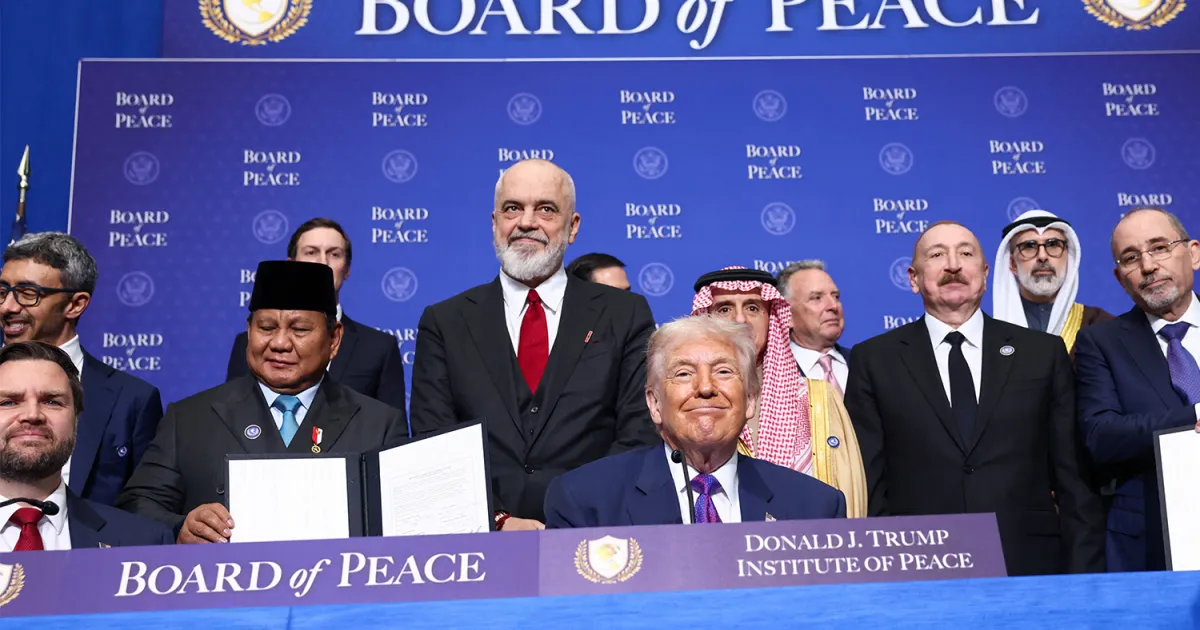
“I think [Trump’s] 20-point plan, which was adopted by the UN Security Council, and now moving forward with the guidelines and the agreements that are going to be reached, is a very positive step with the clear caveat…that Hamas must be disarmed, and I hope Hamas will be disarmed fully.”
—Israeli President Yitzchak Herzog, putting a positive spin on the deal made by the Board of Peace in apparent contradiction to multiple Israeli officials
When President Trump presented his 20-point plan for peace between Israel and Gaza last year, Israeli officials expressed public support. The details, though, were vague, and the likelihood existed that the agreement would lead Israel in a direction it didn’t want to go.
Israel has already reinterpreted several points of the plan to its own liking, such as the percentage of Gaza that can be under Israeli control, even when doing so contradicted the plain language of the agreement. Still, the Board of Peace, the body established to help implement the plan, never called Israel on the carpet for those apparent violations.
Now, however, we have arrived at a true sticking point, a fundamental disagreement between the Board of Peace and Israel. The Board of Peace put forth a so-called disarmament plan that would, if implemented, see Hamas and other armed groups in Gaza give up their larger armaments and allow the technocratic Palestinian government (often referred to as the National Committee for the Administration of Gaza) and the International Stabilization Force to be the only major weapons-wielding forces in Gaza. (Private small arms would still be allowed.)
Both Hamas and Palestinian Islamic Jihad have signed the accord. But Israel has said, mostly through anonymous officials, that it will not accept its terms unless Hamas is disarmed first. Israel has also explicitly defied the first few clauses of the accord, which require both Israel and Hamas to cease any fighting. Indeed, Israel carried out airstrikes in Gaza after the accord was signed.
Understanding the real repercussions depends primarily on one man: Donald Trump. He has touted the deal and said that Israel is happy with it, which it patently is not. The question is, will he let Israel refuse to comply, or will he retaliate if it doesn’t acquiesce?
A document full of details and questions
One reason the various peace plans and related documents ultimately founder is that they contain vague language that leaves key points open to interpretation by both sides. This new deal is no exception; for example, it doesn’t seem to clarify the exact level of weaponry Hamas will be able to retain.
A large portion of the agreement seems quite clear, much to Israel’s displeasure. That includes the requirement for Israel to adhere to a ceasefire and withdraw its forces to the original Yellow Line (and eventually out of Gaza entirely). It is also clear from the accord that Hamas’ disarmament is expected to take place simultaneously with the withdrawal rather than precede it.
Israeli officials declared this unacceptable, but Board of Peace officials retorted that Israel had been informed of the timetable and order of operations months ago, and the terms shouldn’t have come as a surprise.
Then, if only to compound the confusion around the agreement, the Board of Peace publicly stated on Monday, after a meeting between Board of Peace Gaza envoy Nickolay Mladenov and Netanyahu, that Israel would only need to withdraw beyond the Yellow Line after Hamas disarms entirely, including from small arms. They didn’t mention the fact that Israel has expanded the Yellow Line since the initial plan was first announced, though with the level of confusing rhetoric around this deal, that is hardly surprising.
To read more, subscribe to Ami