



At 2:08 a.m. on May 13, 2026, I received a text from Kai Höss. “Hi, Dov,” he wrote. “I’m looking forward to our time together in Auschwitz, and I am praying that the subsequent article will move and encourage many people.”
The house was dark. I looked across the hall at my young children sleeping peacefully in their beds, untethered to the terrors of the past and unaware of what the future might hold. All I could think about was my elter-zeide, Reb Nosson Duvid Silberstein, z”l, whose two o’clock in the morning was very different; it was not a quiet hour.
That was usually the time when the entire block on Penn Street in Williamsburg was awakened by his piteous cries: “The Nazis are coming! The Nazis are coming!”
The neighbors had gotten used to the scene. My great-grandfather, who had endured six years of horror during the Holocaust, would wake up in terror almost every night, run to their window and scream that the Nazis were on their way. He would refuse to stop until the gentle voice of his wife—my great-grandmother Liba Ettel, also a Holocaust survivor—calmed him, reminding him that he was in America now and that there was nothing to be afraid of anymore.
That kind of story wasn’t unusual when I was growing up. In those years, Williamsburg was home to thousands of Holocaust survivors who were still fighting their demons. All eight of my great-grandparents were survivors who lived in the neighborhood. The Holocaust wasn’t in the past; it was in the air in the room, in the silence at the table. It was the invisible companion that followed them wherever they went.
Reb Nosson Duvid came from Krakow, a city that had been a vibrant center of Jewish life before the war. Members of many branches of my family are buried there, including the Rema, the Tosfos Yom Tov, the Bach and the Megaleh Amukos in the old beis hachaim, and my zeides Rabbi Arye Leib Bleich, Reb Avraham Alter Forchgott and Reb Yitzchak Silberstein in the new one.
It was in Krakow that my ancestors were crammed into cattle cars and shipped off to Auschwitz, where the majority of them were turned into smoke. Very few survived. Reb Nosson Duvid was one of them.
Several decades later, with only one of my eight great-grandparents still alive, I was preparing to travel there. But not only to Krakow. I would be going to Auschwitz with a man named Kai Höss, a grandson of the infamous Rudolf Höss, the commandant of Auschwitz who oversaw the murder of more than a million people, most of them Jews.
Yes, a descendant of Holocaust survivors would be visiting Auschwitz with a descendant of the man who ran it.
* * *
It had all started several months earlier, when I was pondering a philosophical question: What would become of memory once the survivors in my family were gone? As a descendant of the victims, was I doomed to carry this inherited pain in silence? On the flip side, was there a descendant of the perpetrators who was carrying around the burden of shame?
In the course of my search I came across Kai Höss, who had spent years speaking out publicly against the evil his own grandfather had helped to unleash, encouraging people to stand up against anti-Semitism.
At first, just the thought of writing to him felt strange. How could I even begin a conversation when the last time our families had encountered each other, his side had given orders that mine should be tortured and murdered?
In the end, I decided to send him an email. I wrote, “My name is Dov Bleich, and I am a grandson of Holocaust survivors.” Then I bit my nails and wondered what would happen.
Four days later, a shiver went through me when I saw the name Höss in my inbox. “Shalom, Dov,” his reply read. “Please accept my apologies for the delayed response. I was out of town for the past few days, supporting the synagogue in Freiburg and the Jewish community during this year’s Holocaust remembrance events.” He ended with three words: “Am Yisrael chai.”
His warmth caught me off guard. We spoke over the phone a few times, and I asked him questions about his family, how old he was when he discovered whose blood ran in his veins, and what it meant to carry a name forever tarnished by the evil of his grandfather. Those conversations eventually led to the decision that we wouldn’t just talk about Auschwitz but actually go there together to bear witness.
Which is not to say that I approached the prospect without trepidation. What would it feel like to go to the place where my people were almost completely erased and stand next to the grandson of the person who had orchestrated that erasure?
As I sat with these thoughts, the sun crept through my windows, and I realized that it was already morning. I came back to reality as if waking from a bad dream and returned to my daily routine. But the question didn’t leave me.
May 21, 2026
It’s Erev Shavuos, and I am making my way to Williamsburg to spend Yom Tov in my mother’s house, as I do every year. Every time I visit these streets—Hewes Street, Penn Street—I am reminded again of the memories they carry. Seven of my great grandparents who lived here are no longer with us. I am fortunate to have the zechus that my last remaining great-grandmother, Oma, Mrs. Weinstock, may she live to 120, is still here on Penn Street, and we visit this treasure every chance we get.
As I make my way over, I pass the house where my dear bubby—Liba Ettel Silberstein, the wife of Reb Nosson Duvid—lived not long ago. She was born in Tarcal, a small village in eastern Hungary, and was descended from some of the greatest Hungarian rabbanim, including the Shaarei Torah, the Shemen Rokei’ach, the Mareh Yechezkel and more. I will never forget the bright smile that appeared on her face whenever I entered. Each time, without fail, she would turn to my mother and say, “A sheine, a hoiche, a gepitzte, telling her how tall and handsome I looked.
I thought I was special. It was only when I got older that I found out she said the same thing about all of her descendants. She took immense pride in us. Until her last day at the age of 103, she remembered the name of every single grandchild, great-grandchild and great-great-grandchild, and she said Tehillim and davened for all of us. The last time I was blessed to see her was on Purim of 2020, right before COVID, which claimed her life; until then, she had been healthy.
Now, a few years later, I pass by and the front gate stands empty. Her smile is gone. No more words of encouragement, no more rays of warmth and love shining through the grates. She is no longer there. There’s only a memory, slowly fading in my consciousness. And that is when Abie Rottenberg’s “Memories” begins playing somewhere in the back of my mind. I’m saddened that my children will never know her, and I wipe the tears off my cheeks.
We arrive at my great-grandmother’s house an hour before the zman. We make our way up the brown-painted stairs and along the crackling hallway, and we knock on the door. My uncle, who has come to spend Yom Tov with my grandmother, opens it. We walk in and see our matriarch, the last Holocaust survivor in my family, sitting on the couch in the corner of her dining room. Her wrinkles and piercing blue eyes tell the story of generations. She is royalty—a sister of Rav Nosson Gestetner, rosh yeshivas Panim Meiros, and a descendant of the Chasam Sofer.
As a teenager, she had hidden in Budapest with her married sister Chaila and her husband, and their parents were taken to a guarded camp elsewhere in the city. From the camp, her father had sent letters to his children, urging them to stay in good spirits and to say Tehillim with tears. Both he and his wife were deported to Auschwitz and murdered there. Chaila, my bubby’s older sister, was shot on a Budapest street. My bubby married a widower, our grandfather Reb Wolf, and they ended coming to America along with his two children.
The moment my great-grandmother sees us, her face lights up. She stands up and gives everyone a hug, telling me what a beautiful family I have and how wonderful it is to see us. Then she takes out a bag of old-fashioned jelly beans for the kids and says with a wink, “Tatty and Mommy are allowed to have some too.” She gives us a brachah and wishes us a good Yom Tov, and then she waves us off.
Back on the streets of Williamsburg, I wonder whether I am even allowed to walk into Auschwitz with the grandson of Rudolf Höss. Would my murdered ancestors see it as a betrayal, or would they view it as an opportunity to ask the questions they never got to ask? I honestly don’t know. A part of me believes that we have to find the courage to stand upright in the very places where our enemies wanted to kill us.
The Holocaust didn’t end in 1945 for the people who survived it. It entered their homes, their marriages, the way they raised their children, the way they hoarded food, the way they scanned a room. I was privileged to be born in America. And yet there are fears in me that are older than I am, a heaviness that rises without warning, as if some part of my soul remembers what happened before I was born.
I don’t have to stand next to the descendant of a Nazi to turn my family’s pain into someone else’s symbol of healing. But what if going to Auschwitz isn’t a betrayal of the past but a way of honoring it? I am still conflicted.
I didn’t decide to go because I had resolved this inner conflict. I went because I had not.
June 11, 2026
It is the day before Kai and I will be visiting Auschwitz. As my plane makes its way through the clouds above Kraków, a somber tone sets in.
A white European-style van is waiting outside the terminal. After greeting me, my driver, Maksym, takes my luggage and says that it’s a 40-minute drive to our destination. As we drive through the outskirts, I watch the city slide past the window: Polish signs over corner shops, a bakery, two older men talking on a bench at a bus stop, little children playing in a courtyard. It is ordinary, pleasant and alive, which unsettles me. For a country that was once home to the largest Jewish population in the world, try as I might, I don’t spot a single visible Jew.
My mind slips back over the Atlantic to the large Jewish communities in New York and New Jersey. And the thought arises unbidden: Could those streets look like these one day? Could someone drive through them a hundred years from now and find no trace that we were ever there? I push the thought away. Some questions you just don’t let yourself answer.
My thoughts are interrupted by my phone. I look down and see a text from Kai: “Hope you are well and had an easy trip. I’m in Room 141.”
My heart starts racing. Until now, this whole thing has lived safely in my head; now it is real. In a few hours I will be face to face with someone who carries the family name of the person who was responsible for my family’s deepest wounds. I read the text twice but don’t answer it. Arriving at the hotel, I check into my room, splash water on my face, and text back that I will meet him in the lobby at 6:30.
At 6:28 I start going down. My stomach is tight in a way I can’t reason myself out of. At exactly 6:30—German to the minute—I see him. He looks like his photographs but is taller than I imagined. He crosses the lobby with his hand out and says, “Shalom, Dov. It’s very good to see you.”
I shake his hand. His grip is firm and ordinary. That is its own kind of strange—that his hand should feel just like anyone else’s. “Thank you for coming,” I reply. “For me, this trip is manageable. I’m relatively young, and I fly all the time. It’s not easy, but it’s not the end of the world. You are already in your 60s. You flew here from Germany with a stopover to visit Auschwitz with a Jew you never met. Why? What made you do this? What’s your agenda, if I may ask you bluntly?”
Without flinching, he says, “First of all, I came here to meet you. We spoke on the phone several times. You had so many questions, and I wanted to answer them as best as I could. I always enjoy meeting Jewish people. It’s a blessing to me to bless them. I know that I can never compensate for what happened or correct what my grandfather did; nothing can. But I can stand with the Jewish people and speak up for them.
“I was 17 when I learned who my grandfather was. When I read his testimony, I was shattered. Something inside me changed forever. Ever since then, I have been asking myself a single question: How do I give back to these people?”
It’s the right answer, but I’m still dissatisfied. I keep asking him more questions, circling the same ground from new angles, looking for an opening where his answer might give way to something more unprocessed, but I don’t find it. I don’t feel as if I am getting the answer my brain is begging for. In the end, I realize that while I can’t see the inside of this man, I can see what he has done. He took a plane and is now sitting across from me. He is saying the things any decent man would say. I will take him at face value…and I will keep my eyes open.
We go outside and start walking down the cobblestoned streets. They are the same stones that thousands of Yidden once trod, hurrying off to Minchah, to the market, to their homes. I show him the Rema Shul, where my own zeide led klal Yisrael almost 500 years ago, and mention that giants of our people lie buried a few feet from where tourists now take photographs. But we are heading toward a place that matters even more to me tonight—the Izaak Synagogue.
As we walk, I tell Kai some of the shul’s history. When the Gestapo arrived in Krakow, one of their first stops was at this very shul. Immediately upon arrival, they ordered a man named Mordechai Redlich to burn the sifrei Torah. When he refused, they shot him dead. Then they destroyed the sacred walls covered with hundreds of years of Jewish art, along with the bimah and the aron kodesh.
After the war, the building was used as a sculpture atelier and then by a theater company to store props. A fire damaged the interior in 1981. Only with the fall of communism in 1989 was the building returned to the Jewish community. Today the doors are open and Jews daven there again.
When we arrive, Kai stops at the entrance and asks if he can have a yarmulke. Inside, a small group of Yidden are gathered for the yahrtzeit of Reb Izaak Jakubowicz, the shul’s founder. I join their minyan and daven with them while Kai stands off to the side and watches.
I cannot fully explain my thoughts and emotions standing in that room. I am davening in a shul the Nazis defiled, reciting the same words they had tried to delete from the world, while the grandson of the person who tried to destroy us observes our devotions.
Making our way back to the hotel, I ask the question I have been holding in all evening. In his last letter, Kai’s grandfather had urged his wife to raise their children far from his own path. “He wrote,” I tell Kai, “and I quote: ‘Our dear children are good-natured. Nurture all of these good impulses in their hearts in every way; make them sensitive to all human sorrow.’” I look at him. “Kai, tell me honestly. In some twisted way, are you fulfilling your grandfather’s last wish that his children and grandchildren grow into kindhearted people?”
He takes a deep breath and replies, “I see him differently than that. I think he was embellishing right up to his last minute. There was no real remorse. When I look at my grandfather, I don’t see a man who wanted his children to be good. I see evil, a man who made the worst choices a person can make and who made them again every single day. He had chance after chance to step away, and each time he chose to stay.
“So no, I am not trying to honor his wish or please him in any way. I am trying to do what is right. To please G-d. To be there for my family, for the Jewish people and for all of G-d’s creations.”
When we reach the hotel, we wish each other good night and go up to our rooms. By now I’ve been awake for almost 40 hours. I had expected to fall asleep the second my head hit the pillow, but I lie here in the dark with my eyes open. What have I gotten myself into? Was this really the right thing to do?
I give up looking for an answer and reach for my phone instead. I call home to speak to my daughters, Rachel and Levia Leah, both named for women whose lives were snuffed out in the place I will be visiting in a few hours. They tell me everything about their day—gymnastics, the snacks they had at Bubby’s house, who did what to whom. Their sweet voices and silly jokes do for my soul what no answer could possibly do.
A little after midnight, I finally fall asleep.
June 12, 2026
My alarm rings at 5 a.m. After a fitful night, I am immediately awake, feeling a heavy sense of the day’s gravity. I pack my book—Rudolf Höss’s autobiography, creased everywhere, notation stickers all over it—along with my tefillin, my Tehillim and siddur, and some tissues in case I need them.
I make my way down to the hotel lobby and see that Kai is already there. Out of habit, I go to the coffee station and pour myself a cup of black coffee to go. We head outside, where our driver, a Polish gentleman named Rafal, is waiting. I offer Kai the front seat and settle into the comfortably large van, ready for the 80-minute ride from Krakow to Oświęcim.
The driver pulls out. Kai asks me how I slept. “Well,” I say, not wanting to engage in conversation at this hour. A few minutes in, I feel like drinking my coffee, and something inside me says, “Seriously? You’re heading to Auschwitz, and all you can think of are creature comforts? Your relatives were forced into cattle cars without a sip of water or air to breathe. Uh-uh.”
I decide to forgo the coffee. Since I am sitting in the middle section and there aren’t any cup holders, I ask the driver if he can put it somewhere up front. Kai offers to do so, turns around and takes the cup from my hand.
The countryside is beautiful. I envision shtetlach filled with Yiddishe kinder playing, their mothers baking, their fathers toiling to bring home a few zlotys. I wonder how much of this land was confiscated from Jews.
As we get closer to Auschwitz, I start seeing long stretches of forest, but not the kind of forest I’m used to in America. It’s darker here, and the trees are a bit thinner—a different species, it seems, and much more dense. I immediately think of my elter-zeide Reb Aron Bleich, born in Kerestir in northeastern Hungary, where his father, Reb Moshe Leib, was the famous gabbai of Rebbe Shayale Kerestirer. He joined a partisan group and fought the Nazis in the forests until the day of liberation. It was in forests like these that Yidden gathered together and fought with their last bit of strength, surviving on grass and rainwater. Most of them did not make it.
A minute later I am pulled out of my reverie by a sign that says “Oświęcim.” I remind myself that the cattle cars had no windows. Those poor people had no idea where they were heading.
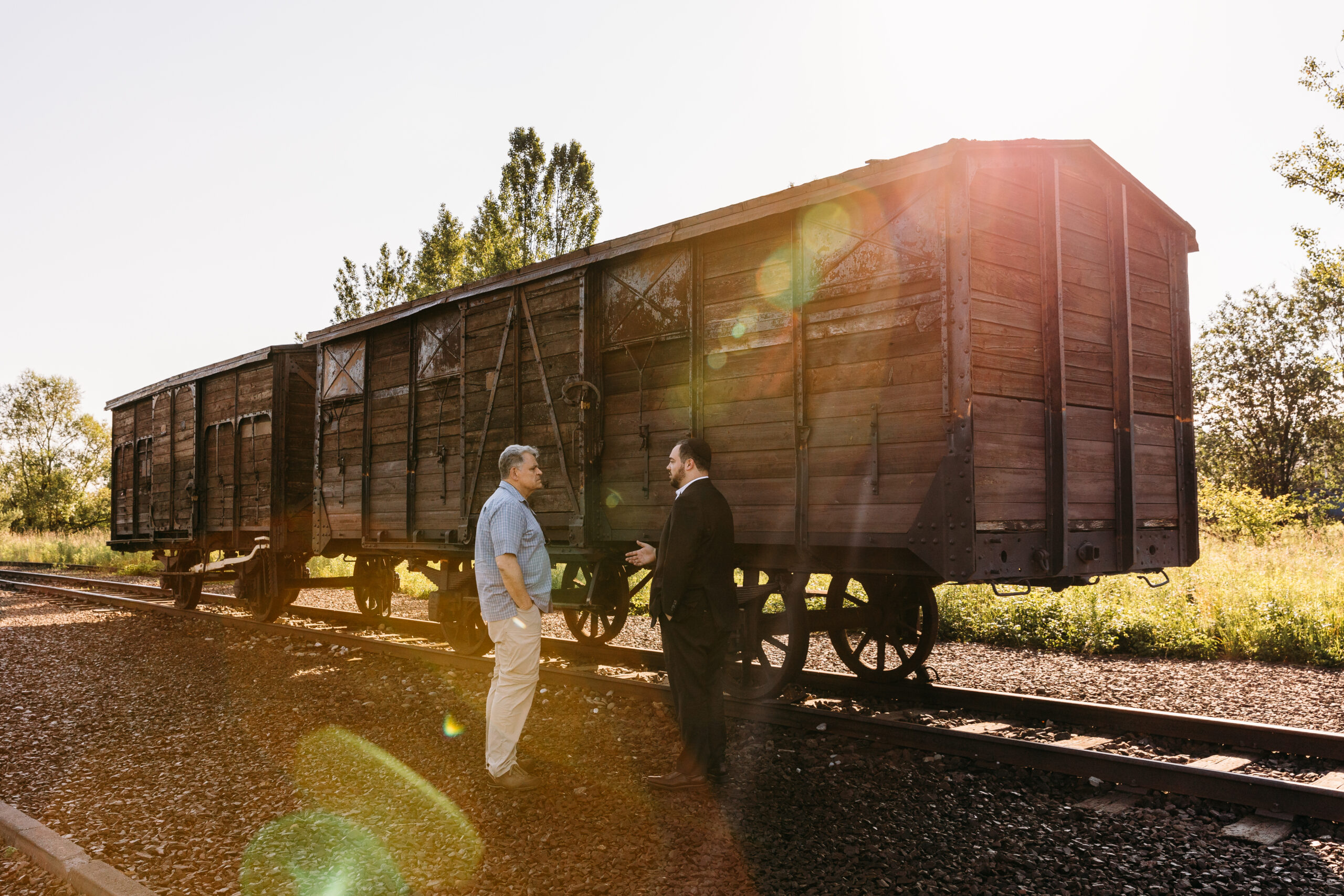
The first thing I see is a cattle car resting on the tracks near the Birkenau camp. I ask the driver to stop. We step out of the vehicle, and I walk over, wondering if it’s a replica or the real thing. Kai tells me that it’s real.
For a minute, I am at a loss for words. Then I’m reminded of a well-known story about my great-great-grandfather, Reb Amrom Gestetner, Oma’s father. I ask Kai, “Can I share a story with you that occurred on one of these trains?”
“Sure,” he says.
In 1944, Reb Amrom was one of the last people to be deported from Budapest. A survivor later told our family that it was Shabbos when the Nazis herded him onto a wagon. Reb Amrom had packed a small can of sardines for shalosh seudos. When the time came, he took it out, made a brachah with tears and offered tiny pieces to whoever wanted. He then began to sing zemiros with great dveikus. He looked around and asked everyone to join him, explaining that Shabbos is not a time to mourn. The broken Jews were soon singing holy niggunim just days before arriving at the selection, where Reb Amrom was directed to the left and perished with all the other kedoshim.
I finish the story and touch the train. Who knows? Maybe this is the one Reb Amrom was in. Tears roll down my cheeks as Kai embraces me and says, “Dov, I am very sorry to hear this.” The driver reminds us that we have a schedule to keep and that we should head to the camp, where we have a guided walk-through booked for 8:15 a.m.
A few minutes later, we arrive at the main parking lot of the Auschwitz camp. The place is packed with hundreds, perhaps thousands, of tourists; it’s the most visited site in Poland. A few feet away I see souvenir shops and ice cream stands. Kai whispers what I’m thinking: “This place has become so commercialized. We should do a better job of teaching people about the gravity of this place.”
Our driver hands us our tickets, and when I see Kai’s ticket with the name “Höss,” I feel a chill. We have a few minutes until we can go inside, so we find our way to a small book shop. There’s an entire shelf of books devoted to Kai’s grandfather, Rudolf Höss. I ask Kai what it feels like to see his face on the covers. He thinks for a minute. “I feel a deep sense of shame that my grandfather was capable of these horrific acts. That is precisely why I am here, not because of what was done but for how I respond to it today.”
I want to believe this. He has said these things before, and he will say them again. But a part of me wonders if they are the practiced lines of a man who has given this answer many times. I decide that it really doesn’t matter. I let it sit, and we go inside just as the clock shows 8:15.
Our tickets are scanned—again, painfully commercial. We are offered headphones and a guided tour, but Kai and I prefer to walk around on our own rather than follow a script that does nothing but distract from what actually took place here. I make my way down a long concrete walkway, marveling over the fact that no one else is aware that a grandson of the camp commandant and a grandson of survivors are both visiting this place that has shaped their lives.
As I approach the gate on a paved path, wearing comfortable shoes, I imagine what it was like for the Jews who arrived here in cattle cars. Instead of fresh-cut grass, their senses were assailed by the smell of burning flesh. They heard the cries of their children, the screams of their mothers, the final goodbyes of their fathers, Nazis shouting at them, and the barking of vicious dogs. They clutched the hands of both the elderly and the young.
We reach the main entrance with its infamous inscription, “Arbeit Macht Frei.” In Kai’s grandfather’s autobiography, he wrote that work makes prison life more bearable and instills discipline. I ask Kai how he feels about that. “It is despicable and wickedly cynical,” he says.
We start out in Block 4. The first room traces where the Nazis’ evil ideology came from. A sign on the wall features a quote from Hans Frank, the Nazi governor general of Poland, in 1944: “Jews are a race that must be totally exterminated.” This is language we are seeing every day on social media now. It is not a fringe phenomenon.
When I look at Kai, he says, “It was relentless propaganda that normalized hatred and led to the Holocaust. People like me, as well as the rest of the world, are responsible to make sure it never happens again.”
In the next room are photographs of the camp. “Dov, look at these innocent children,” Kai says, a tear on his cheek.
We then head to Block 5. The first thing we see is a pile of talleisim. I burst into tears. Told that they could take with them only absolute necessities, this was what they chose to pack.
We then come to huge piles of children’s shoes, and all I can hear is Michoel Schnitzler’s song “Mir zenen shich, mir zenen letzte eidus—We are shoes, we are the last witnesses.” Again I burst into tears; I can’t hold back. People are looking at me, but I can’t stop. In my mind’s eye, I see the closet in my daughters’ room with at least a dozen pairs of shoes in it, each connected to a happy event or a fun day when it was purchased.
Kai puts his hand my shoulder. “I’m sorry, Dov. This should have never happened. It is so evil.” On the other side of the room we see suitcases with names on them; they were once owned by people like my grandparents.
Going back outside, I take a minute to breathe before we continue. Then I ask, “Kai, do you think your grandfather was aware that he was committing such evil?”
He takes a deep breath and says, “Yes. He was not an ignorant bystander. He was a highly organized, disciplined individual who fully embraced the ideology. He believed the lies and the conspiracies, the narrative that portrayed the Jewish people as vermin. That’s what makes this so sobering—that ordinary men are capable of extraordinary evil.”
I wonder if his grandfather can really be called an ordinary man. On the other hand, if we pretend that these people weren’t ordinary, we lose sight of the danger.
Our next stop is Block 11, the one they call the Death Block. We make our way down to the cellar, and all of a sudden we understand how this place acquired its name. This is where they kept the starvation cells, the standing cells, the punishment cells where they tortured, interrogated and executed. It was also here that Zyklon B, a poison used to kill insects and rats, was first used on human beings in September 1941. Its first victims were Soviet POWs and sick Polish inmates.
For the SS, the experiment proved that killing could be accomplished much more quickly and efficiently. Höss noted coldly, “I was relieved. We were now all saved from the bloodbaths caused by machine guns and pistols.” He then expanded the method—first a converted morgue at Auschwitz I, and then the huge gas chambers and crematoria of Birkenau, built to murder thousands of people a day. What began in a basement became a factory.
Outside in the courtyard, the Death Wall still stands. It is estimated that the Nazis executed up to 20,000 unfortunates who stood against it. The wall is pockmarked with bullet holes, and I try to imagine what was going through the victims’ minds in their last minutes of life.
From there, we continue walking through the camp toward the only standing gas chamber in Auschwitz-Birkenau; all the others were destroyed by the German monsters in a cowardly final attempt to cover up their heinous crimes.
Right outside the chamber is the gallows upon which Rudolf Höss was hanged. Everything around me seems to go into slow motion; it is an extremely powerful moment. I observe Kai moving closer. He shakes his head and sighs quietly. I can’t take my eyes off of him. After a long silence, I ask, “Kai, do you feel guilty for what your grandfather did?”
He keeps looking at the gallows. “I don’t feel personal guilt for the crimes my grandfather committed, because I didn’t take part in them. Guilt isn’t transferable from one generation to the next; every person is accountable for his own actions before G-d. But that doesn’t mean that I am indifferent. No human effort can pay for the evil of Auschwitz, so I don’t believe in atonement as a way of making up for what he did. What I can do is live in the opposite spirit of what he represented—where there was evil, to do good; where there was silence, to speak openly. My role is not to atone but to bear witness with you here today.”
I’m still not satisfied. I reach into my bag for his grandfather’s memoir, find the page I’d marked and read aloud: “Was it right or was it wrong? In my opinion, all our paths through life are predestined by fate and a wise providence, and are unchangeable.” I close the book and look at Kai. “He’s saying that he had no choice, that it was all predetermined. Do you believe that people have free will? And if you had been in your grandfather’s shoes, would you have acted the same way?”
For a moment, Kai doesn’t answer. Then he takes his eyes off the gallows and looks at me. “Of course there is such a thing as fate. But we are always given a choice by G-d between good and evil. My grandfather made a conscious choice every day to do what he did, and he chose it anew each morning. I don’t accept his cowardly claim that fate led him there.”
In retrospect, that was the moment Kai felt the most real to me. His refusal to let his grandfather hide behind some notion of “destiny” seemed genuine.
Kai is a Christian pastor, a founding member of the Bible Church of Stuttgart in Germany, where he preaches against anti-Semitism and Holocaust denial. So I push once more, this time with regard to his own faith. “In one of his last letters, your grandfather wrote, ‘I have found my faith in G-d again.’ According to your religion, virtually all sins can be forgiven. Do you believe that G-d forgave your grandfather?”
He thinks for a moment. “In order to be forgiven, there has to be true repentance,” he says, “and I don’t believe there was any. He died without ever apologizing to the Jewish people. And I don’t believe he truly came back to faith, regardless of what he wrote. If he had, he would have asked for forgiveness. He didn’t.”
“I once read,” I tell him, “that when he was asked for his final words right before he was hanged, your grandfather said, ‘I would like to send my warmest regards to my wife and children. I also ask the Polish people to forgive me for what I did to them.’ He asked the Poles for forgiveness and skipped the Jews. That is truly the worst thing I ever read about him.”
Kai nods slowly. “Exactly. He didn’t mean it. He died an evil man, and he deserved to die in the very concentration camp he ran.”
In that moment, I understand the true meaning of “yimach shemo,” the complete erasure of someone’s name. Kai is admitting that his grandfather deserved to be hanged. He is shamed by the name he bears, tainted for eternity by his grandfather’s monstrous deeds.
I think, We will never forget, and we will continue to tell their story.
The gas chamber is only a few feet way. It is almost unbearable for me to be there. I touch the walls and see the scratches made in them. I imagine mothers holding their babies, gasping for their last breath.
In his book, Höss writes, “One time, a woman with four children, all holding each other’s hands to help the smallest ones over the rough ground, walked by me very slowly. She stepped very close to me, and pointing to her four children, whispered, ‘How can you murder these beautiful, darling children? Have you no heart at all?’”
The answer is no, he did not. I cannot stay in the gas chamber longer than a minute. I grab Kai’s hand and burst into a loud wail, telling him that I am going to repeat the words that were cried out in this room thousands of times. Then I fill that accursed place with the loudest, most heartbroken Shema Yisrael I have ever uttered. Kai holds my hands and tries to comfort me, but nothing can.
It takes me some time to get back to myself. I breathe deeply as we make our way out of the camp. I am horrified to see a large sign with the word “Restaurant” on it, right there on the premises of Auschwitz. Can humanity go any lower than this?
As we are leaving, Kai tells me that his grandfather’s villa stood just over the gate, where his own father and his siblings had lived as children. “We should see what evil looks like up close,” he says. On the way, I ask if I can tell him about my late great-grandmother, Reizel Bleich.
“Sure,” he says.
“My great-grandmother was born to Reb Usher Zelig Halevi and Levia Leah Rosenthal in Salgótarján, a city in northern Hungary. Her father ran a large department store that employed many people, Jews and non-Jews alike. In July 1944, the whole family was sent to Auschwitz. At the selection, her parents and their elderly parents were sent to the left and murdered soon afterward. My great-grandmother, her brother Chaim and her younger sister Edith were sent as slave laborers to Birkenau, where the two sisters managed to stay together.
“Like many survivors, she rarely spoke about it, but she did tell us this: ‘In January of 1945, word began to spread that the Russians were coming and that we would soon be liberated. But a few days before the Soviets arrived, the SS opened the gates and threw everyone out. Tens of thousands of us were forced to march for miles and miles in the snow, without any food or water. Anyone who fell, tripped or even slowed down was immediately shot.
“‘My sister and I were walking together, but she eventually grew weak. I held her hand and encouraged her, saying that our nightmare would soon be over. Then she tripped over something, and her leg got caught. She was nebach screaming for help, but very soon her scream was cut short by a gunshot.’
“At this point in the story, my grandmother would always choke up with tears. ‘I was never able to give my sister a proper goodbye,’ she would say. ‘I wasn’t even allowed to turn around and look back, because then I would have been shot as well.’ Days later they were freed by the Allies, and she was reunited with her only surviving sibling out of ten.”
Kai shakes his head in disbelief, a somber look on his face.
We reach the house in minutes. It is a beautiful gated property, a three-story villa with big windows, a garden and a porch. The house sits less than 50 feet from the gate of the camp and probably less than 500 feet from the gas chamber and crematoria. This is where Kai’s father and his siblings grew up while his grandfather butchered millions only a short walk away. This is where his grandmother planted basil and thyme in her garden while her husband’s underlings dropped Zyklon B pellets on their victims through openings in the ceiling.
To stand there and take in that obliviousness to suffering, the fact that a family lived comfortably in the shadow of mass murder, feels like a punch in the gut.
“My grandfather was a very big coward,” Kai tells me. “He abandoned his family and went into hiding near the Danish border, thinking he would never be found. My family is cursed. My uncle Klaus died of an overdose, my aunt Brigitte died of cancer, and there has been a lot of mental illness.
“The one thing I am grateful for is that my father, Hans, finally accepted the truth about who his father was in the last year of his life. This was after I hadn’t spoken to him for almost 30 years. Maybe that’s why I feel the way I do—that I’ve been given a chance to do the opposite of what my grandfather did, to bless the Jewish people instead of cursing them. So yes, G-d has His ways.”
June 16, 2026
I’ve been home for two days. The heaviness hasn’t lifted—maybe it never fully will—but Monsey looks exactly as I left it. The grass is cut. My car is in the driveway. Our apple trees are already covered with tiny little apples. My children are loud and alive and arguing about whose turn it is on the swing, and the ordinariness is almost more than I can assimilate after where I’ve been.
Later that day, I tell them that Tatty went on a trip far away, to a place I want them to know about. I explain in words they can understand that long before they were born, there was a whole world of Yidden—zeides and bubbes and children just like them—who loved Shabbos and made brachos and ran to the playground, and that wicked men tried to destroy all of them and almost did. In fact, their own great-great-grandparents were there. Some of their family members never came home, and the ones who did are our most precious treasures.
Then I tell them about Kai. I met a man, I say, whose grandfather was one of those wicked men, maybe the most wicked of all. My oldest daughter, Rachel, looks confused. How could Tatty stand next to such a person? I tell her the truth as I now understand it—that Kai didn’t choose his grandfather. His grandfather was an evil man, but Kai has spent his whole life doing the opposite, telling the world what his family did so that it can never happen again.
Then I point to the little one—our Levia Leah, who can never sit still and is already halfway off her chair—and tell them the one thing I want them to know the most. There was once a woman named Levia Leah. She was our Bubby Reizel’s mother, and she was murdered in that place. The murderers wanted her name to be gone from the earth forever. Then I tell them to look at who’s sitting and squirming right here at our table, asking for more jelly beans! They wanted her erased. Instead, she is here.
I don’t say all of it perfectly. Some of it they’re too young to understand, and some of it I’m still too broken to talk about. But I have planted a little seed. That is my job now. The witnesses are leaving us—Oma is the last one in our family—and my children will never hear what happened firsthand. The memory has to pass through me now or it won’t pass down at all.
Later that evening I tuck them in and we say Krias Shema as we do every night. Shema Yisrael Hashem Elokeinu Hashem Echad. The last words of so many of our kedoshim are now being whispered over my children’s beds, in a warm room in a free country. The murderers heard Shema as a final cry. My children know it as a lullaby.
Reb Nosson Duvid stood by the window screaming that the Nazis were coming. I stand in my children’s doorway and take comfort that we are still here. ●
To submit your story for this column or have your story featured here, please send an email to [email protected] or call 718-534-8800, ext. 202. All details will be kept confidential.
To read more, subscribe to Ami