



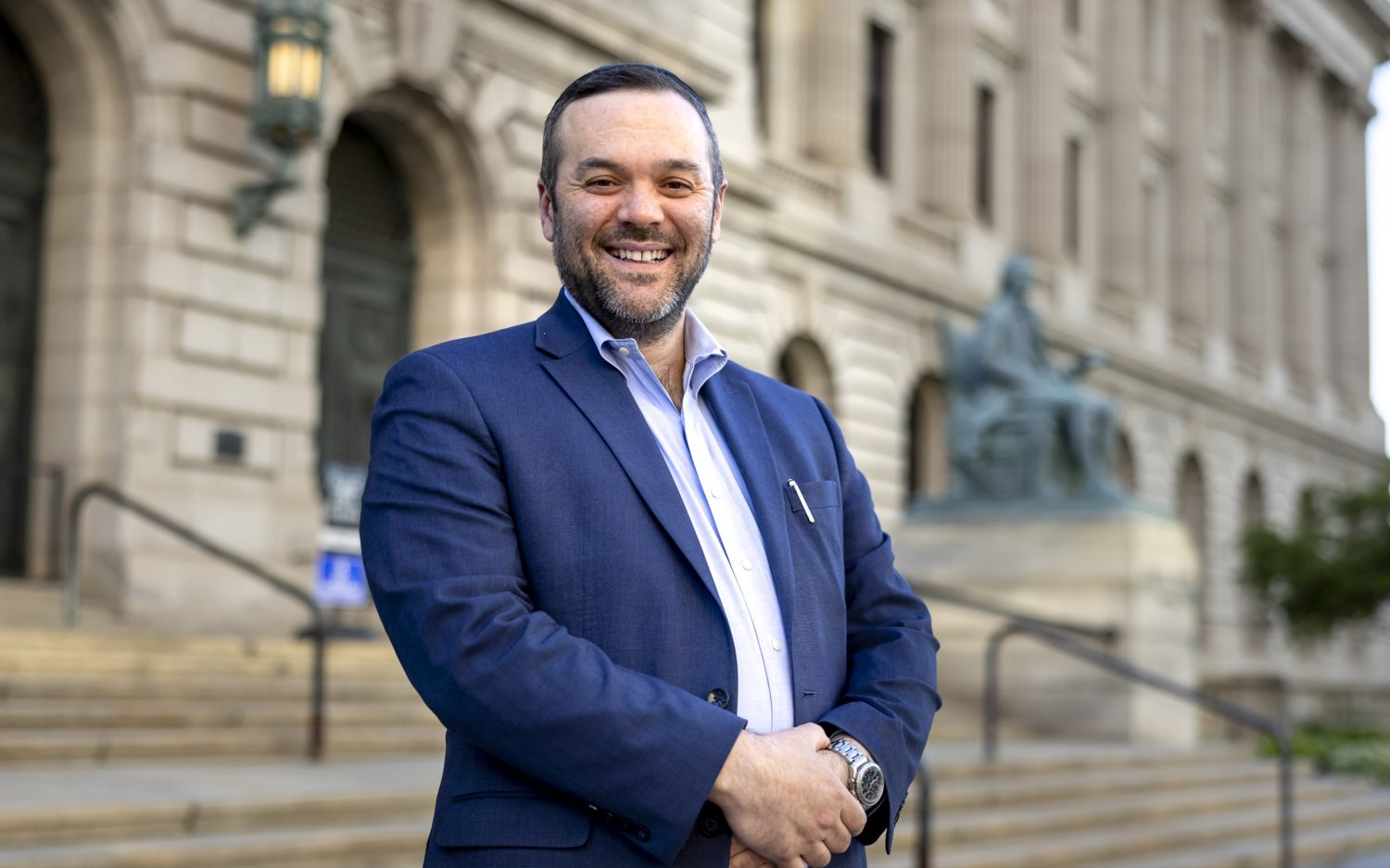
When Daniel Grand invited a small group of friends to gather in his home for davening, he never imagined that the matter would eventually make its way to the Supreme Court. What began as an effort to host an informal minyan soon evolved into a years-long legal battle over religious liberty, zoning regulations and the rights of religious communities to gather for worship in private homes.
At the center of the dispute lies a question whose implications extend far beyond one neighborhood in Ohio: At what point may a citizen challenge governmental restrictions on religious practice, and how long are local authorities allowed to delay a definitive answer before access to the courts is effectively denied? Joined by his attorney, Jonathan Gross, Grand argues that his case represents not merely a local zoning disagreement but a test of the protections afforded to religious Americans under federal law.
In this conversation, Daniel Grand and Jonathan Gross discuss the origins of the controversy, the legal battle that followed, and why they believe the case has consequences that go far beyond the limits of University Heights.
Your story really resonated with me because I occasionally try to make a minyan in a little town in New Jersey, and I’m always afraid of a knock at the door to shut me down.
I never imagined that in the United States I would have to be concerned about inviting friends over to my house to pray. I found it very strange that the mayor felt it important enough to contact me and tell me that I wouldn’t be allowed to have any kind of prayer group in my house unless I obtained a special use permit. It was something I didn’t feel very good about.
What’s the name of the town?
University Heights, Ohio. It’s a small suburb of Cleveland.
If the mayor called you personally, it must be a very small town.
Correct. It’s 1.5 miles by 1.5 miles and has about 15,000 people.
What percentage of the population is Jewish?
I believe it’s the largest Orthodox population of any city in Ohio. It’s definitely over one-third.
So it’s an Orthodox Jewish hub.
Yes. We also have the first female Orthodox Jewish mayor in the United States after the previous administration collapsed following all of the mistreatment.
How many years ago did your story begin?
It’s been going on since 2021.
I’m assuming that if you have that large a population there are a lot of shuls in the area, and you don’t necessarily need a minyan in your house.
Not everything is so organized. Also, at the time there were only two proper synagogues in University Heights, the Katz Kollel and Heights Jewish Center. Between the two of them you might have had a maximum capacity of 300 or 400 people, but there were a couple of thousand Jews living there.
Orthodox Jews come from all walks of life. What are the demographics in your neck of the woods?
We have a mix of kollel yungeleit, yeshivah bachurim, balebatim, Modern Orthodox and a nice chasidishe community in the Alexander shtiebel. The Alexander Rebbe is a descendant of the Alter Rebbe, and he’s named Schneur Zalman after him.
With which community are you affiliated, or are you unaffiliated?
I’m very affiliated. I’m a Torah Jew. My rosh yeshivah, Rav Elyakim Rosenblatt of Chofetz Chaim, was a student of Rav Henoch Leibowitz and Rav Aharon Kotler, and my rabbi, Rabbi Elihu Marcus, was a student of Rabbi Soloveitchik, so I’m a shtickel Chofetz Chaim/Brisker.
Rabbi Marcus was a pulpit rabbi for 25 years in Queens, after which he was a director of synagogues for the State of Israel. He worked for the Israeli government and put up over 3,000 synagogues. Then he went to Touro College to be the executive assistant to the president, Dr. Bernard Lander, whom I knew very well. I used to drive in every morning with Dr. Lander.
You said that Rabbi Marcus was a talmid of Rabbi Soloveitchik?
He was. When he was getting semichah back in the 1960s, there were three dayanim at the table. Rabbi Soloveitchik turned to Rabbi Marcus and said, “Mr. Marcus, we’re going to give you your semichah, but I want you to know something. When you get your teudah, you’re going to see that our names are signed on it. If a single day in your life goes by when by the time you go to bed at night you haven’t learned something you didn’t know the day before, my name is written in invisible ink.”
When he was in his mid-70s, he told me that despite having children, bar mitzvahs, hospital stays, weddings and all sorts of things, he obeyed his rabbi’s directive.
What do you do for a living?
I’m in real estate, I’m an entrepreneur, I’m in technology, and I’m also in the legal world. I went to law school but I’m not an attorney. I would say that I’m a bit of an enigma. I’m a Chovos Halevavos Yid. If I tell everyone how Hashem blesses me it wouldn’t work, so I just say that I do all these little things, but really it’s Hashem Who provides.
To read more, subscribe to Ami