



It was the morning of Shemini Atzeres, October 9, 1982.
For the Jews of the ancient Ghetto of Rome it was an ordinary Yom Tov morning, with no premonition of the chaos to come. Men, women and children dressed in their holiday best streamed to shul, the grand Tempio Maggiore di Roma, Rome’s Great Synagogue, which was spared by the Nazis during the Holocaust. Parents had brought their kids along for the annual tradition of “Birkat Hayeladim,” when the rabbi blesses all of the children. The prayers had ended relatively early, at around 11:50 a.m., when the carnage began.
As the families streamed out of the building, several elegantly dressed Palestinians calmly walked up to the back entrance and tossed three hand grenades at the departing crowd. When people started shouting in terror and running for their lives, they sprayed them with machine gun fire. At the same time, the grenades bounced off the stairs and exploded on the street, adding to the mayhem. The attackers then drove off in two cars and disappeared.
When the smoke cleared, a two-year-old toddler, Stefano Gaj Taché, was rushed to the hospital, where he passed away. His brother Gadiel was seriously wounded, along with 40 others. Gadiel later recovered and wrote a book about his experiences. His family still lives in the community.
The attack was especially galling considering that the Jewish community had requested additional security from the Roman police, as it was the height of the Lebanon War. The local government sent two security guards, who would be on duty from midnight until 6:00 a.m. On the evening before the attack, they didn’t show up at all. Although no one claimed responsibility for the attack, one of the assailants was identified as Osama Abdel al-Zomar, a member of the Abu Nidal terror organization.
Since then, security has been very tight around the Jewish ghetto, with two armed guards stationed near the shul. A nearby memorial pays tribute to the victims and their families. The attack has been duly recorded in the history books. But for Marco Misano, a beloved tour guide whose family has lived in Rome for generations, it was a turning point in his life.
“I remember it like it was yesterday,” he recalled in an emotional interview, during which he teared up at the memory. “My parents, Massimo and Bruna, may they be healthy and well, are religious Sephardic Jews and we were praying downstairs. I was only six years old, and my brother was a toddler. I recalled the noise as the shooting began.
“As soon as the grenades exploded, my father realized what was happening and ran with us through the nearby piazza into a local store to seek shelter. Not everyone escaped in time, however, and I could hear the screams of the wounded. My mother, who was very traumatized, began shouting and hyperventilating while my father tried to calm her down. They were so hysterical that they almost forgot about their two terrified children who were cowering behind them.
“I can recall my terror. I was struck almost mute and could only repeat two words: ‘bomba borochu’ (‘bomba’ meaning a bomb, and ‘borochu’ meaning the synagogue, which was what I called it). When the pandemonium had calmed down somewhat and the shell-shocked survivors began to emerge, my parents realized how traumatized I was. They took me to the hospital where they took my vital signs, but who knew about PTSD in those days? When I began to speak again, it was with a permanent stutter.”
Marco returned to school, to the iconic building located inside the ghetto, but the carefree young boy was gone. “A bit of my childhood was stolen that day,” he said. “I did well in school, but I suffered socially because the other children made fun of my stutter. I wanted to seem tough so I would also laugh along with them when they mocked me, but inside I felt like I was dying.”
Today, Marco and his wife, Barbara, are the parents of two grown sons, and he is very proud of his “famiglia.” Undaunted by what happened 43 years ago, he still davens in the same shul. He has become a very sought-after tour guide, given that the city of Rome and its history is in his DNA. Jewish tourists from around the world vie to have him give a guided tour of this fascinating city.
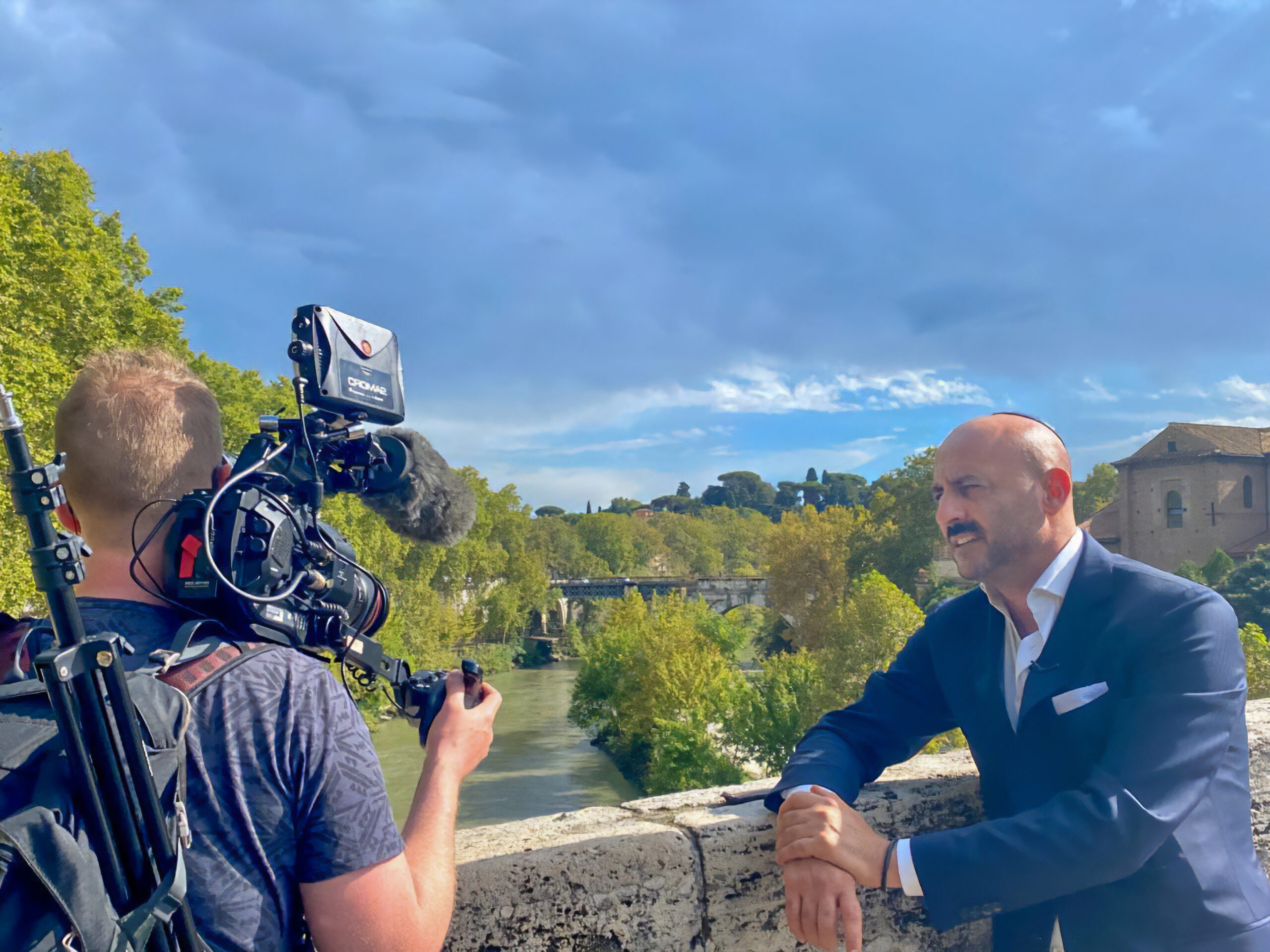
During my recent trip to Rome, I was fortunate to be given a tour of the Great Synagogue and museum, the Arch of Titus, the Colosseum and the ancient Jewish catacombs by Marco.
Marco hadn’t always dreamed of being a tour guide. That came about later, after he graduated from a small yeshivah in Rome. (He would later obtain a PhD in Jewish studies and history.)
While still in his 20s, Marco began helping his father, who had a special license from the pope to sell souvenirs outside the Vatican.
Both sets of Marco’s grandparents also had the same coveted license, which they purchased for a significant sum. “My father’s mother and my mother’s father were also selling these trinkets and got to know each other. That’s how they ended up making a shidduch between their children,” he explained.
“Selling these items was considered a privilege for the Jews, who had always been persecuted and confined to the ghetto for over 300 years, from 1555 until 1870. The only kind of work we were allowed to engage in was the schmatte business and financing, which didn’t exactly endear us to our neighbors.”
Marco continued to help his father, but at the same time he yearned to expand his horizons and do something different. He was fascinated by history and was very knowledgeable about the Jews of ancient Rome, one of the oldest Jewish communities in the world. Many Roman Jews can trace their lineage back to the era of Chanukah, well before the second churban. His new opportunity came via an unusual request.
“One day, my father was approached by a good friend who was looking for someone to give tours to a group of Israelis. ‘My son Marco would be perfect,’ my father said. ‘He knows Hebrew and he also knows a lot about Jewish history.’ When he offered me the position I was hesitant, as I still struggled with stuttering, but my father encouraged me to try. To my surprise, when I spoke in Hebrew and English my stutter disappeared! I was delighted. It only came back when I reverted to Italian. I later learned that most people who stutter only do so in their native language. If they speak another language or sing a song the stutter disappears, as they’re using a different part of their brain.”
Marco was successful at connecting with the group and his services were requested time and again. He eventually realized that this was something he wanted to do full time. However, he would first have to become certified, which meant going back to school and then passing a challenging exam. After graduating from Northwest University with honors, Marco obtained a PhD in Jewish studies, studying history, archaeology and geography. The process took six years.
“I had to stand before a panel of 13 professors, who grilled me for hours about various landmarks in Rome, both Jewish and pagan, lehavdil. There are hundreds of churches and temples in the ancient city and I needed to memorize all kinds of details, giving them the answer on the spot. I don’t know how I was able to pass the exam and I’m not sure I could ever do it again,” he quipped. “Out of 5.000 applicants, only a few hundred made the cut.”
Marco began giving tours of Rome, working with local agencies and then large cruise ships. He became so popular, mostly through word of mouth, that he soon opened his own tour agency, which he called RomanJews. Aside from his training and years of experience, his success lies in reading a crowd and understanding the key to people’s hearts. Or as he calls it, “The fifth volume of Shulchan Aruch.”
Because Rome has a Middle-Eastern climate and flavor, most of the tours are conducted in the early morning and late afternoon, with a typical two-hour break for lunch and a short siesta during the hottest time of day. Whereas in the past most tourists chose to visit in the summer, these days the tourist season is year-round and heats up even more during yeshivah break in January.
A Community Steeped in Tradition
Rome is Italy’s largest and most populated city, and is also home to one of the oldest Jewish communities of the entire Diaspora. Before the second churban, Jews lived in Rome without fear. Julius Caesar, who was later assassinated, was hospitable towards the Jews and allowed them to flourish.
All of that changed in 70 CE. After the Romans destroyed the Beis Hamikdash, they brought tens of thousands of bound and captive Jews to Rome through the Ostia Harbor, condemned to a life of slavery. These people joined the Jewish residents of Rome who had emigrated there years earlier, during the reign of Yehuda Hamaccabi. Their descendants are still living in Rome today.
As Marco explained, “My ancestors have been living in Rome for nearly two millennia. When people ask me why I don’t move to Israel, I tell them, ‘According to the Gemara, Eliyahu Hanavi told Rabbi Yehoshua ben Levi that Moshiach is sitting and wrapping his bandages at the gates of Rome, waiting to be summoned to redeem our nation. Someone has to be here to welcome him!
“Even though we pray and yearn to return to Yerushalayim, right now, while we are still in exile, my soul is bound up in Rome. I’ve never known any other home, but my older son learned in Israel and is currently serving in the IDF. This year, the Roman Jewish community sent a large group of students to learn in Israel. Many of our young people want to go abroad because the anti-Semitism here has become very challenging. The root of the name ‘Yaakov’ is eikev, ‘heel,’ because he was born holding the heel of his brother Esav, who tried to destroy him while still in the womb and has hated him ever since. It is no coincidence that Italy and the center of Christianity, the Vatican, is shaped like a heel.
“There’s another well-known Gemara (Sanhedrin 21b) that says that the day Shlomo Hamelech married the daughter of Pharaoh, the malach Gavriel descended and stuck a reed into the sea. This caused a sandbank to grow around it, upon which the city of Rome was eventually built. When I discuss these concepts during my tours, it ties everything together. Anti-Semitism isn’t a new phenomenon. It goes back to ancient times, and it’s a halachah that Esav hates Yaakov.
“That being said, it’s obvious that anti-Semitism has been growing by leaps and bounds in recent years. Our Christian neighbors used to feel bad and apologize about the Holocaust, for not protecting our grandparents when they were sent to their deaths. But today, with the media having a field day with the doctored images from Gaza, they feel that they don’t owe us anything anymore. We sense it in every interaction every day. The hatred on social media and on college campuses is out of control, and it spills over into the streets. Even middle-aged Italians, who used to be neutral or had a positive relationship with us, are becoming brainwashed. Such is the power of social media.”
Marco’s colleague and fellow guide Yael Calo, an expert in Roman Jewish history and Holocaust studies, who works in the local Jewish museum, joined the conversation and added a powerful thought.
“I studied for many years in the local university. I often think about what would have happened to me if I had been living here 80 years ago. Would I have had a chance to escape or hide? Would my non-Jewish friends protect me? Sadly, I now have my answer. Over the past two years, ever since October 7, most of my friends have dropped me cold turkey. Only two of them out of our group have texted to see how I am doing. The rest act as if I don’t exist, which I find very painful. But to be honest, I don’t really want to hang out with them anymore.
“Now I understand how the Holocaust occurred and how the Jewish community was so easily deported. Many people simply didn’t care. Today we are no longer living under fascism and people aren’t as ignorant, but it makes no difference. I see the same patterns of apathy and hate. However, this anti-Semitism has a powerful side effect: it brings the Jewish community together. We realize that we can’t depend on our neighbors and need to lean on our fellow Jews.”
Marco, who experiences these behaviors on a daily basis, concurred. “We are a very close-knit community of about 13,000 and we stick together, even though most of us don’t live in the ghetto because it isn’t affordable. These days, the ghetto is home to many influential politicians, as it’s close to the Parliament, which is located near the Pantheon.
“Most of the Jews live in the Marconi neighborhood or the Piazza Bologna area near the city center, an hour’s walk from the ghetto, which makes it impractical to daven in the main shul except during the High Holy Days. My elderly parents stay in the ghetto and my family and I walk there on foot.”
In the Ghetto
In 1555, the Papal degree “Cum Nimis Absurdum” led to the establishment of a walled-in ghetto in a rundown part of the city on the banks of the Tiber River.
The decision to choose that location was calculated and cunning. Situated at a lower elevation and without embankments, it was prone to flooding in the winter and the neighborhood was often wet and smelly, with unsanitary living conditions.
The ghetto was created to prevent the Jewish community from expanding and freely visiting the rest of the city. It also allowed the Church to put pressure on the Jews to convert to Christianity.
A curfew was implemented, forcing them to be inside the gates by nightfall, one of which was located near the ancient Portico D’ottavia. Those who did leave during the day were forced to wear “badges of shame”: yellow pointed hats for the men and yellow identifying scarves for the women. They were also barred from owning property and engaging in business or medicine. The few Jewish doctors who resided in the ghetto could only aid Jewish patients.
The Ghetto of Rome was crowded: 8,000 people confined to approximately seven acres. Because they couldn’t afford to buy meat or chicken, they learned to create dishes out of other things, such as carciofi alla giudia (fried artichokes) and pizza Ebraica (“Jewish pizza”), a sweet pastry full of nuts and candied fruit.
The Jews of Rome were emancipated in 1870 during the risorgimento, the movement that led to the unification of Italy and the end of papal rule.
Today, Rome is also home to a large number of Libyan Jews, who settled in the region of Viale Libia. After living Libya for generations, many Jews left the country after a series of pogroms in the 1940s and again in 1967, after the Six-Day War. The rest were expelled by Ghadaffi in 1970 and their assets and belongings were confiscated. When some of these refugees arrived in Rome, they brought along their ancient traditions and cuisine. Libyan Jews have their own shuls that follow the Sephardic-Maghrebi tradition.
There has been a Chabad House in Rome for years, founded by Rabbi Yitzchok and Sara Chazan in 1976, as well as a small Ashkenazi community founded by Holocaust survivors. Starting in the 1970s, many Jews leaving Russia and Iran came to Rome and stayed in its suburbs while they waited to get visas to the United States, Canada or Australia.
One of the most popular community events organized by Chabad is the public menorah lighting in Piazza Barberini, a central square. The event draws hundreds of locals, community leaders and dignitaries.
Frozen in Time
Marco’s most popular tour, featuring the shul and museum, begins in the heart of the Jewish ghetto. It’s a self-contained enclave that is closed off to traffic, seemingly frozen in time. The ghetto is miniscule, only a few crowded streets adjacent to the muddy Tiber River, but what it lacks in size it more than compensates for in grandeur.
Our tour began at the vast Tempio Maggiore di Roma overlooking the Tiber River, situated between Via Catalana and Lungotevere de’Cenci. This magnificent building has a unique square dome.
Jews weren’t allowed to have more than one shul in the ghetto, so they carved five small shuls out of one tall building. Three of them followed the Italian minhagim (Scola del Tempio, Scola Nuova and Scola Siciliana), and the other two, Scola Catalana and Scola Castigliana, were Sephardic.
The Piazza delle Cinque Scole (“the Plaza of Five Synagogues”), which covers part of the former ghetto, commemorates the original building. After the Jews were emancipated, they built a single large shul in 1904 that follows the Roman nusach. There is also a shul downstairs that follows the Sephardic nusach. Marco, whose ancestors davened in the Sephardic section, showed us a special siddur printed with the brachah “she’asani Yisraeli” instead of the more common “shelo asani goy.”
The Roman nusach is neither Ashkenazic nor Sephardic. The historic Roman Jewish community is part of a small but ancient group known as Italki (Italian) Jews. Their siddurim follow the Nusach Bnei Romi.
The community has its own unique minhag: Every year on Rosh Chodesh Elul, men, women and children gather to hear the shofar being blown, after which they enjoy a festive meal.
On the night of Tishah B’Av, the Roman Jews gather to read Eichah in the dark, holding long tapered candles. These candles are then used as the shamash on the Chanukah menorah, symbolizing that even during their most intense mourning, they are looking ahead to the future.
The Judeo-Roman dialect of Italian is quite unique. While it’s based on the standard Romanesco dialect spoken by everyone else, it incorporates many Hebrew words and expressions. Roman Jews pronounce the letter ayin as “ng,” so instead of “Shema” they say “Shemange.” Similarly, “Ivrim” meaning Jews, turns into “Inghiverimme.” They communicate in a high-pitched sing-song, turning their sentences into questions.
Marco showed us many golden treasures, including Renaissance velvet coverings, Baroque-era woven mantels, glistening crowns of pure gold and magnificent paintings. There were also numerous textiles that adorn their sifrei Torah, such as the mitpachat (inner wimple) and mappot (cloths that come in contact with the parchment), which were delicately hand-embroidered with gold threads by local women.
One of the paintings showed hundreds of Jews crowded into a church, with one Jew trying to escape and being held back at the door. Marco explained that this depicted a sad saga in Roman history. For over 500 years, the popes demanded that the Jews visit the church each Shabbos on their way to shul, where they would be locked in for hours and forced to listen to sermons denigrating their religion. Many Jews would stuff bread or wax into their ears to avoid hearing them. They were only allowed to leave in the late afternoon, famished and exhausted, after which they would go to shul.
Despite this treatment, almost no Jews converted over the years. As Marcos quips, more Jewish children were forcibly converted during one year of the Holocaust when they were hidden among gentiles than during the previous five centuries!
A Diabolical Plot
Hauntingly, there is an entire glass case of receipt books that tell the story of the decimation of Roman Jewry during the Holocaust.
The Jews of Italy were subject to racial laws beginning in 1938, under Benito Mussolini. After Mussolini was arrested in the summer of 1943, the new government began secret negotiations with the Allies, but when the Germans got wind of it, they resolved to deport Rome’s Jews. As the Romans waited for the arrival of the Allies from Sicily, the Nazis seized the opportunity. On September 10 they invaded Rome, entering through the Porta San Paolo. This was the beginning of Rome’s darkest days, as Herbert Kappler, the SS commander of the Gestapo, set up headquarters on the Via Tasso in a fearsome building from which few emerged alive.
Kappler ruthlessly exploited his power over Rome’s Jewish population. On September 26, he summoned the president of the Jewish community of Rome, Ugo Foà, and the president of the Union of Italian Jewish communities, Dante Almansi, to his headquarters and informed them that the Jews were “the greatest enemy.” Nonetheless, their lives would be spared if they gave up their gold.
Kappler gave Foà and Almansi an ultimatum: They would deliver 50 kilograms of gold to his headquarters within 36 hours or 200 Jews would be immediately deported. The chief rabbi, Israel Zolli, asked the locals for their help. The Romans gathered all their treasures, including watches, coins and old cigarette cases. Accompanied by an armed escort, Foà and Almansi delivered the gold and over two million lire to Kappler’s headquarters. But they were ignored by Kappler and greeted by his subordinate, a man named Schutz. The arrogant SS officer weighed the gold and falsely claimed that they had brought only 45 kilograms. He refused to give them a receipt but assured them that it would be recorded.
At this point, the Jews were forced to hand over their personal receipt books. The gold was transported to Berlin where it was stored inside the office of Ernst Kaltenbrunner, chief of the Reich Central Security Office. But the sacrifice of the Roman Jews would prove to be in vain.
On the morning of October 16, 1943, 365 German soldiers stormed the Jewish ghetto. The Nazis went house to house and rounded up its Jewish residents, using the census records and local registrars. Many Jews attempted to hide or flee, escaping across rooftops and going into cellars, but most of them were tracked down and caught. Of the 1,000 Jews who were rounded up that day and loaded onto trucks bound for Auschwitz, only 16 survived. There would be additional roundups for the next nine months, but many Jews miraculously survived.
The actual shul upstairs is vast and breathtaking, with magnificent architecture, priceless artifacts and gravity-defying pillars. The building was constructed in the early 1900s, after the unification of Italy, when the ghetto was dismantled and Jews were granted full citizenship. It was designed by non-Jewish architects Vincenzo Costa and Osvaldo Armanni in a mixture of traditional and Art Nouveau styles.
Marco showed us the globs of red wax still stuck to the upper portion of the entrance doors. During the Holocaust, the Nazis had deliberately kept this shul intact and the Italian government had sealed its doors with hot wax. Perhaps they were hoping to build a museum that would pay tribute to the “vanished race.” Today, there are few signs of the Nazis, but the so-called “vanished race” is alive and thriving.
In the Catacombs
One of the historical sites we visited was the Carcere Mamertino, the ancient Roman jail where prominent figures were held before being brutally executed. A plaque in the jail mentions Shimon Bar Giora, the leader of one of the Judean revolts against the Romans who was captured after the destruction of the Second Beis Hamikdash and held there before being thrown to his death.
We also toured the Vigna Randanini, a Jewish catacomb (underground burial site) where the local Jews buried their dead nearly 2,000 years ago. The Catacombe di Roma are ancient burial tunnels where the deceased were laid to rest on shelves dug into the walls, and then left mostly uncovered. There are at least 50 catacombs in Rome, but only six of them were proven to be Jewish. They are closed to the general public and accessible by appointment only. An elderly caretaker ushered us inside.
Although the temperature outside was well over 100ºF, inside the catacombs, hundreds of feet below street level, the temperature hovers around 50ºF all year long. For over an hour we wandered about in the pitch blackness, using our flashlights as we walked through the macabre tunnels, filled with the remains of Jews who lived in ancient times. Separate sections housed entire families, with larger and smaller shelves hewn out to accommodate children and adults. Our guide pointed out the ornate inscriptions carved into marble plaques in Greek and Latin, explaining the meaning of the honorifics and menorahs, dreidels and other symbols meant to honor the departed.
One plaque depicting a scroll was in homage to a man named Castrieus, who was a grammateus—a sofer—having been dedicated by his wife, Julia. Another tiny shelf, which housed a four-year-old girl, was decorated with images of a spinning top, a popular children’s toy that resembles a dreidel.
Today, most Roman Jews bury their dead in the Jewish section of the Prima Porta cemetery outside the city or take them to Israel, as the catacombs are no longer in use.
Next was a tour of the elaborate public squares, hundreds of which dot this dusty and ancient place. They include the famous Piazza Navona, with its stunning Baroque art; the Piazza di Spagna, which contains the “Spanish steps”; the Piazza San Pietro in Vatican City; and the Piazza della Rotonda, which surrounds the ancient Pantheon, the Roman seat of government.
At the bustling Piazza Campo de Fiori, our tour guide pointed out an unobtrusive plaque built into the cobblestones marking the spot where, on Rosh Hashanah of 5314, (September 1553,) the pope supervised the confiscation of all the copies of the Talmud, which were the burned in the square along with many other holy sefarim. This sad anniversary is commemorated by the Roman Jewish community every year.
We Won, Titus!
Our final tour was an inside view of the Colosseum and the Arch of Titus. Situated on the highest point of the Via Sacra that leads to the Roman Forum, the Arch depicts the destruction of the Beis Hamikdash and the precious keilim being carried off into captivity.
Rav Yosef Shlomo Kahaneman, the Ponevezher Rav, often had to fundraise for the yeshivah in Europe, and he would travel with Dr. Moshe Rothschild, the director of Mayanei Hayeshua Hospital. On one of these journeys they spent time in Rome, where the rosh yeshivah gave shiurim at Yeshiva Shearis Hapleitah. One day, Rav Kahaneman asked Dr. Rothschild to drive him to the famous Arch of Titus.
The Ponevezher Rav stood opposite the gate eyeing it with contempt. “Titus! Titus!” he called in a trembling voice. “You thought you would destroy the Beis Hamikdash and defeat Am Yisrael! That you would take the holy vessels to Rome and leave us with nothing. What remains of you, Titus? Not a single remnant. We were victorious. We can be found everywhere, sitting and learning Torah in every corner. Titus, Titus—we won!”
There wasn’t a dry eye as we stood near the Arch (the minhag is not to stand underneath it, showing reverence for the images of the menorah and other keilim) and repeated the words of the Ponovezher Rav, affirming the eternity of our nation.
Marco had arranged for a special tour of the ruins of the Colosseum, which was built mostly by Jewish slaves. Begun under Emperor Vespasian, it was completed by his two sons, Emperors Titus and Domitian. About 100,000 slaves were involved in the construction of this vast outdoor stadium, which took only eight years to complete, from the year 72 to 80 CE.
In its heyday, the Colosseum provided entertainment to up to 80,000 spectators, who sat in various sections according to their wealth and status. Several of the sections are still extant.
The stage of the Colosseum is no longer in existence and the empty space reveals the hypogeum, a network of underground tunnels and chambers where gladiators, wild animals and prisoners were imprisoned before entering the arena. There were 80 vertical shafts to access the arena from the hypogeum, and a network of trap doors throughout. The underground shafts were manned by “human elevators,” or slaves who used their brute strength to haul up cables bringing those condemned to death to the arena. Sadly, these slaves were worked to the bone until they expired.
Many species of wild animals were brought to the Colosseum, including lions, tigers, wolves, bears, leopards, wild boar, elephants, hyenas, buffalo, hippopotami, crocodiles and giraffes. They were often starved before being brought into the arena to fight slaves who were condemned to death. The Romans would dine on a variety of snacks and cooked dishes as they watched these bloody one-sided battles. Around 400,000 prisoners, including many Jews, were tragically mauled to death in the Colosseum over the 350 or so years during which it was used for human bloodsports.
On our way out of the Colosseum, Marco shared a disturbing story that occurred not too long ago. He was conducting one of his regular tours, along with his assistant Susanna, when a nearby tour guide turned to them with a cynical expression and shouted, “Free Palestine!” Susanna, who isn’t Jewish, was caught off guard, but Marco refused to let it pass without a response.
“I lunged at this Jew hater and held him by his neck,” he recalled. “I wasn’t going to let him get away with this deliberate provocation.”
A crowd soon gathered to gawk and a commotion ensued. Within moments, the local security showed up to arrest Marco who was still holding the anti-Semite by the scruff of his neck.
“Some 40 people had witnessed the scene, and they told the police exactly what happened. They didn’t dare arrest me, as they didn’t want more headlines in the papers about the rampant anti-Semitism in Rome. But they threatened to revoke my license, which I knew was an empty threat. That guide won’t be starting up with my Jewish groups anytime soon,” Marco said. He later received a letter of commendation for his act from Professor Simcha Fishbane of Touro University.
Marco, who over the years has earned the respect of the locals, also took on the Vatican without any qualms.
As he shared, “A couple of years ago, I was invited to lead a tour for several prestigious and well-connected Jewish clients who lived in Panama. When I went online to the sign-up page for Vatican tours and typed in ‘P’ for Panama, as I needed to specify their location, the words ‘Palestinian Territory, Occupied’ popped up. I was furious at this blatant display of anti-Semitism and immediately wrote to them protesting this travesty. I received a generic reply in response, something to the effect of ‘We are sorry but this is an internal Vatican matter, etc.,’ which basically means just get off our backs.
“I reached out to a prominent politician who is an attorney and he lodged a formal complaint. But it never got that far: the Vatican, very sensitive to public opinion, immediately backed down and removed the offensive title from their website. However, the words still are shamelessly painted on their tour buses.”
Sadly, only a few months ago over 200,000 people gathered in a nearby piazza to join a pro-Palestinian protest. He showed us a clip of the violent crowd, which had to be dispersed with tear gas and water cannons after they threw stones and bottles at the police.
“But the more they persecute us, the more we continue to thrive,” Marco said. “We have been here for generations and will remain here until the coming of Moshiach, may he come speedily in our days!”
To read more, subscribe to Ami