




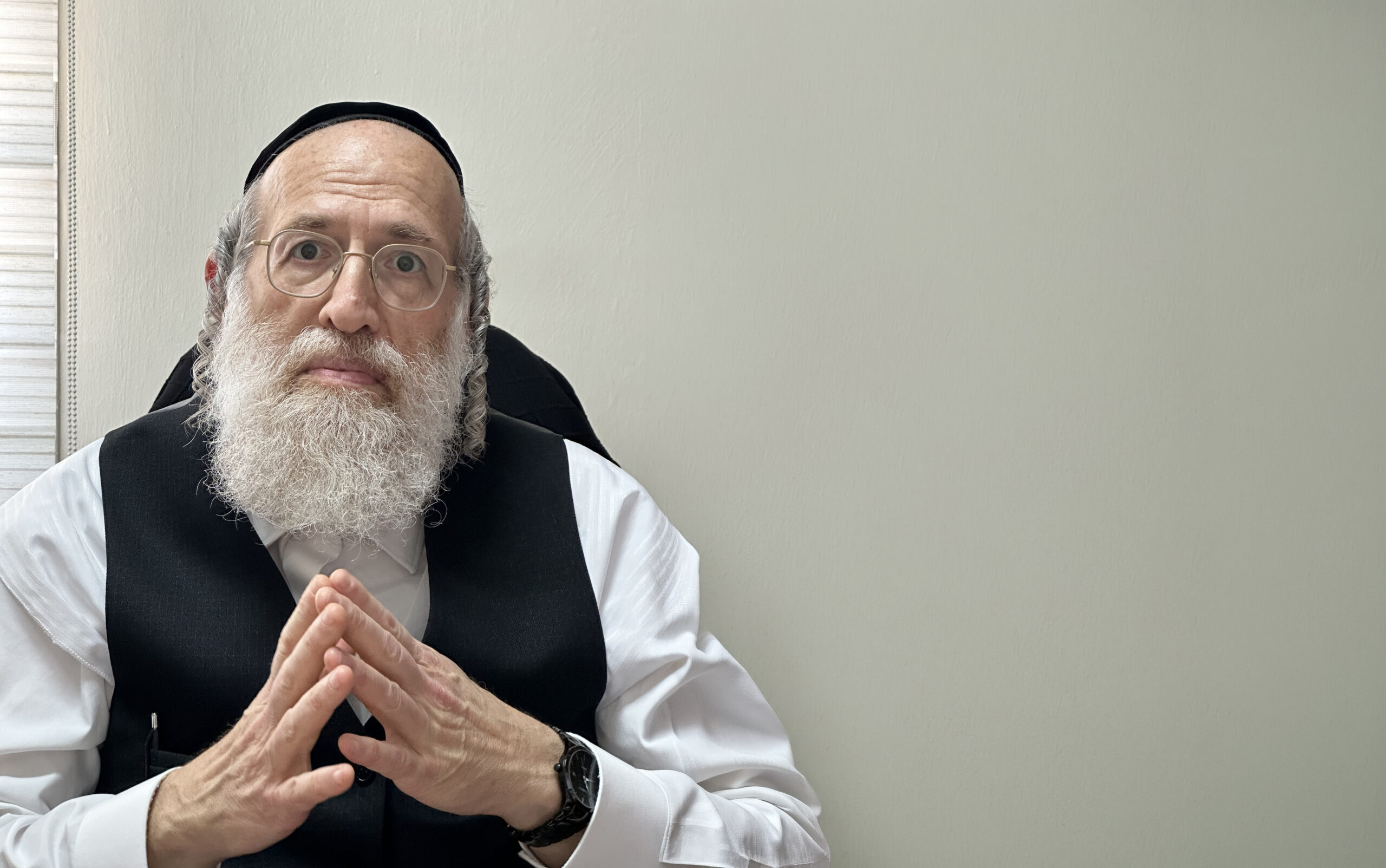
Rabbi Aharon Friedman has spent decades speaking about the workings of the human mind and applying those insights to the practical challenges of everyday life. He has counseled generations of bachurim, yungeleit, parents and families on a wide range of issues.
You’re not a licensed psychologist, but people come to you with many of the same struggles they might bring to a therapist. I would imagine it all takes place in this very room.
I’m not a psychologist, although people sometimes call me one. My rebbe, the Belzer Rav, didn’t allow me to go to college to study psychology, so I don’t have a formal license and never received conventional academic training. I’m a chasidishe yungerman.
And you’re a Belzer chasid in every sense?
Absolutely. I have always been a Belzer chasid, and for 11 years I served as the Rav’s private secretary. I worked in his house, served as the librarian, typed responses to kvitlach and answered the phone, taking down shailos. Very often I would speak to people directly, hear what they were going through and then bring their problems and questions to the Rav.
I spoke with the Rav almost every day, which became an education in its own right. I learned a great deal from watching how he approached people and their issues, especially the questions he would ask in order to understand what was really going on.
On the pasuk “Yifkod Hashem Elokei haruchos—May Hashem, G-d of the spirits of all flesh, appoint (a man over the congregation),” Rav Yosef Chaim Sonnenfeld said that there is a deeper meaning here. Moshe Rabbeinu was asking that the next leader be someone capable of discerning the spirit of each individual.
When someone comes into the beis midrash and starts yelling, you have to understand that what he is screaming about may not be what is really troubling him. There might be something deeper underlying his outburst. There are many stories about Rav Yosef Chaim looking beyond what a person was saying in order to understand what was really troubling him.
A manhig Yisrael cannot simply react to what he sees on the surface. He has to address the underlying problem. That is what the Belzer Rav does.
We say in Ana B’koach, “Shavaseinu kabeil u’shma tzaakaseinu, yodei’a taalumos—Accept our plea and hear our cry, You Who knows hidden things.” What are we saying? The meaning is that when a person cries out that he needs something, the Eibershter knows what is really behind that request. For that reason, He doesn’t necessarily give him what he is asking for; He gives him what he actually needs.
I saw the Rav do that countless times. He would send me to speak to different people and gather more information because he understood that the question being asked was often not the real question.
So you learned from the Rav how to analyze things that trouble people.
Yes, but that’s not really how I started. What first awakened my interest in psychology were the challenges I faced in my own life.
My father was diagnosed with yene maaseh when I was still a bachur, and he passed away only a few weeks after my chasunah. Then, after I moved to Eretz Yisrael, my oldest child was born with a heart defect. I was young, I had no father, my mother was an almanah, and I really didn’t have anyone to turn to. On top of that, I was deeply in debt and had no parnasah. I’d grown up as a spoiled boy in Williamsburg, and suddenly I found myself immersed in tzaros.
What was your father’s name?
Reb Shia Friedman. He was a contractor, but he also knew how to learn very well. He used to finish the entire Shishah Sidrei Mishnah every few months.
You may have heard of my uncle, Rav Avraham Aharon Friedman, who wrote the famous handwritten Haggadah Beis Avraham Beis Aharon with his own chiddushim.
To read more, subscribe to Ami