



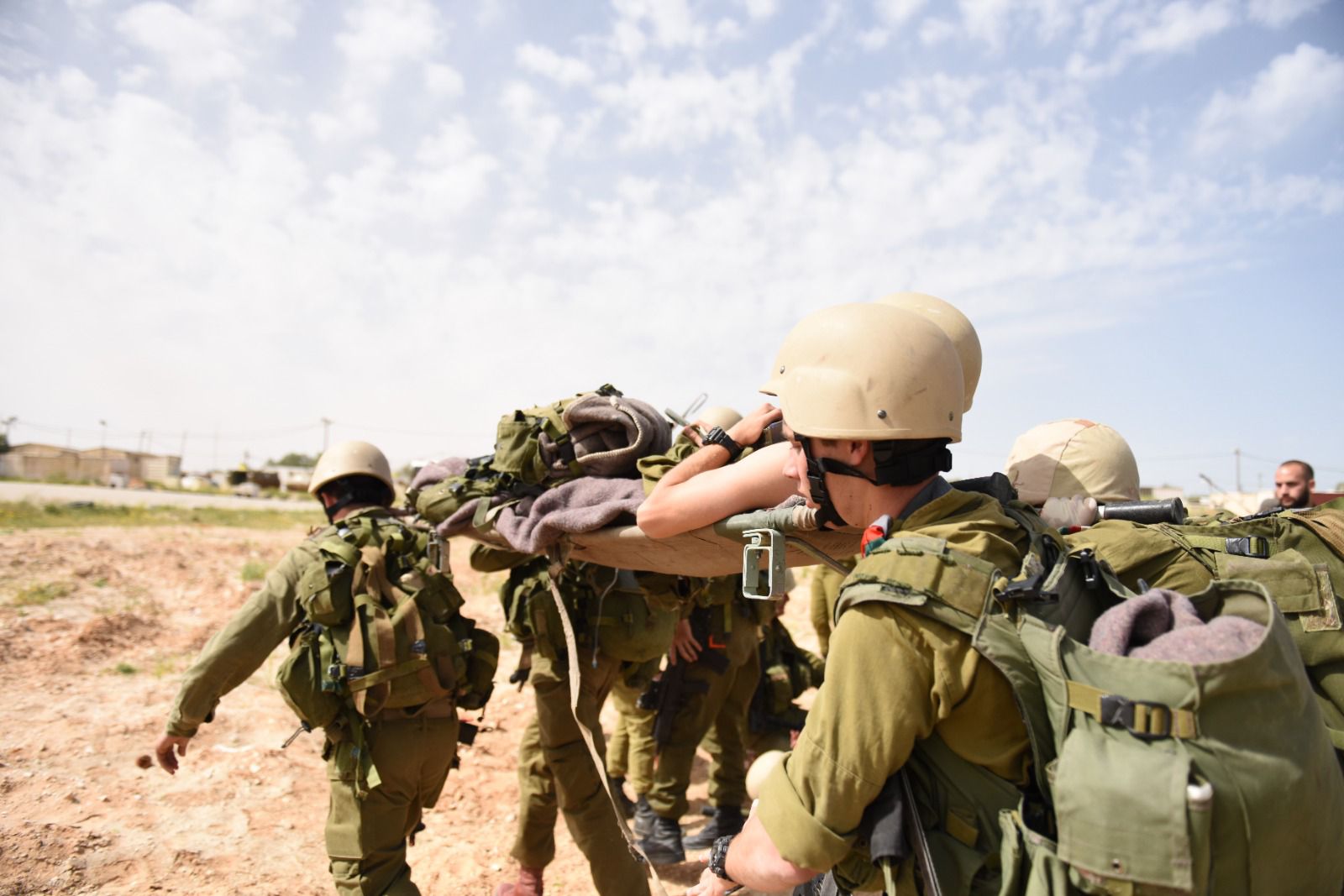
It happened shortly after the fighting began and we entered northern Gaza. I was a battalion doctor with the Givati Reconnaissance Unit. We entered Jabalia, the second-most densely populated refugee camp in the world. When an anti-tank missile struck our position, two soldiers were killed instantly, and three others were seriously wounded,” Lieutenant Dr. Chananel She’ar Yashuv relates.
“In a situation like that, you have an enormous responsibility. After years of working in a hospital, backed up by all the latest equipment and a full staff, you now have only yourself, the paramedics and the equipment you’re carrying. The bond that you form with your team is impossible to describe. You trust each other completely, because in the midst of that chaos, the only order that exists is the medical protocol. You immediately set up your treatment area and perform lifesaving procedures—chest drainage, applying tourniquets—under heavy fire. You stabilize the wounded person as best as you can, knowing that his best chance of survival comes from being evacuated as quickly as possible by a medevac helicopter.
“The most powerful part of the experience is the sharp transition. You’re focused on fighting for a soldier’s life, with your hands covered in blood, and then he’s strapped onto the helicopter and taken away. Suddenly, there’s a strange silence. You clean yourself and your equipment, grab a small bite to eat, and pray that the patients survive. I found out a few days later that all three soldiers made it. I later visited them in the hospital; our reunion was very moving.”
A surgeon at Ichilov Medical Center, Dr. She’ar Yashuv was called up for reserve duty after October 7 and served at the front in Gaza. His account reflects what unfolded across the entire IDF Medical Corps during the Iron Swords war.
Close to 900 soldiers were killed in the course of the conflict, a quarter of whom fell on the very first day of fighting after the massacre. Every fallen soldier represents the loss of an entire world and immense pain for each member of his or her family. But alongside this profound grief, one striking, almost unimaginable statistic stands out: the IDF Medical Corps broke global records in saving lives on the battlefield.
According to the data, the fatality rate among the severely wounded in the Iron Swords conflict stood at 5.7 percent, approximately one death for every 18 wounded. By comparison, US forces in Iraq and Afghanistan recorded a fatality rate of approximately 13.1 percent. Western military delegations, including those from America and Germany, are studying the IDF Medical Corps protocol to see what they can learn from it.
These lifesaving outcomes are primarily due to a fundamental transformation in the organization of casualty care, both on the battlefield and throughout the evacuation chain leading to the hospital. At the beginning of the war, the decision was made to move the focus from traditional field aid stations to rapid evacuation after minimal treatment. Rather than providing comprehensive care to severely wounded soldiers in these makeshift field hospitals, the goal became to remove them from the combat zone as quickly as possible, either by armored personnel carriers converted into ambulances or by helicopters conducting direct extractions.
This strategic shift led to a dramatic decrease in evacuation times and a significant improvement in survival rates. To ensure quality of care, approximately 650 senior medical personnel, both active duty and reserve, were embedded into the combat units so that they were able to treat casualties immediately.
However, this unprecedented decision to send medical teams to the front lines came at a heavy price. Since the start of the war, 43 Medical Corps personnel have been killed—the highest number of casualties it has suffered in the past 50 years.
During the Second Lebanon War, the average helicopter evacuation time exceeded three hours. Today, that has been cut down to roughly one hour. As a result, the survival rate for critically wounded soldiers has reached the highest point in military history.
Initially developed in 2006, this model was refined in the following years primarily in Yehudah and Shomron, where frequent activity made it an ideal testing ground for these protocols.
“There is nothing like it anywhere in the world,” says former IDF Chief Medical Officer Brig. Gen. Elon Glassberg. “No military anywhere has produced numbers like these consistently over an extended time. We managed to save soldiers with catastrophic injuries, the kind that until very recently would have meant certain death.
“One soldier suffered a severe abdominal wound and lost over four liters of blood. In similar cases in the past, the fatality rate was nearly 98 percent, but we were able to save him. As early as the second day of the war, our hospital trauma departments reported that they had never seen patients arrive with injuries that severe yet still in a survivable condition. It was like a treatment for terminal cancer with a 98 percent fatality rate suddenly saving 50 percent of patients. That is a genuine, dramatic achievement.”
One of the key factors behind the shift, in Dr. Glassberg’s view, is the emphasis on treating casualties classified as “salvageable.” According to professional literature, this group constitutes approximately 25 percent of all battlefield fatalities—deaths that, under the right conditions, are considered preventable.
“To make an impact on the battlefield, you need to focus,” Glassberg explains. “We analyzed the causes of death and built a structured plan to save those lives. It took a decade, but today we are seeing the process come to fruition. The drop in mortality rates is the direct result of our concentrating on this critical group. We are now saving far more lives than ever, despite the fact that the average severity of injuries is significantly worse.”
To read more, subscribe to Ami