




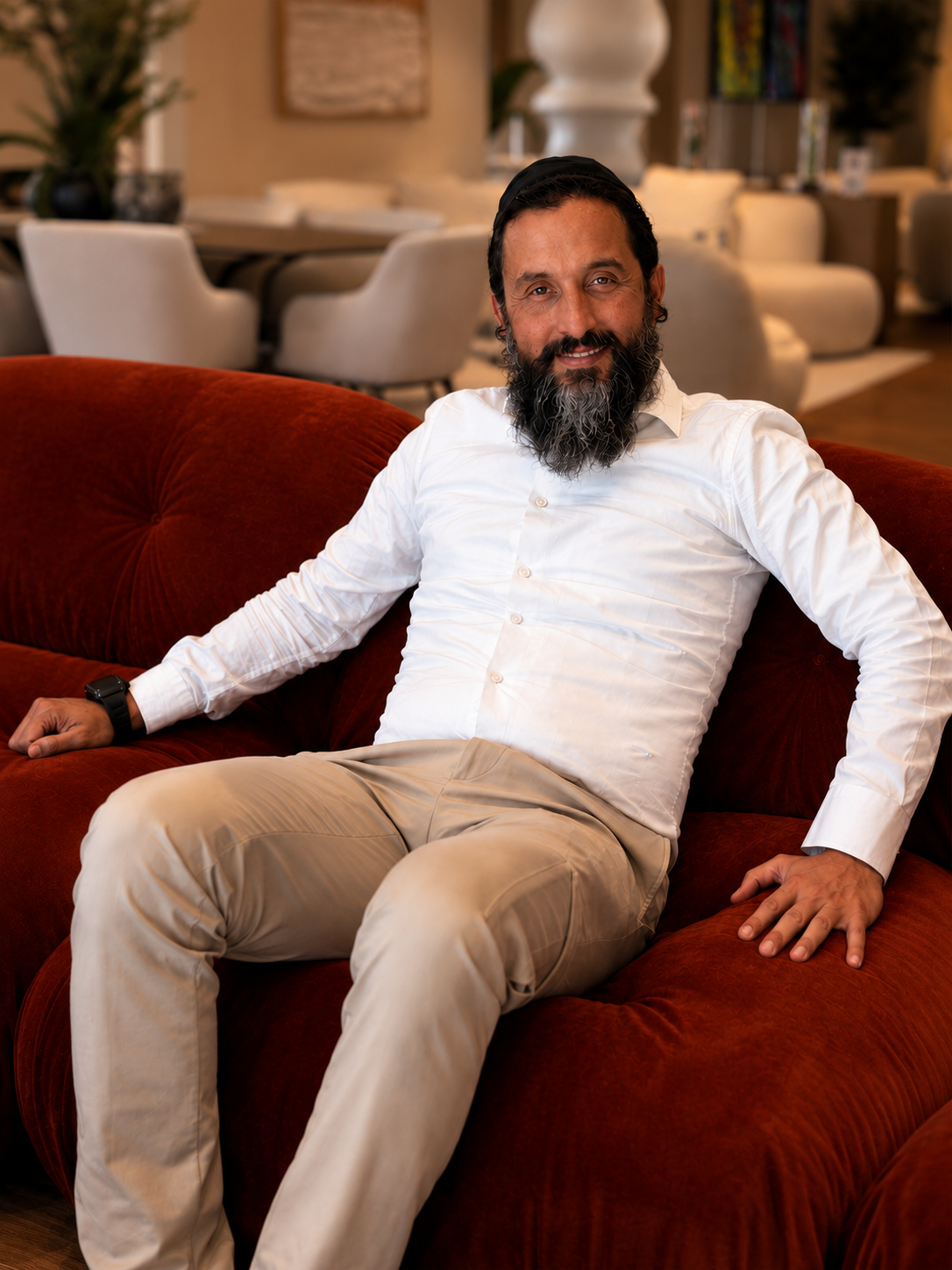
Over the years, several people had mentioned that I should speak to Yonel Fellous, founder of the growing furniture company Modani, because “Yonel has a good story!” Everyone also noted that his company is generous with tzedakah.
I finally followed up on those suggestions and found out that it’s true, but there’s even more to Yonel than that. His outlook on life and business converged with the same goal: giving, and giving more.
Originally from France, Yonel came to the US seeking new opportunities. Starting out as a real estate broker, he soon recognized a need for high-quality yet accessible contemporary furniture, and he partnered with a friend to start Modani.
Today, Modani is considered a premier modern furniture brand. While over 90% of its business is direct to consumer, the company maintains a strong commercial division, collaborating directly with leading real estate developers, including industry giants such as Lennar and the BH Group.
Beyond offering quality products, Yonel attributes Modani’s success to the company’s commitment to contributing a chomesh (one-fifth) of their profits to tzedakah—a standard of which they are very proud.
Yonel and I spoke about building a furniture brand from nothing, the highs and lows of selling and buying back your own company, and why he believes giving is the only real measure of success.
And of course, we discussed the meaning of the name “Modani” (guess why he chose that!).
Enjoy!
—Nesanel
I was born in Paris, France, and lived there until I was 22. My parents were from Tunisia. My father, may he be well, worked as the sales director for a telecom company. My mother was a Hebrew teacher. Sadly, she passed away of cancer at the age of 48, when I was 11. I have two sisters, both of whom live in Eretz Yisrael.
“We didn’t grow up religious, and I went to public school in France. Reform doesn’t exist in France, and although we weren’t religious, we all knew there is only one way and that is the Orthodox way. We grew up making Kiddush but not actually keeping Shabbos and the chagim. I became religious at the age of 26 when I was in South Beach, Florida.
“I was entrepreneurial from a young age. It’s in my DNA. When I was 14, I started selling all kinds of trendy items in school. I would buy things that students wanted, mainly in the fashion industry, from Chinese wholesalers who lived in Paris. I also created a company that organized birthday parties for kids. I would come to the kid’s house with someone to play music, and I’d play games with the kids.
“After high school, I went to EDC Business School in Paris for four years and then worked in finance for nine months. I started as an intern and was then hired. But after I received my first paycheck, I told my father, ‘I’m not staying here.’ I felt that France was not the right country for me to be an entrepreneur because you have to fit into a box there. The mentality is—at least that’s the way it was 20 years ago—that if you don’t have at least 30 years of experience in a single field, they don’t trust you. You’d have to do an internship in marketing, stay there for 10-20 years to become a marketing director, and then continue until you retire. But as an entrepreneur and a risk taker, I didn’t fit in a box. I wanted to start my own company, and I wanted to try the American dream, where there were fewer barriers to success. So at the age of 22, I went to the US.
“My sister suggested I post my resume on Craigslist. I got the most responses from Miami Beach, including from Nathan Cohen, my current partner. I moved to Miami with $2,600 and started working in real estate as a broker for him, although my main job then was as a waiter. I did the real estate work in my free time.
“My first sale came three months after I was licensed. It was actually the 14-unit apartment building that I was living in at the time. I found the seller and got the listing, and Nathan brought in the buyer, a French investor. I was paying $600 rent, and the building sold for $1.4 million. I didn’t know anything about real estate, but if you know how to sell, you can sell anything.
“Then we started brokering sales for pre-construction, which was a very hot market. In 2007, when we realized there was a crash coming, I told Nathan, ‘We need to find something to leverage all our clients.’
“The second most important purchase after the home itself is furniture. We realized that there was a gap in the furniture market. There was model furniture from brands in Italy and the rest of Europe that were super expensive or there was Ikea. There was no healthy middle ground. Our clients were the smart buyers who wouldn’t buy Ikea because they’re not starving students, and who would also not spend $20k on a couch because they’re prudent.
“We decided to import furniture that would allow us to sell high-quality pieces at affordable prices.
“We didn’t start out as men of means. We didn’t inherit any money from our parents. We were three partners who each put in $33K. The third partner, Steven Athea, was also French, but we didn’t know each other from France; we all met here. Nathan was more the CEO, I was the VP of sales, and Steven was VP of design.
“I put Hashem into the company from the start. Nathan is the one who said we need to find a name that has some meaning but is also not too much in your face. Something subtle. The name Modani came from the prayer Modeh Ani. Modani sounds Italian, but it has a profound meaning: to be grateful. We also decided to give 20 percent of the net profits to charity. Chomesh is a big part of our foundation. Modani is not only a furniture company; it’s a means to give.
To read more, subscribe to Ami