



Once a hub for regional and international travel, Yerushalayim’s airport lies abandoned and in ruins. Shloime Zionce presents a hands-on tour of the off-limits facility and its storied history
The Friday morning bustle of Yerushalayim’s Ramat Eshkol neighborhood is just beginning as my rental car pulls into one of the only vacant parking spots on Rechov Paran near the shopping center. The smell of exhaust fumes from my engine is drowned out by the scents of freshly baked challah, ground spices and the familiar aroma of overnight potato kugel. It’s a few minutes past 8:00 a.m. and it will be Shabbos in a few hours, but I’m not here to do any shopping. In fact, if everything goes according to plan I’ll be headed to an airport in a few minutes.
You may be wondering: Why would I choose to fly somewhere on a Friday? First, the airport I’m talking about isn’t Tel Aviv’s Ben Gurion International Airport, which is located an hour away. Second, the airport I’m heading to hasn’t seen any flights in over 20 years. I’m supposed to be meeting someone who is going to be my guide on a trip to the old Jerusalem International Airport. Yes, you read that right. And if you’re of a younger generation, you’ve probably never heard of it.
An Idea Takes Flight
It was sometime in 2022 when I first learned about this airport and was immediately intrigued. How could it be that the holiest city in the world has an airport and I didn’t know that it exists? I knew I had to see it for myself. After a bit of digging, I ended up on the phone with Israeli writer, researcher and tour guide Eldad Brim, who has an odd fascination with this place. He told me that at one point the airport was a bustling hub for international as well as regional travel but is now in ruins. He also said that while it is officially closed, he had managed to visit it a couple of times. Then he added a caveat: It is in such bad shape and there is so much debris lying around that he highly discourages people from attempting to gain access to the site due to the risk of falls or injury. But Eldad’s warning was no match for my fascination with urban exploration, aviation and forgotten history, so after a little bit of prodding, he finally agreed to take me on a tour.
Eldad is waiting for me at the bus stop in Ramat Eshkol. He’s a middle-aged guy with short hair, wearing a Canadian T-shirt and a sun hat. He speaks perfect English. We head out of Ramat Eshkol and onto the highway for the drive to Atarot, which takes approximately 20 minutes. We drive through Arab neighborhoods until we turn onto a road that seems to lead nowhere. He tells me to keep going, and we soon arrive at what looks like a small checkpoint. As we pull up to it, a big truck being driven by an Arab man drives out of a gated property, much of which is hidden by trees and wild greenery. “Park here,” Eldad says as he points to an empty spot on the side of the road. “Are you sure this is okay?” I ask. “It should be fine,” he says.
We get out of the car, and I follow him through the checkpoint, which is unmanned. “This is the gate to the airport,” he says. It happens to be open right now, but I notice that it’s an electronic gate, meaning that it can almost certainly be operated remotely so someone can seal the area if necessary. Visiting this place, my guide explains, falls into somewhat of a gray area in terms of legality. While there’s no sign telling people to stay out, there’s also nothing indicating that we’re welcome, aside from the fact that the gate is partially open. At the same time, the barrier arm that would have to be raised in order for cars to enter is closed. In short, I don’t know if we’re supposed to be here, but I also don’t know if we’re not supposed to be here.
“This road leads directly to the terminal,” Eldad says as I follow him through the gate. We are walking on a slight incline that is barely noticeable. He points out a small stone building on the left that he says was built by the Jordanian authorities to monitor vehicles going in and out of the airport perimeter. The building consists of a single room, maybe 150 square feet in size, and has a small desk at the front. The doors and windows are long gone and the room smells musty. Pieces of plaster litter the floor. “The guards could also help you arrange a taxi if you needed one,” he says.
It’s eerily quiet aside from the faint sounds of construction somewhere off in the distance. “Wasn’t this place bustling at one point?” I ask.
“It certainly was,” he replies. “We’re talking about hundreds of thousands of passengers a year, especially in the early 1960s.”
I’m confident that Eldad knows what he’s talking about, as he’s done tons of research and is even in the process of writing a book about this airport. But based on what I’ve seen so far, hundreds of thousands of passengers is hard to believe.
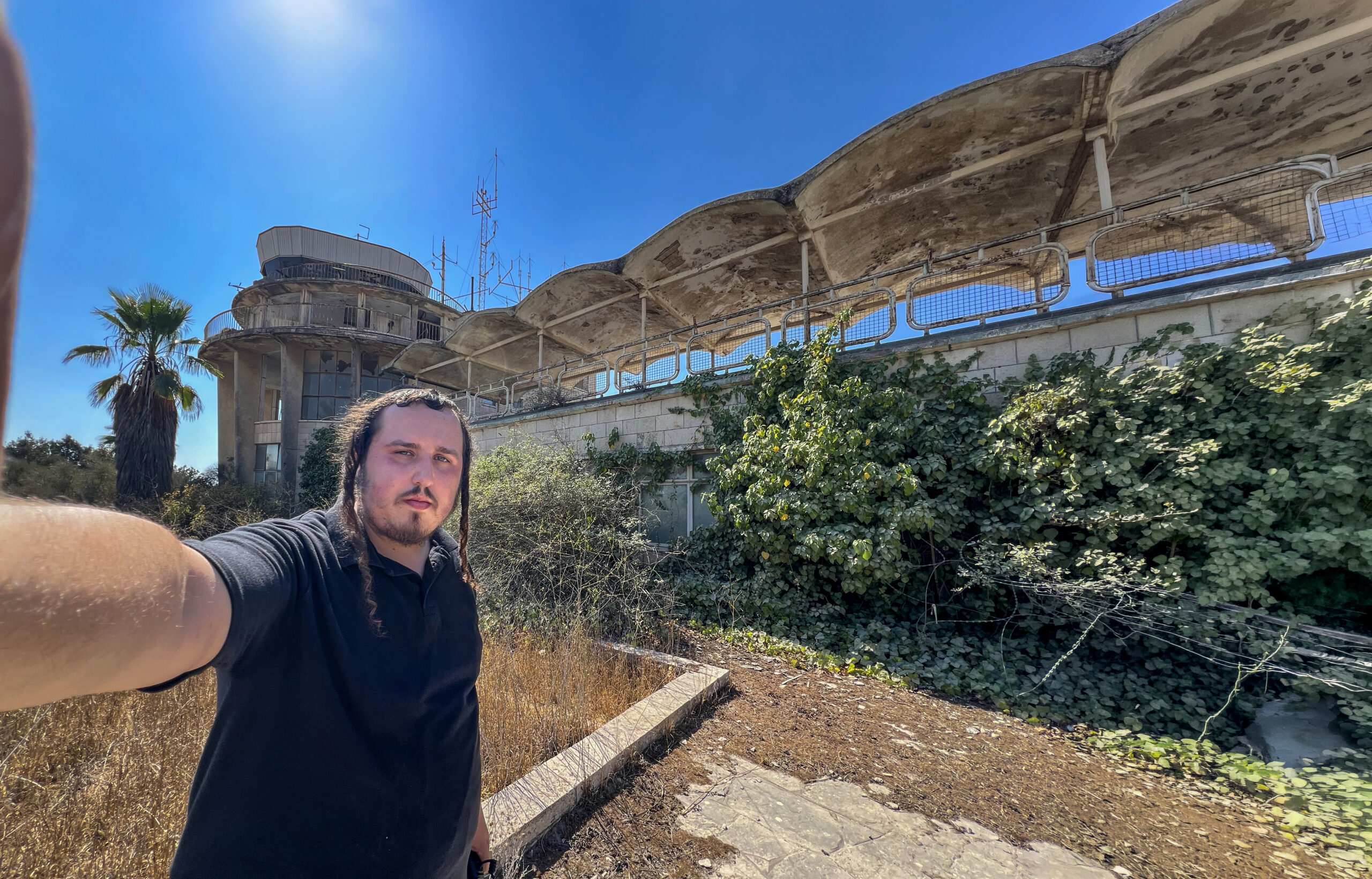
We leave the guard booth and walk farther up the road. The terminal now comes into view. The structure looks just like it did in the photos from its prime, except that it is now dusty and dilapidated. Large shrubs have reclaimed parts of the parking lot. Eldad comments on the architecture. “The building is simple modernist, or what is known as late international style. All of the antennas were added by the Israelis,” he says, pointing to a few rusty pieces of metal protruding from the roof. “You’ll notice that the building is in the shape of an airplane. This is the body,” he continues, referring to the three-story central section. “Then there’s the top of the control tower, bringing it to a total of four stories above ground, plus the two wings coming out on both sides.”
“They’re even angled like airplane wings,” I comment.
“Yes, when seen from above,” he agrees.
To read more, subscribe to Ami